Hashimoto's Thyroiditis: Symptoms, Diagnosis and Treatment
Reviewed by the LabReadAI medical team
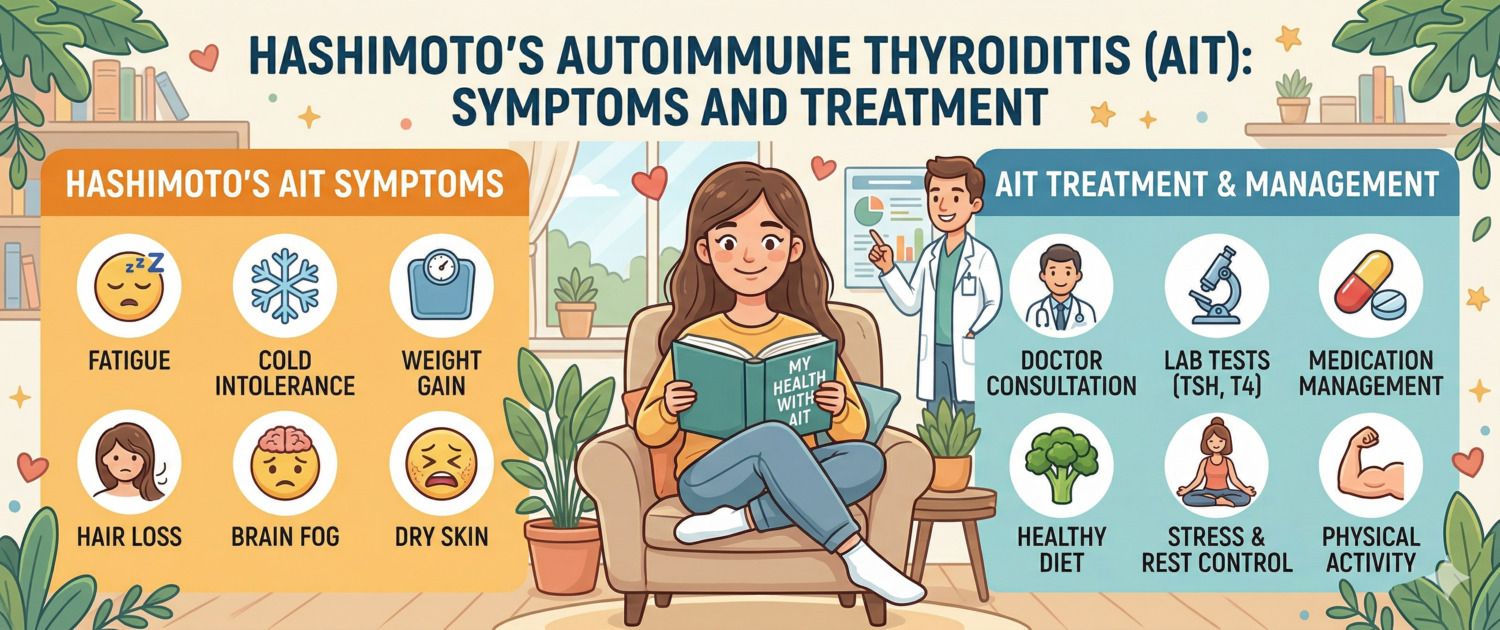
The thyroid gland rarely hurts — but it can be destroyed silently, over years. Hashimoto's thyroiditis is the most common thyroid disorder and the leading cause of hypothyroidism worldwide: it affects hundreds of millions of people, the vast majority of them women. The condition's insidious nature is that for many years the person may feel relatively well — until the gland exhausts its functional reserve.
What Hashimoto's Thyroiditis Is and Why It Develops
Autoimmune thyroiditis (Hashimoto's disease) is a chronic inflammatory disease of the thyroid gland in which the body's own immune system mistakenly attacks thyroid tissue. Immune cells — lymphocytes — infiltrate the gland, progressively destroying the follicles that produce thyroid hormones.
The disease is named after Japanese surgeon Hakaru Hashimoto, who in 1912 first described the characteristic tissue changes. It was the first condition ever identified as autoimmune.
Causes and risk factors: the precise trigger of the autoimmune attack is not fully understood. Key contributing factors include:
- Genetics — hereditary predisposition accounts for 70–80% of risk; family history of thyroid or other autoimmune diseases is common
- Sex — women are affected 7–10 times more often than men, pointing to estrogen's role in immune regulation
- Iodine — excessive iodine intake in populations previously deficient in it is associated with increased Hashimoto's incidence
- Viral infections — some viruses (Epstein-Barr, cytomegalovirus) are thought to trigger autoimmunity through molecular mimicry
- Stress and pregnancy — periods of hormonal change can provoke or accelerate the condition
- Other autoimmune diseases — Hashimoto's co-occurs with type 1 diabetes, rheumatoid arthritis, and SLE far more often than chance would predict
How the Disease Progresses: Three Phases of Hashimoto's
Hashimoto's is a slowly progressive disease unfolding across years or decades through three general phases.
Euthyroid phase: the immune attack is already underway and antibodies are detectable in the blood — but thyroid function remains intact. TSH and free T4 are normal. The person feels nothing unusual. This phase is most often discovered incidentally during a preventive ultrasound or antibody screen.
Subclinical hypothyroidism phase: the gland gradually loses functional capacity. The pituitary "senses" falling hormone levels and increases stimulation — TSH begins rising above normal while T4 and free T3 remain within range. Symptoms may be mild or absent.
Overt hypothyroidism phase: functional reserve is exhausted. Free T4 falls below normal; TSH is markedly elevated. Clear symptoms emerge — fatigue, cold intolerance, weight gain, constipation, slowed thinking, facial puffiness, bradycardia. For a detailed account of this stage, see Hypothyroidism.
Hashitoxicosis: When Hashimoto's Mimics Hyperthyroidism
One of the least recognised but clinically important aspects of Hashimoto's is the hashitoxicosis phase. In the early stages of the disease, mass follicle destruction releases large amounts of pre-formed thyroid hormone into the blood. The result is a transient thyrotoxicosis clinically indistinguishable from true hyperthyroidism: palpitations, anxiety, weight loss, sweating, insomnia.
The critical distinction from Graves' disease: hashitoxicosis is self-limiting. Within weeks to months, the hormone stores in destroyed follicles are depleted and thyrotoxicosis gives way to normal function or hypothyroidism. Prescribing antithyroid drugs for hashitoxicosis is an error — they are unnecessary and may accelerate the onset of hypothyroidism.
Laboratory pattern: TSH suppressed, elevated T4 and T3, strongly positive anti-TPO antibodies. In Graves' disease: positive TSH receptor antibodies (TRAb) are the distinguishing feature.
Diagnosis: Which Tests Are Needed for Suspected Hashimoto's
The diagnosis of Hashimoto's rests on three criteria in combination:
1. Laboratory markers: A comprehensive thyroid panel includes:
- TSH — the primary functional marker: elevated in hypothyroidism, suppressed in hashitoxicosis, normal in the euthyroid phase
- Free T4 — assesses actual hormonal activity
- Free T3 — important in atypical TSH/T4 patterns
- Anti-thyroid peroxidase antibodies (anti-TPO) — the primary immunological marker: elevated in 90–95% of patients. Normal is generally < 35 IU/mL (varies by laboratory)
- Anti-thyroglobulin antibodies (anti-TG) — supplementary marker, elevated in 60–70%
Important: elevated antibodies alone are not an indication for treatment. They mark the autoimmune process but not its activity. Treatment is initiated for impaired thyroid function (elevated TSH), not for antibody positivity.
2. Thyroid ultrasound: The characteristic Hashimoto's pattern: diffusely reduced echogenicity ("dark" gland), heterogeneous texture, pseudonodularity. In advanced disease — volume reduction (atrophy).
3. Clinical presentation: Symptoms of hypothyroidism or hyperthyroidism in the context of laboratory and ultrasound findings.
Symptoms of Hashimoto's: From Silent Carrier to Overt Hypothyroidism
Most patients with Hashimoto's in the euthyroid phase have no specific symptoms. However, some report non-specific complaints even with normal TSH — fatigue, brain fog, dry skin, hair loss. Their relationship to autoimmune inflammation is actively studied but not fully explained.
As the condition transitions to hypothyroidism, symptoms become distinct: chronic fatigue, cold intolerance, weight gain, constipation, slowed speech and cognition, facial puffiness, bradycardia, reduced libido. In women — menstrual irregularities; in pregnancy — elevated risk of miscarriage.
Some patients experience mild neck discomfort — not true pain but a sense of pressure or fullness. Significant tenderness of the gland is atypical for Hashimoto's and warrants exclusion of de Quervain's (subacute) thyroiditis.
Treatment of Autoimmune Thyroiditis
There is no specific treatment targeting the autoimmune process itself. The goal of therapy is correcting hypothyroidism when it develops.
Levothyroxine replacement therapy: Indicated for overt hypothyroidism (TSH > 10 mIU/L) and for subclinical hypothyroidism with TSH of 4–10 mIU/L when symptoms are present, during pregnancy, or when pregnancy is planned. The medication is taken lifelong; the dose is titrated to a target TSH of 0.5–2.5 mIU/L for most patients.
For hashitoxicosis: symptomatic treatment (beta-blockers for heart rate control) and watchful waiting. Antithyroid drugs are not indicated.
For euthyroid Hashimoto's: active surveillance — TSH monitoring every 6–12 months. Reducing anti-TPO antibody levels is not a treatment goal — antibody titres are not a therapeutic target. Lifestyle measures: adequate sleep, stress management, weight normalisation. The role of selenium in reducing disease activity is under investigation — some studies show modest anti-TPO reduction at 200 mcg/day, but evidence is insufficient for routine prescription.
Prognosis: with timely hypothyroidism correction, quality of life is equivalent to the general population. The risk of malignant transformation is minimal. Pregnancy is possible with well-controlled Hashimoto's — with strict TSH monitoring (target < 2.5 mIU/L in the first trimester).
When to Seek Urgent Medical Attention
- Rapidly worsening thyrotoxicosis symptoms (resting heart rate > 100 bpm, marked tremor, weight loss) — rule out hashitoxicosis or Graves' disease; urgent endocrinology consultation.
- TSH > 10 mIU/L at first detection — routine consultation within 1–2 weeks to discuss treatment initiation.
- Pregnancy or planning pregnancy with known Hashimoto's — mandatory TSH correction before conception; target < 2.5 mIU/L.
- Rapid thyroid enlargement with pain — rule out subacute thyroiditis or, rarely, thyroid lymphoma.
Autoimmune thyroiditis often does not come alone: in some people type 1 diabetes or adrenal insufficiency joins it over time. Such combinations are described in the article on polyendocrine syndrome, along with the tests that help not to miss the second condition.
This article is for informational purposes only and does not replace consultation with a qualified endocrinologist.
For informational purposes only
This article is for informational purposes only and does not constitute medical advice, diagnosis, or treatment. Please consult a healthcare professional for medical guidance.