Free T4 (Thyroxine): Normal Levels, Interpretation and Causes
Reviewed by the LabReadAI medical team
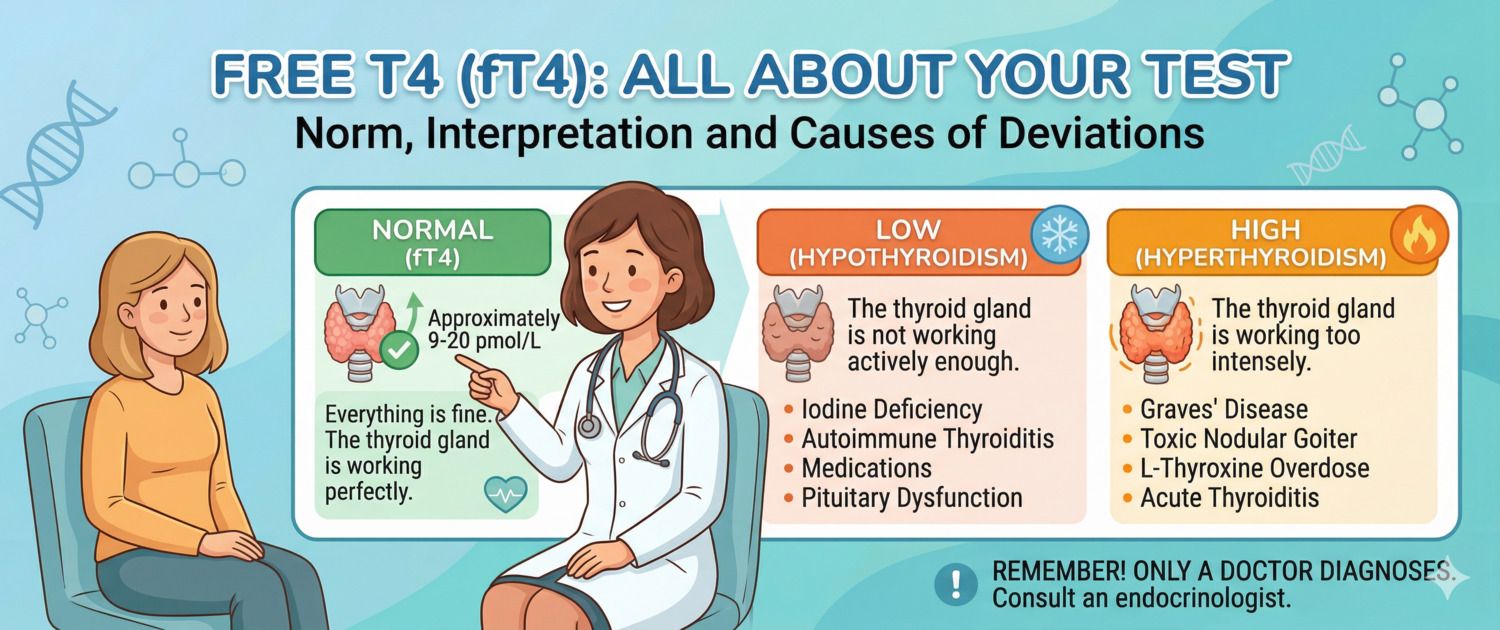
Noticed "FT4" on your thyroid test results and wondering what it means? Free T4 — the unbound fraction of the hormone thyroxine — is the only form that actually enters cells and drives metabolism, heart rate, and energy balance. This article explains what free T4 is, its normal reference ranges by age and sex, what high or low levels indicate, and when to seek urgent medical attention.
What Is Free T4 and Why Is It Measured?
The thyroid gland produces thyroxine (T4), most of which immediately binds to carrier proteins — thyroxine-binding globulin, albumin, and transthyretin. Protein-bound T4 is biologically inactive: it cannot interact with cell receptors and serves only as a circulating reserve.
Only about 0.03–0.05% of total thyroxine remains unbound — this is free T4 (FT4). This small fraction penetrates tissues and triggers all the biological effects of the hormone: regulating metabolic rate, heart rate, body temperature, nervous system function, and reproductive health.
FT4 is measured as part of a comprehensive thyroid panel alongside TSH and free T3. Measuring FT4 alone without TSH provides an incomplete picture and is rarely used for primary diagnosis. Unlike total T4, the free fraction is not affected by changes in carrier protein levels — making it a more reliable marker of thyroid function during pregnancy, liver disease, or oral contraceptive use.
How to Prepare for a Free T4 Blood Test
FT4 results are sensitive to testing conditions. Follow these steps for an accurate result:
- Timing: have blood drawn in the morning between 8:00–10:00 AM when hormone concentrations are most stable.
- Fasting: no food for 8–12 hours before the test; water is fine.
- Levothyroxine: if you take thyroid replacement medication, take your dose after the blood draw, not before.
- Biotin (vitamin B7): high-dose biotin supplements can interfere with immunochemical FT4 assays — pause for 48 hours before testing.
- Other medications: amiodarone, corticosteroids, heparin, and lithium can affect thyroid hormone levels — ask your doctor whether to pause.
- Physical and emotional stress: avoid intense exercise and major stressors in the 24 hours before the test.
Free T4 Normal Ranges by Age and Sex
Reference ranges vary by laboratory method and reagents — always use the reference interval printed on your specific lab report. Common guideline values:
| Group | FT4, pmol/L | FT4, ng/dL |
|---|---|---|
| Adult men | 9.0–20.0 | 0.70–1.56 |
| Adult women | 9.0–20.0 | 0.70–1.56 |
| Pregnancy, 1st trimester | 10.0–24.0 | 0.78–1.87 |
| Pregnancy, 2nd–3rd trimester | 8.0–16.0 | 0.62–1.25 |
| Infants under 1 year | 11.5–28.3 | 0.89–2.20 |
| Children 1–5 years | 10.6–22.0 | 0.82–1.71 |
Unit conversion: 1 ng/dL ≈ 12.87 pmol/L. A borderline result is not a diagnosis on its own — your doctor will always interpret FT4 alongside TSH, symptoms, and medical history.
High Free T4: Causes and Symptoms
An FT4 level above the upper reference limit means the thyroid is producing excess thyroxine or its breakdown is slowed. The body runs in overdrive: heart rate increases, body temperature rises, and metabolism accelerates.
Common causes of elevated FT4:
- Hyperthyroidism — Graves' disease, toxic nodular goiter
- Hashimoto's thyroiditis during a transient thyrotoxic phase (hashitoxicosis)
- Subacute (de Quervain) thyroiditis in the acute inflammatory phase
- Levothyroxine overdose
- TSH-secreting pituitary adenoma (rare)
- Thyroid hormone resistance syndrome
Symptoms: resting tachycardia, weight loss despite good appetite, hand tremor, irritability, excessive sweating, insomnia, heat intolerance. In Graves' disease — characteristic eye protrusion (exophthalmos).
Low Free T4: Causes and Consequences
A low FT4 signals that the thyroid is not producing enough thyroxine. Every bodily process slows down — think of an engine running on depleted fuel.
Common causes of low FT4:
- Hypothyroidism — primary (thyroid gland damage) or central (pituitary or hypothalamic pathology)
- Hashimoto's thyroiditis in the hypothyroid stage
- Post-thyroidectomy or radioiodine therapy
- Severe iodine deficiency
- Amiodarone, lithium, or high-dose corticosteroid use
Symptoms: persistent fatigue, cold intolerance, facial and limb puffiness, unexplained weight gain, constipation, dry skin and brittle hair, slowed speech, impaired memory and concentration.
Free T4 and Free T3: How Thyroid Hormones Work Together
T4 is often called a "prohormone" — it is relatively inactive on its own. In peripheral tissues, primarily the liver, muscles, and kidneys, enzymes called deiodinases remove one iodine atom from thyroxine and convert it into the far more potent free T3.
This conversion matters for test interpretation: normal FT4 with low FT3 may point to impaired peripheral conversion rather than a problem with the thyroid gland itself — this occurs in severe stress, prolonged fasting, or systemic illness. This pattern is impossible to detect by measuring FT4 alone. Evaluating FT4, FT3, and TSH together provides a complete picture of thyroid axis function.
When to See a Doctor Urgently
Some situations with abnormal FT4 cannot wait for a routine appointment:
- Sharply elevated FT4 + tachycardia, high fever, altered consciousness — possible thyrotoxic crisis, a life-threatening emergency requiring immediate hospitalization.
- Critically low FT4 + profound drowsiness, severe edema, body temperature below 36°C (96.8°F) — signs of myxedema coma.
- Newly discovered significant abnormality with symptoms — see an endocrinologist within 2–5 days.
- Abnormal result without clear symptoms — schedule a routine consultation within 2–4 weeks and confirm with a repeat test.
Do not attempt to interpret your FT4 result in isolation. The same FT4 level can indicate entirely different conditions depending on TSH, current medications, and clinical presentation.
This article is for informational purposes only and does not replace consultation with a qualified endocrinologist.
For informational purposes only
This article is for informational purposes only and does not constitute medical advice, diagnosis, or treatment. Please consult a healthcare professional for medical guidance.