Iodine Deficiency: Symptoms, Consequences and How to Correct It
Reviewed by the LabReadAI medical team
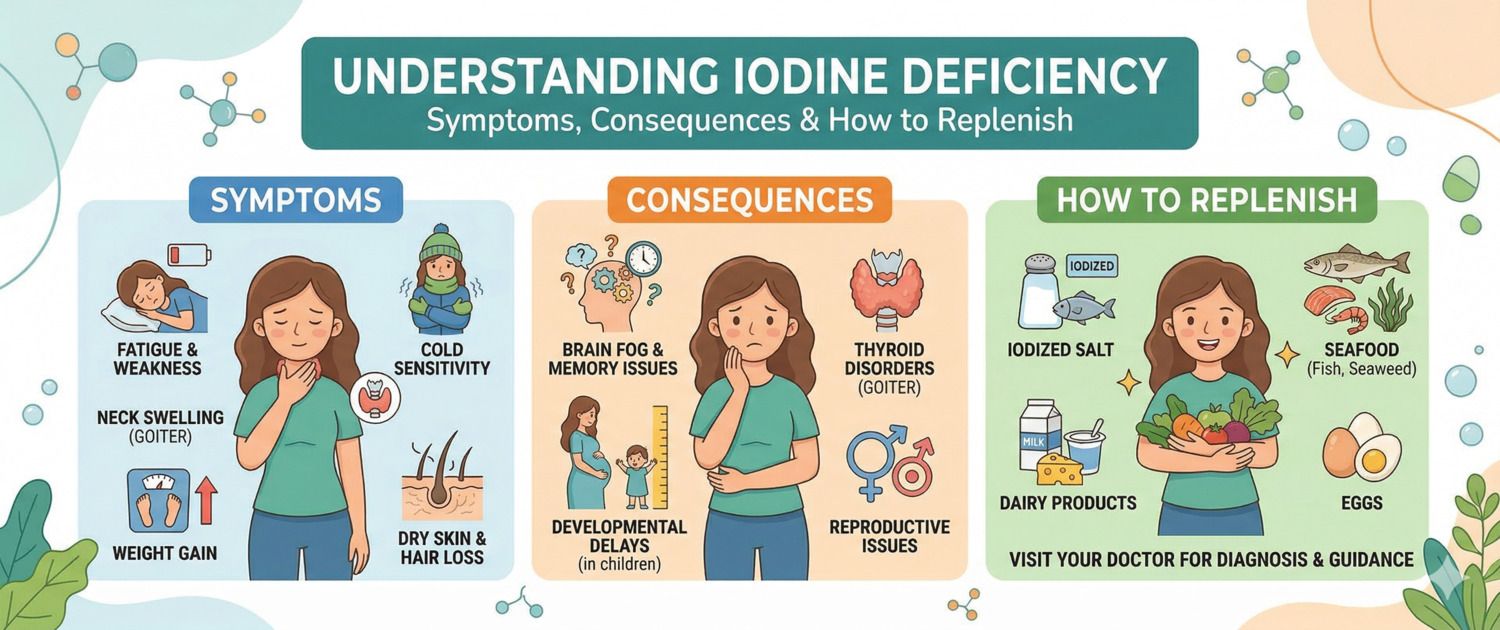
Iodine is the one micronutrient without which the thyroid gland cannot synthesise a single molecule of thyroid hormone. Yet iodine deficiency remains a global problem: according to the WHO, more than two billion people live in areas with insufficient iodine intake. Even in developed countries, pregnant women and young children remain the most vulnerable groups.
Why Iodine Is Essential for the Thyroid
Iodine is a structural component of thyroid hormones. The thyroxine (T4) molecule contains 4 iodine atoms; triiodothyronine (T3) contains 3. Without iodine, hormone synthesis is physically impossible.
The thyroid gland has the unique ability to concentrate iodine from the blood: its iodine content is 20–50 times higher than in plasma. When iodine intake is adequate, this mechanism operates normally. In deficiency, the gland activates compensatory mechanisms: it avidly captures remaining iodine, hypertrophies (goitre), and shifts its synthetic output toward T3 (the more economical option — 3 iodine atoms instead of 4).
With prolonged severe deficiency, compensatory capacity is exhausted and hypothyroidism develops.
Daily Iodine Requirements
| Group | Iodine requirement |
|---|---|
| Children 0–5 years | 90 µg/day |
| Children 6–12 years | 120 µg/day |
| Adolescents and adults | 150 µg/day |
| Pregnant women | 220–250 µg/day |
| Breastfeeding women | 250–290 µg/day |
Deficiency is defined as a population median urinary iodine excretion < 100 µg/L. Individual spot urine iodine measurements are unreliable for diagnosis — only population-level studies provide a valid picture.
Causes of Iodine Deficiency
Geographic factor — the primary cause. Soil and water in mountainous areas and regions far from the sea contain little iodine. Iodine depletion results from glacial and erosional processes over geological time.
Diet: without regular consumption of seafood, ocean fish, and iodised salt, iodine intake easily falls below requirements. Iodine is virtually absent in freshwater fish, meat, eggs (from animals raised in iodine-deficient regions), and most grains.
Goitrogens — substances that impair iodine utilisation:
- Thiocyanates — in cabbage, broccoli, Brussels sprouts, and turnips when consumed in excess
- Perchlorates and nitrates — in drinking water in some regions
- Soy in large quantities
These substances are only relevant when baseline iodine intake is already deficient. With adequate iodine intake, cabbage does not affect the thyroid.
Increased requirements: pregnancy and breastfeeding substantially raise iodine needs — the fetus and newborn depend entirely on the mother's iodine supply.
Symptoms and Consequences of Iodine Deficiency
Manifestations depend on age and severity of deficiency.
In adults
Goitre — thyroid gland enlargement — is the most characteristic finding. The gland hypertrophies in its attempt to capture more iodine. In early stages it is diffuse and soft; with prolonged deficiency it may become nodular. A large goitre can cause a sensation of neck pressure, difficulty swallowing, or hoarseness.
Subclinical hypothyroidism — early evidence of impaired hormone synthesis: TSH mildly elevated with normal free T4. Symptoms may be absent or non-specific: fatigue, reduced concentration.
Overt hypothyroidism in severe deficiency: fatigue, cold intolerance, weight gain, constipation, dry skin, hair loss, slowed cognition and speech. For detail — see the hypothyroidism article.
In children and adolescents
Iodine deficiency is particularly dangerous for the developing brain. Thyroid hormones are essential for neurogenesis, myelination, and synaptogenesis — critical from the first trimester of pregnancy through the first 2–3 years of life.
- Mild to moderate deficiency → IQ reduction of 10–15 points, learning difficulties, impaired speech and memory
- Severe fetal and neonatal deficiency → cretinism: irreversible intellectual disability, deaf-mutism, movement disorders, dwarfism
Cretinism is rare wherever salt iodisation programmes operate, but has not been fully eliminated in some low-income countries.
In pregnancy
Iodine deficiency in pregnant women increases the risk of:
- Miscarriage and stillbirth
- Preterm birth
- Fetal nervous system development impairment
- Reduced child intelligence even with mild deficiency
Diagnosis: How to Assess Iodine Status
Urinary iodine excretion — the gold standard for population-level iodine assessment. A single spot urine measurement is unreliable for individual diagnosis due to large day-to-day variation.
TSH — the primary screening marker of thyroid function. In moderate iodine deficiency, TSH is mildly elevated. Neonatal TSH screening is a standard programme that detects congenital hypothyroidism including iodine-induced cases.
Free T4 — reduced in overt hypothyroidism resulting from iodine deficiency.
Thyroid ultrasound — part of a comprehensive thyroid panel work-up — assesses gland volume. Normal: women < 18 mL, men < 25 mL. Volume increase is a goitre marker. At the population level, median thyroid volume in children aged 6–12 is used as an iodine deficiency indicator.
Prevention and Treatment of Iodine Deficiency
Salt iodisation — the primary prevention measure
Iodised table salt is the most effective and cost-efficient approach to mass prevention. Potassium iodate (KIO₃) is used in most countries: approximately 20–40 µg iodine per gram of salt. At daily salt consumption of 5–6 g, this delivers 100–240 µg of iodine — close to or above the adult daily requirement.
Practical notes: iodine in salt is lost with prolonged storage (especially in light and heat) and partially with boiling. Adding iodised salt at the end of cooking preserves more iodine.
Dietary sources of iodine
| Food | Iodine content |
|---|---|
| Seaweed (nori, kelp) | 16–2,984 µg/100 g (highly variable) |
| Cod, pollock, haddock | 100–200 µg/100 g |
| Shrimp, mussels | 50–150 µg/100 g |
| Milk, kefir | 10–20 µg/100 mL |
| Eggs | 20–25 µg/unit |
| Bread (made with iodised salt) | 10–30 µg/100 g |
Seaweed (especially kelp/laminaria) contains enormous amounts of iodine — regular excess consumption can trigger iodine-induced hyperthyroidism or hypothyroidism.
Individual supplementation
Pregnant and breastfeeding women: potassium iodide 200–250 µg/day — recommended in all clinical guidelines. Start at the time of conception planning.
Children under 2 years in iodine-deficient regions: 90–150 µg/day.
Adults in iodine-deficient regions: supplementary 100–150 µg/day when seafood intake is low.
With nodular goitre: iodine supplementation is only given after exclusion of functional thyroid autonomy — in autonomous nodules, iodine can precipitate thyrotoxicosis.
When to See a Doctor
- Visible or palpable thyroid enlargement — ultrasound and TSH are essential
- Hypothyroid symptoms (fatigue, cold intolerance, weight gain) — rule out iodine deficiency and autoimmune thyroiditis
- Pregnancy or conception planning without iodine supplementation — start immediately
- A child from an iodine-deficient region with signs of developmental delay — endocrinologist and paediatrician
This article is for informational purposes only and does not replace consultation with a qualified endocrinologist.
For informational purposes only
This article is for informational purposes only and does not constitute medical advice, diagnosis, or treatment. Please consult a healthcare professional for medical guidance.