Euthyroid Sick Syndrome (Low T3): Causes and Management
Reviewed by the LabReadAI medical team
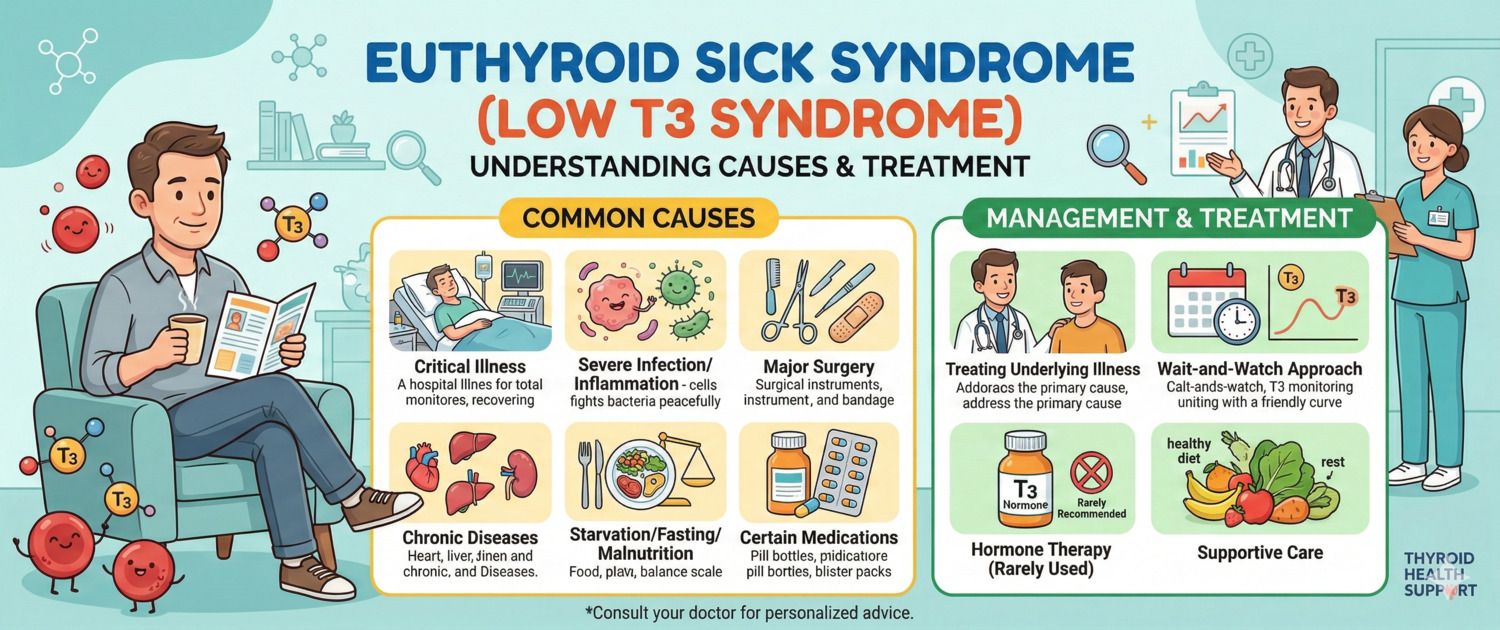
A critically ill patient in the ICU: labs show low T3, normal TSH, and normal or slightly reduced T4. Hypothyroidism? — No. This is euthyroid sick syndrome — an adaptive response to systemic stress in which the thyroid gland is healthy and the changes in thyroid hormones reflect the underlying disease. Prescribing levothyroxine in this setting is a mistake. Understanding the mechanism is essential.
What Euthyroid Sick Syndrome Is
Euthyroid sick syndrome (ESS), also called non-thyroidal illness syndrome (NTI) or low T3 syndrome, is a complex of changes in thyroid hormone levels that develops in severe systemic illness without primary thyroid pathology. The term "euthyroid" is central: the gland itself is functioning normally, but the hormonal profile is altered.
ESS occurs in 40–70% of ICU patients and in severe chronic disease. The degree of T3 reduction correlates with disease severity — and is an independent predictor of adverse outcomes.
Mechanism: Why T3 Falls
ESS is driven by impaired peripheral conversion of T4 to T3. In health, most circulating T3 is produced not by the thyroid gland itself but in peripheral tissues — primarily the liver, kidneys, and muscle — through deiodination of T4 by deiodinase enzymes.
In severe illness, this process is disrupted at several levels:
1. Reduced type 1 deiodinase (D1) activity: D1 is the primary enzyme for peripheral T4→T3 conversion. In systemic inflammation, starvation, and critical illness, its activity falls sharply. Result: T4 is not converted to active T3.
2. Alternative T4 metabolism: instead of generating T3, T4 is converted to reverse T3 (rT3) — a biologically inert isomer. rT3 has no hormonal activity and competitively blocks T3 receptors. In ESS, rT3 is markedly elevated.
3. Role of cytokines: interleukin-1, interleukin-6, and TNF-α — inflammatory mediators — directly suppress intracellular T4 transport, thyroid hormone synthesis, and T3 receptor expression.
4. Altered protein binding: acute inflammation reduces thyroxine-binding globulin levels → bound T4 falls while free T4 is preserved — an important interpretive nuance.
Teleological hypothesis: the fall in T3 during illness is not pathological but adaptive. T3 is the primary driver of catabolism: it accelerates energy expenditure and stimulates protein breakdown. In severe disease, reduced T3 → lower metabolic demands → conservation of energy resources for survival. This is an evolutionarily advantageous response, analogous to hibernation.
Laboratory Pattern of ESS
Changes in thyroid hormones in ESS evolve through phases depending on severity and duration.
Mild phase (early):
Severe phase:
- Free T3 — markedly reduced
- Free T4 — reduced (an adverse prognostic sign)
- TSH — normal or slightly suppressed (transiently rises in the recovery phase)
- rT3 — markedly elevated
Recovery phase:
- TSH transiently rises (the pituitary "re-engages" regulation)
- T3 gradually normalises
- Full recovery takes days to weeks
Key diagnostic pattern: low T3 + normal or slightly low TSH + clinical context of severe illness = ESS, not hypothyroidism.
How to Distinguish ESS from True Hypothyroidism
This distinction is critical, as it determines management.
| Feature | ESS | Hypothyroidism |
|---|---|---|
| TSH | Normal or slightly low | Markedly elevated |
| Free T4 | Normal or slightly low | Reduced |
| Free T3 | Markedly reduced | Reduced |
| Reverse T3 | Markedly elevated | Normal |
| Clinical context | Severe systemic disease | Absent or subclinical |
| Anti-TPO antibodies | Negative | May be positive (in Hashimoto's) |
| Normalisation after recovery | Yes | No (requires therapy) |
The primary differentiating feature is TSH. In true primary hypothyroidism, TSH is markedly elevated. In ESS, TSH is normal or slightly suppressed (due to cytokine inhibition of the hypothalamic-pituitary axis).
Exception: central hypothyroidism (pituitary or hypothalamic pathology) also presents with low TSH and low T4/T3. Additional workup is required in that case (other pituitary hormones, MRI).
Causes of Euthyroid Sick Syndrome
ESS develops in any severe systemic stress:
Acute conditions:
- Sepsis and septic shock — the most common ICU cause
- Myocardial infarction
- Acute kidney injury
- Major trauma and burns
- Major surgical procedures
- Stroke
Chronic diseases:
- Chronic kidney disease — impaired D1 activity in uraemia
- Liver cirrhosis — the liver is the primary organ of T4→T3 conversion
- Malignancies
- Chronic heart failure
- HIV infection
Metabolic stressors:
- Starvation — the classic ESS model
- Anorexia nervosa
- Prolonged very-low-calorie diets
Medications:
- Amiodarone — a potent D1 and D2 inhibitor; produces a characteristic pattern: high T4, low T3, high rT3 with normal TSH
- High-dose glucocorticoids
- Dopamine and dobutamine — suppress TSH
Should ESS Be Treated?
This question has been debated, but the current consensus is clear: ESS is not treated with thyroid hormone replacement.
Arguments against treatment:
- ESS is an adaptive response, not a hormone deficiency
- Randomised controlled trials of T3 or T4 supplementation in ESS have not shown improved survival
- Administering T3 to critically ill patients increases catabolism → potentially worsens prognosis
- Normalisation of T3 after recovery confirms the transient, adaptive nature of the changes
The correct approach:
- Treat the underlying disease — the only path to hormonal normalisation
- Do not prescribe thyroid hormones without clear evidence of primary hypothyroidism (markedly elevated TSH)
- Repeat thyroid function tests after recovery (6–8 weeks) — to exclude true hypothyroidism
When treatment may be considered: cardiac surgery with cardiopulmonary bypass — a distinct research area with a specific hormonal profile.
Clinical Significance
The T3 level in ESS is an independent predictor of ICU survival. The lower the T3, the worse the prognosis. This does not mean T3 should be artificially raised — it means that low T3 reflects the severity of the underlying disease.
The key clinical lesson: do not interpret thyroid hormones in severely ill patients as evidence of primary thyroid disease. Initiating replacement therapy in this setting is a common error.
This article is for informational purposes only and does not replace consultation with a qualified endocrinologist.
For informational purposes only
This article is for informational purposes only and does not constitute medical advice, diagnosis, or treatment. Please consult a healthcare professional for medical guidance.