Stool Test for Parasites and Worm Eggs: Preparation and Results
Reviewed by the LabReadAI medical team
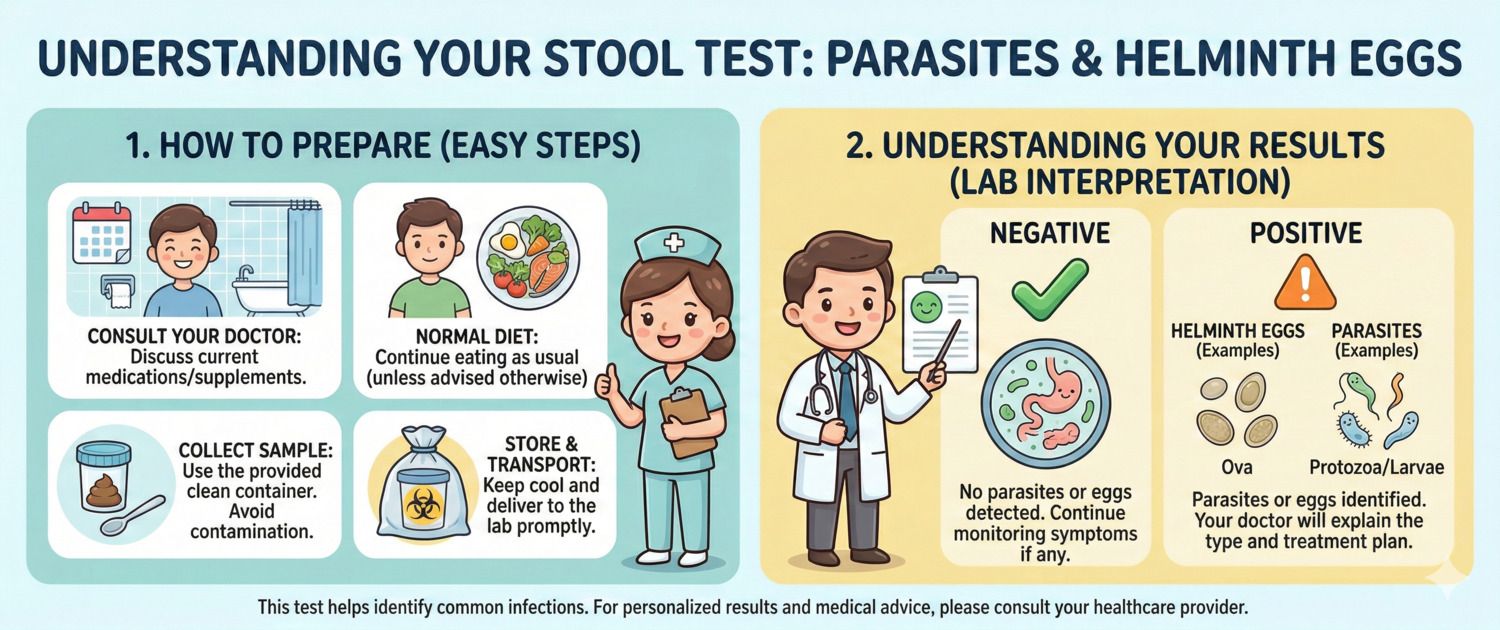
Abdominal pain, diarrhoea, unexplained weight loss, persistent fatigue — any of these can be symptoms of intestinal parasites, or they can have nothing to do with them. The only way to find out is laboratory testing. A stool examination for helminth eggs and protozoan cysts detects most common intestinal parasitic infections — ascariasis, giardiasis, trichuriasis and others. But this test has important limitations, and the most important one should be understood from the outset.
What the Stool Parasite Test Detects
The stool examination for helminth eggs and protozoan cysts (coproscopy, or ova and parasite exam) is a microscopic study of faeces. The laboratory technician looks under a microscope for:
- Helminth eggs — roundworm (Ascaris lumbricoides), whipworm (Trichuris trichiura), hookworms, toxocara, broad tapeworm, pork and beef tapeworms, and others
- Cysts and trophozoites of protozoa — Giardia lamblia, Entamoeba histolytica, Balantidium coli, Cryptosporidium
What the stool test does NOT detect: Pinworms (Enterobius vermicularis) — they deposit eggs outside the bowel, in the perianal skin folds, not inside the intestine. A separate enterobiasis test (perianal swab) is required to detect them. This is a very common source of confusion: a "worm test" referral does not cover the most common helminth in children.
An indirect sign of helminthiasis is eosinophilia — elevated eosinophils on a full blood count. However, this is a non-specific marker, and diagnosis must be confirmed only by coproscopy or other targeted tests.
Who Should Be Tested and When
Routine indications:
- health screening for children and adults
- enrolment in nursery, school, swimming pool, or summer camp
- hospital admission
- occupational screening for food industry workers, childcare staff, and healthcare workers
Symptom-based indications:
- diarrhoea alternating with constipation lasting more than two weeks
- cramping abdominal pain without obvious cause
- unexplained weight loss
- perianal itching, especially in children
- nausea, reduced appetite
- elevated eosinophils on blood count
- identified parasitic infection in a family member or close contact
How to Prepare and Collect the Sample Correctly
Correct stool collection is half the battle. Violating any of the rules sharply reduces test sensitivity.
In the days before collection:
- avoid laxatives, rectal suppositories, enemas, bismuth and iron preparations for 3 days — they alter stool consistency and may mask parasites
- avoid antiparasitic and antibacterial agents for 3 days — they destroy or suppress parasite forms
- no special diet is needed, but a very fatty meal may interfere with microscopy
Collection rules:
- collect stool in the morning after a spontaneous bowel movement (no laxatives)
- use a sterile container with a spoon (available at pharmacies)
- collect material from 3 different parts of the stool (beginning, middle, end) — parasites are not evenly distributed
- minimum amount — approximately one teaspoon (5–10 g)
- do not collect from a toilet bowl with water — use a bedpan or disposable liner
- urine must not contaminate the sample
Delivery times:
- optimal — within 1–2 hours of collection
- acceptable — up to 8 hours if refrigerated (+2 to +8 °C)
- for detecting trophozoites (amoeba, Giardia) — ideally within 30–60 minutes: they break down rapidly on cooling. Use a container with preservative in this case.
How Many Times Should the Test Be Repeated
A single stool test is unreliable. Helminth eggs and protozoan cysts are shed intermittently, and the sensitivity of a single examination is only 40–60%.
Recommended protocol:
- routine screening — once, as required by the institution
- when symptoms are present — 3 tests on consecutive or alternate days
- post-treatment control — 3 tests 3–4 weeks after completing the course
A single negative result does not exclude infection when symptoms persist.
How to Interpret the Results
| Result | Meaning |
|---|---|
| No helminth eggs detected, no protozoan cysts detected | Parasitic infection not identified (if preparation rules were followed) |
| Eggs of [species] detected | Infection with this helminth species confirmed |
| Cysts of [species] detected | Infection with this protozoan species confirmed |
Reports may state only presence or absence of findings. Species identification is essential: different parasites require different treatments.
Most commonly detected in clinical practice:
- Roundworm (Ascaris) — characteristic eggs with a rough outer coat
- Whipworm (Trichuris) — lemon-shaped eggs with polar plugs
- Giardia — oval cysts with 2–4 nuclei
- Hookworms — thin-shelled eggs with blastomeres
In giardiasis, cysts in stool are shed inconsistently — during asymptomatic carriage, shedding is intermittent. This is why three-sample testing is particularly important when giardiasis is suspected. How this test relates to the other methods is in the overview on testing for worms and parasites.
Special Considerations for Specific Parasites
Giardia: trophozoites break down rapidly — stool must be delivered within 30–60 minutes or collected into a preservative container (formalin or PVA fixative). PCR for Giardia is now more sensitive than microscopy.
Amoeba: similar to Giardia — trophozoites do not survive outside the host. Ideally examine fresh, warm stool.
Toxocara: eggs are rarely found in stool — toxocara more commonly causes visceral or ocular disease without intestinal involvement. Diagnosis is serological (ELISA for antibodies).
Taeniasis (pork and beef tapeworm): stool is examined for proglottids and eggs. When suspected, a perianal swab may be added.
When to See a Doctor
See a GP or paediatrician if the result is positive — the choice of drug, dosage and duration depends on the specific parasite. Self-treating with anthelmintics without identifying the causative organism is ineffective and can be unsafe.
If symptoms persist and three stool tests are all negative, a doctor may order serological tests (ELISA) for toxocariasis, trichinellosis, or echinococcosis — some parasitic infections cannot be detected by coproscopy. If pinworms are suspected, a separate enterobiasis test is ordered.
This article is for informational purposes only. Diagnosis and treatment are provided exclusively by a qualified physician.
For informational purposes only
This article is for informational purposes only and does not constitute medical advice, diagnosis, or treatment. Please consult a healthcare professional for medical guidance.