Enterobiasis Test (Pinworm Scrape): How to Collect and Read Results
Reviewed by the LabReadAI medical team
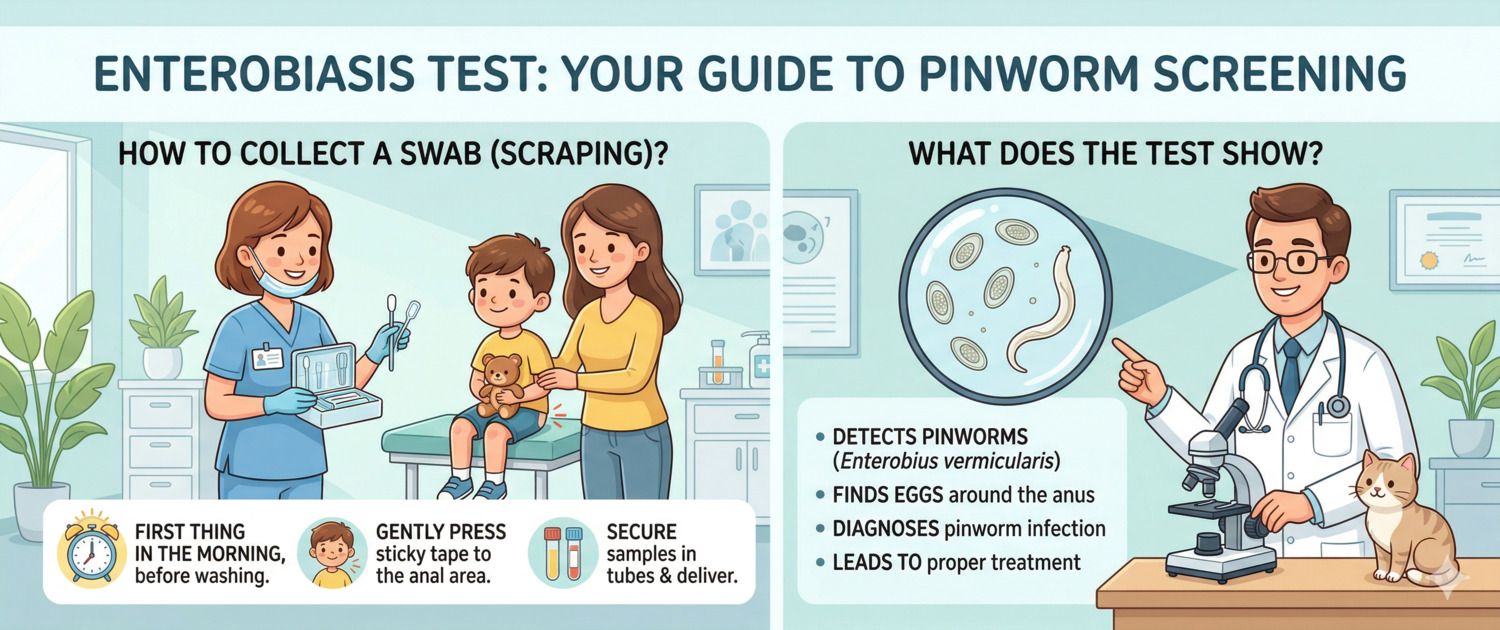
Intense itching around the anus at night — especially in a child — is one of the most tell-tale signs of pinworm infection. But confirming or ruling out enterobiasis requires a laboratory test: pinworms are not always visible to the naked eye, and young children often cannot describe their symptoms. The perianal swab for enterobiasis is the simplest, fastest, and only reliable method. Here is how to collect it correctly, how many times to repeat it, and how to read the result.
What the Enterobiasis Test Detects
The enterobiasis test is a microscopic examination of material collected from the perianal folds (skin around the anus) for the eggs of the pinworm Enterobius vermicularis. This is precisely where the female worm deposits her eggs — typically at night, emerging from the rectum. This is what causes the characteristic nocturnal itching.
A standard stool test for parasite eggs is not suitable for diagnosing enterobiasis: eggs are not deposited inside the bowel but outside it, so they are almost never found in stool. This is a fundamental difference from other intestinal parasitic infections, which are detected via stool parasite examination.
An indirect laboratory sign of infection is eosinophilia — elevated eosinophils on a full blood count. However, this finding is non-specific: eosinophilia occurs with many other parasitic infections and allergic conditions, so enterobiasis must be confirmed by the swab test.
Who Should Be Tested and When
The test is a routine investigation ordered for:
- children enrolling in nursery, school, sports clubs, swimming pools, or summer camps
- patients admitted to hospital (infection control requirement)
- routine health checks for children under 14
- symptoms: nocturnal perianal itching, restless sleep, teeth grinding, unexplained bedwetting, or abdominal pain without a clear cause
- when enterobiasis is detected in one family member — all close contacts are tested
Adults are tested mainly on epidemiological grounds or when symptoms appear. Food industry workers, childcare staff, and healthcare workers are screened as part of occupational health checks.
How to Collect the Perianal Swab Correctly
Correct preparation is the single most important factor for a reliable result. Pinworm eggs are deposited at night and in the early morning hours — this is when their concentration on the skin is highest.
The cardinal rule: do not wash and do not use the toilet before sample collection.
The swab is taken in the morning, immediately upon waking, before any hygiene procedures or bowel movement.
Collection methods:
Adhesive tape (Scotch tape test) — the most widely used method in clinics. A strip of transparent tape is pressed firmly against the perianal folds, then transferred to a glass slide. The slide is delivered to the laboratory.
Cotton swab or spatula — a swab moistened with saline or glycerol is rolled across the perianal folds and placed in a transport tube.
Ready-to-use home collection kits are available in pharmacies — they include instructions, adhesive tape and a transport container. When used correctly, home-collected samples are as reliable as those taken in a clinical setting.
Delivery time to the laboratory — within 2–3 hours of collection; if refrigerated (+2 to +8 °C), up to 8 hours.
How Many Times Should the Test Be Repeated
A single swab is unreliable. The female worm does not deposit eggs every night, so the probability of detecting them in one test is approximately 50%. With two tests it rises to around 90%; with three tests — 95% or above.
Standard protocol:
- routine screening (nursery, swimming pool) — once, as required by the institution
- when symptoms are present — 3 tests on consecutive or alternate days
- post-treatment control — 3 swabs taken 2 weeks after completing the course
If the first result is negative but symptoms persist, repeat the test. A single negative result does not exclude infection.
How to Interpret the Result
The result is straightforward:
| Result | Meaning |
|---|---|
| Enterobius vermicularis eggs not detected | Enterobiasis not identified (if preparation rules were followed) |
| Enterobius vermicularis eggs detected | Enterobiasis confirmed — treatment required |
Quantitative reporting (egg count) is not routinely performed — the presence or absence of eggs is sufficient for a clinical decision. Treatment is indicated for any positive result, regardless of the number of eggs seen.
Following a positive result, the entire household is treated simultaneously — even if others test negative. Pinworms spread very easily by the faecal-oral and contact route, and reinfection from an untreated family member will negate any treatment.
Why the Test May Be False Negative
A negative result despite actual infection is not uncommon. Main reasons:
- Preparation errors: morning shower or toilet before collection washes eggs away
- Wrong timing: the female did not lay eggs that particular night — skin concentration is zero
- Single test only: as described, one swab is insufficient
- Storage or transport failure: prolonged heat exposure destroys eggs
If symptoms are characteristic and three swabs are all negative, a clinician may decide to treat empirically based on the clinical picture.
When to See a Doctor
See a paediatrician or GP if the result is positive — anthelmintic medication and a household treatment plan require medical supervision. Also consult a doctor if symptoms (nocturnal itching, restless sleep, abdominal pain) persist for more than two weeks despite negative tests: other causes are possible, including helminthiasis of a different type or intestinal infection. An overview of all parasite tests is in the article on testing for worms and parasites.
Following a positive result in a child, the doctor will issue a note excluding the child from group settings until treatment is complete and a control negative test is obtained.
This article is for informational purposes only. Diagnosis and treatment are provided exclusively by a qualified physician.
For informational purposes only
This article is for informational purposes only and does not constitute medical advice, diagnosis, or treatment. Please consult a healthcare professional for medical guidance.