Eosinophils: Normal Range, Causes of High and Low Count
Reviewed by the LabReadAI medical team
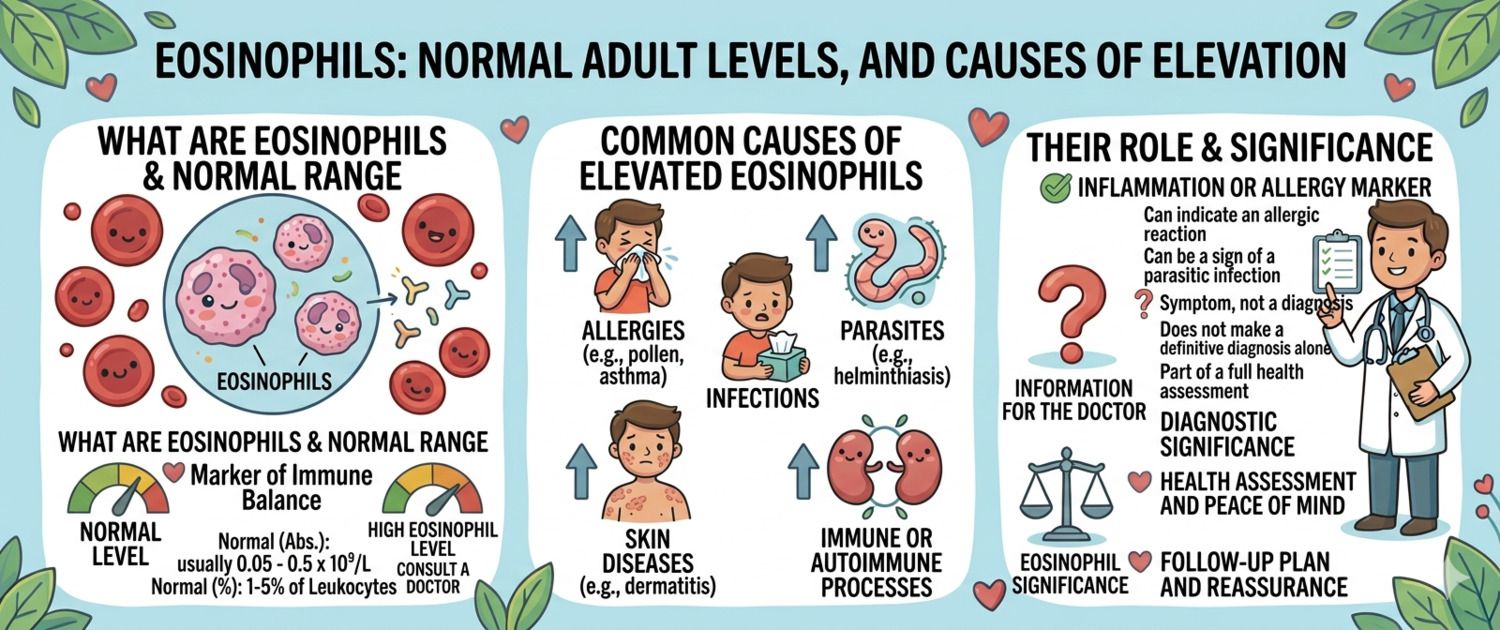
You got a complete blood count and found an upward arrow next to "EOS" in the differential. Most people's first thought is allergy or parasites — and that's not a coincidence. Eosinophils are precisely the cells that specialize in these two threats. Here's what the normal range looks like, what drives elevated counts, and when the number deserves serious attention.
What Are Eosinophils and What Do They Do
Eosinophils are one of five types of white blood cells. Think of them as a chemical-weapons special unit: they step in when ordinary neutrophils can't do the job — against parasites and allergic reactions.
When a parasite is detected, an eosinophil surrounds it and releases toxic proteins that destroy the worm's membrane. In allergic reactions, they release histamine and leukotrienes — triggering swelling and bronchospasm. So eosinophils protect us, but sometimes that protection overshoots and harms the body itself.
In blood, eosinophils are scarce — the second rarest leukocyte after basophils. Most of them live in tissues: the gut, lungs, and skin — exactly where parasites and allergens are most likely to appear.
Normal Eosinophil Count in Adults
In the CBC differential, eosinophils are expressed two ways — as a percentage and as an absolute count:
| Parameter | Normal |
|---|---|
| Eosinophils (%) | 0.5–5% |
| Eosinophils abs. (× 10⁹/L) | 0.05–0.5 |
The percentage depends on the ratio to other leukocytes — during infection, rising neutrophils can make the eosinophil percentage appear falsely low even when the absolute count is normal. That's why the absolute value is the more informative number.
In children, normal ranges are slightly higher than in adults and decrease with age. Reference ranges vary slightly between laboratories — always use the ranges on your specific lab report.
High Eosinophils: Causes of Eosinophilia
Eosinophilia is defined as eosinophils above 0.5 × 10⁹/L. The degree of elevation carries different clinical weight:
| Grade | Absolute count | Typical causes |
|---|---|---|
| Mild | 0.5–1.5 × 10⁹/L | Allergy, medications, post-infection recovery |
| Moderate | 1.5–5.0 × 10⁹/L | Parasitic infections, autoimmune disease |
| Severe eosinophilia | > 5.0 × 10⁹/L | Hematologic malignancy, rare syndromes |
The term hypereosinophilia does not refer to this row: under the WHO and ICC 2024 criteria it means a count persistently above 1.5 × 10⁹/L, confirmed at least twice at least a month apart. The defining feature is persistence, not the absolute figure on a single report.
Allergic diseases — the most common cause of mild to moderate eosinophilia. Asthma, atopic dermatitis, seasonal hay fever, urticaria, food allergy — eosinophils are elevated during flares of all these conditions. ESR is also often elevated as a non-specific inflammation marker. To confirm the allergic origin of eosinophilia, an allergy panel — including total and specific IgE — is ordered.
Parasitic infections — especially helminths that migrate through tissues (toxocariasis, ascariasis, trichinosis). Tissue-migrating larvae trigger the strongest eosinophilic response. Intestinal-stage helminthiasis may cause weaker elevation.
Medications — a common and underappreciated cause. Antibiotics (ampicillin, cephalosporins), NSAIDs, captopril, carbamazepine, and many others can trigger drug-induced eosinophilia. It usually resolves after stopping the drug.
Autoimmune and inflammatory diseases — Crohn's disease, ulcerative colitis, rheumatoid arthritis, systemic lupus erythematosus.
Malignancies — Hodgkin's lymphoma, eosinophilic leukemia. Characterized by persistent severe eosinophilia above 5 × 10⁹/L, often accompanied by drops in other blood cell counts.
Low Eosinophils: When It Matters
Eosinopenia (eosinophils below 0.05 × 10⁹/L) is less common and rarely has independent clinical significance. Main causes:
- Acute bacterial infection — at the peak of infection, cortisol suppresses eosinophils. Their temporary disappearance from the differential alongside high neutrophils is an indirect sign of acute bacterial process.
- Corticosteroid therapy — prednisone and dexamethasone lower eosinophils within hours.
- Cushing's syndrome — excess endogenous cortisol.
Isolated eosinopenia without other CBC changes usually requires no special workup.
How to Correctly Evaluate Eosinophils in a CBC
Eosinophils are never assessed in isolation from the rest of the differential. Key patterns:
- Mild eosinophilia + normal neutrophils — think allergy or parasites.
- Eosinophilia + elevated neutrophils with left shift — infection combined with allergic background, or acute-phase parasitic invasion.
- High eosinophilia + low hemoglobin + low platelets — concerning combination, exclude hematologic malignancy.
- Eosinophilia across multiple consecutive tests without a clear cause — warrants comprehensive workup.
A single moderate elevation after antibiotics or at the peak of pollen season is not alarming. Persistent elevation is a reason to find the cause.
When to Seek Medical Attention
- Eosinophils above 5.0 × 10⁹/L — severe eosinophilia, risk of organ damage
- Eosinophilia rising across consecutive tests
- Elevated eosinophils combined with falling hemoglobin, WBC, or platelets
- Eosinophilia with symptoms: rash, shortness of breath, abdominal pain, fever
Mild eosinophilia (up to 1.5 × 10⁹/L) with an obvious allergic cause — routine visit to an allergist or GP.
Conclusion
Eosinophils are highly specialized cells with a specific mission: fighting parasites and mediating allergic responses. A mild elevation most often points to allergy or a recent parasitic infection. Persistent high eosinophilia signals the need for deeper investigation. In both cases, the key is not to look at the number in isolation — evaluate it in the full context of the blood count.
Eosinophil interpretation and further testing is directed by a doctor — a GP, allergist, or hematologist depending on the clinical picture.
For informational purposes only
This article is for informational purposes only and does not constitute medical advice, diagnosis, or treatment. Please consult a healthcare professional for medical guidance.