Allergy Panel Blood Test: What's Included and How to Read Results
Reviewed by the LabReadAI medical team
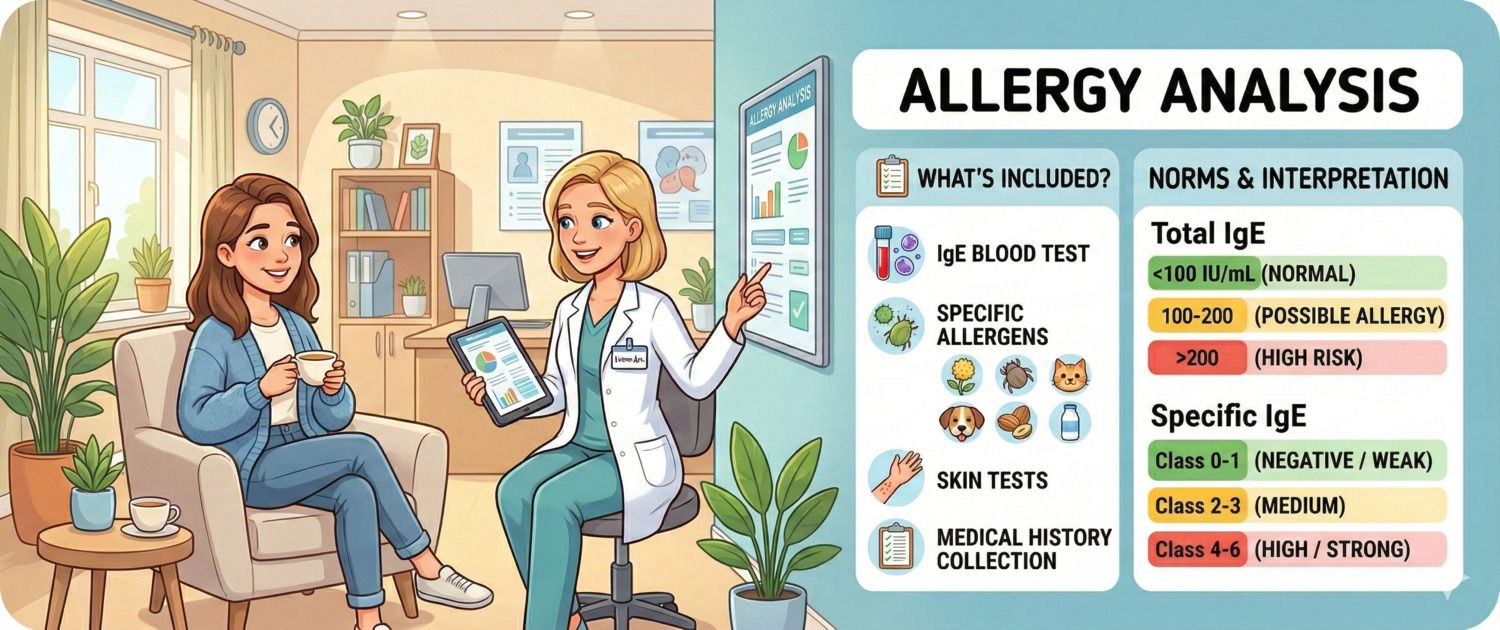
A runny nose every spring, a rash after strawberries, a cough whenever you visit a friend with a cat — and you have long suspected allergy but still do not know exactly what triggers it. Laboratory allergy testing is not a single test but a system of markers, each answering a different question. Here is what the standard allergy panel includes, what your results mean, and how to prepare correctly.
What the Allergy Panel Includes
Laboratory allergy diagnosis operates on three levels: assessing the overall allergic activity of the immune system, detecting antibodies to specific allergens, and measuring indirect inflammatory markers.
Total IgE — the aggregate concentration of class-E immunoglobulins in the blood. This is the screening test: it indicates the general degree of "allergic readiness" of the immune system without naming any specific trigger. Elevated total IgE is the signal to move to the next step.
Specific IgE (sIgE) to individual allergens — the cornerstone of allergy diagnosis. These are antibodies directed against a single substance: birch pollen, cat dander, peanut, house dust mite. Specific IgE confirms sensitisation to a particular trigger. Multiple allergens are tested simultaneously as panels: inhalant (airborne allergens), food, or paediatric.
Eosinophils in the complete blood count — an indirect marker of allergic and parasitic inflammation. They do not confirm specific allergy but help assess the activity of the atopic process and rule out parasitic causes of elevated IgE.
ESR and CRP — inflammatory markers that help distinguish allergic from infectious causes of symptoms: in allergy they are typically normal or only mildly elevated.
Methods of Laboratory Allergy Testing
ImmunoCAP — the Gold Standard
ImmunoCAP (fluorescent enzyme immunoassay) is the most accurate method for measuring specific IgE. The allergen is fixed to a solid phase, binds IgE from the patient's serum, and the signal is measured quantitatively. Results are expressed in kU/L and classified by sensitisation level.
| Class | sIgE concentration (kU/L) | Sensitisation level |
|---|---|---|
| 0 | < 0.35 | None |
| 1 | 0.35–0.69 | Very low |
| 2 | 0.70–3.49 | Low |
| 3 | 3.50–17.49 | Moderate |
| 4 | 17.50–49.99 | High |
| 5 | 50.0–100.0 | Very high |
| 6 | > 100.0 | Extremely high |
Class 2 and above is considered clinically significant, although class 1 with compatible symptoms also warrants attention.
Immunoblot (Multiplex Panels)
An alternative method — simultaneous testing against dozens of allergens in a single assay. Less sensitive than ImmunoCAP, but allows broad screening when the diagnosis is unclear. Results are semi-quantitative: expressed as scores or crosses rather than kU/L.
Molecular (Component-Resolved) Allergy Diagnostics
The modern approach — testing not against a whole allergen extract (e.g. "birch") but against individual allergenic molecules (Bet v 1, Bet v 2, etc.). This allows: risk stratification for severe systemic reactions (patients with antibodies to "major" components carry higher risk), explanation of cross-reactive responses (why a birch-allergic patient reacts to apples), and more precise selection of immunotherapy targets.
Standard Allergen Panels
Laboratories offer ready-made allergen sets grouped by clinical logic.
Inhalant (respiratory) panel — for diagnosing hay fever, allergic rhinitis and asthma: trees (birch, alder, hazel, oak), grasses (timothy, orchard, ryegrass), weeds (ragweed, wormwood), house dust mites (Der p 1, Der f 1), moulds (Alternaria, Cladosporium), cat and dog dander.
Food panel — for food allergy diagnosis: cow's milk, hen's egg (white and yolk separately), peanut, tree nuts, soy, wheat, fish (cod, salmon), shellfish (shrimp, crab).
Paediatric panel — adapted for children: milk, egg, wheat, soy, peanut plus the main inhalant allergens.
Insect venom panel — bee, wasp, and hornet venom — for patients with severe reactions to stings.
An allergist often builds an individualised panel based on the patient's history — this is more accurate than any standard set.
Total IgE Normal Ranges by Age
Total IgE levels are age-dependent and are significantly lower in children.
| Age | Normal total IgE (IU/mL) |
|---|---|
| Under 1 year | < 15 |
| 1–5 years | < 60 |
| 5–14 years | < 90 |
| 14–18 years | < 200 |
| Adults > 18 years | < 100 |
The normal range for specific IgE is universal across all ages: a value < 0.35 kU/L corresponds to class 0 (no sensitisation).
How to Prepare and When to Test
The key advantage of a blood IgE test over skin prick tests is that preparation requirements are minimal.
When to test: any time of year — including peak pollen season and during active symptoms. Antihistamines and intranasal corticosteroids do not affect blood IgE levels and do not need to be stopped. This makes blood testing the preferred option when it is impossible to interrupt treatment.
Basic rules: fast for 4 hours or test in the morning fasting; avoid fatty food and alcohol for 24 hours beforehand; avoid physical exertion and smoking for 30 minutes before the draw.
Inform your doctor: about systemic corticosteroids (they suppress IgE and may underestimate the result) and immunosuppressive drugs.
One exception to the "test any time" rule — molecular diagnostics during acute infection: acute inflammation can non-specifically alter the antibody profile.
Interpreting Your Results
Elevated total IgE + elevated specific IgE to particular allergens — confirmed sensitisation. This is not automatically a diagnosis of allergy: symptoms must correlate with the timing or circumstances of exposure to that allergen.
Elevated total IgE + normal specific IgE — several possible explanations: the responsible allergen was not in the tested panel (the panel should be expanded); parasitic infestation (helminths cause a sharp rise in total IgE, typically combined with elevated eosinophils); rare IgE-mediated immunodeficiency.
Normal total IgE + allergy symptoms — allergy is not excluded. Some allergic reactions — contact dermatitis, certain drug reactions — are not IgE-mediated and will not show up in this test. In localised allergic reactions (for example, confined to the nasal mucosa), blood total IgE may remain normal.
Elevated eosinophils + high IgE without obvious allergens — parasitic infestation (ascariasis, toxocariasis) must be ruled out before attributing the pattern to atopy.
When Allergy Testing Is Mandatory
Routine testing is indicated for: recurrent symptoms (runny nose, sneezing, itching, rash) linked to a specific season, location or food; suspected food allergy; atopic dermatitis with unclear triggers; allergic rhinitis before starting immunotherapy — AIT can only be given when IgE-mediated sensitisation is confirmed; severe reactions to insect stings.
Urgently — after any anaphylactic episode: once stabilised, the causative allergen must be identified to prevent recurrence.
This article is for informational purposes only. Interpretation of results and treatment decisions are the responsibility of a qualified allergist.
For informational purposes only
This article is for informational purposes only and does not constitute medical advice, diagnosis, or treatment. Please consult a healthcare professional for medical guidance.