Total IgE Blood Test: Normal Levels, High Results and Causes
Reviewed by the LabReadAI medical team
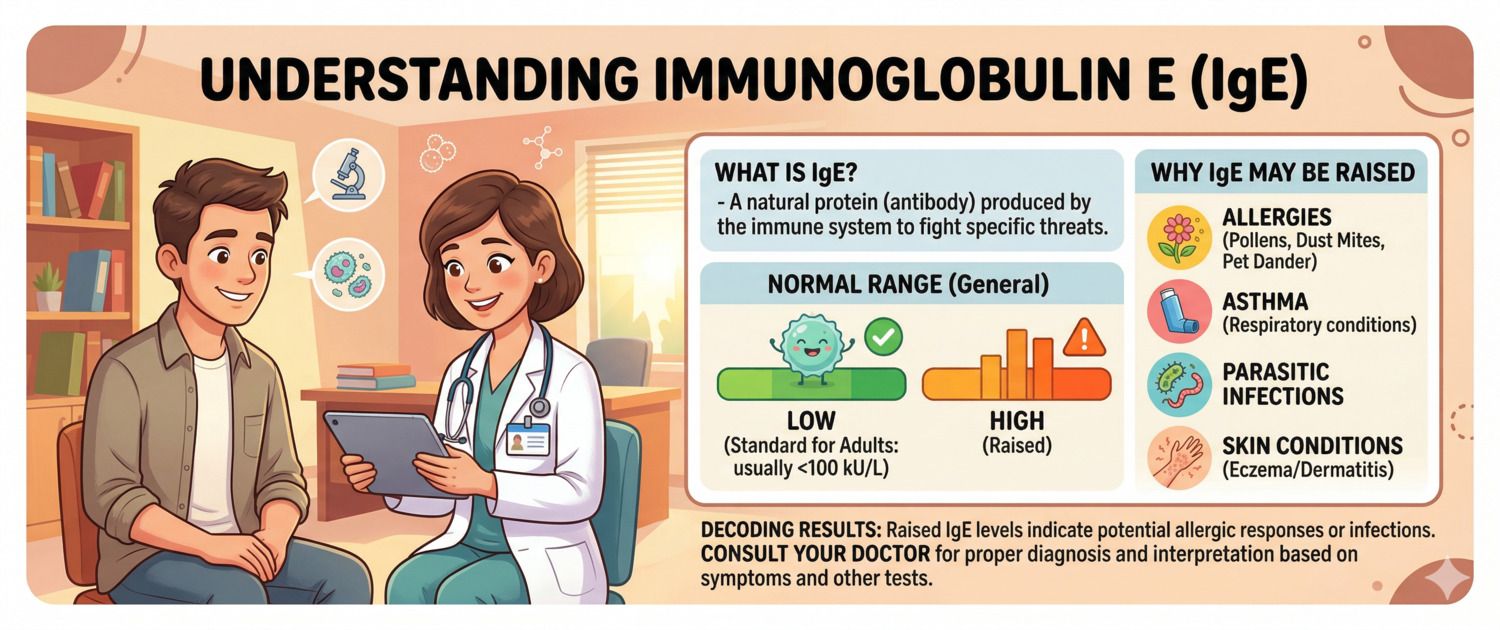
A rash after strawberries, watery eyes around cats, coughing during pollen season — all of these trace back to one immune mechanism centred on immunoglobulin E. A total IgE blood test is the first step in laboratory allergy workup: it shows how active the allergic arm of the immune system is, without yet naming the specific trigger. This article explains what your result means and where to go from there.
What Is Immunoglobulin E and Why Is It Measured?
Immunoglobulin E (IgE) is one of five antibody classes produced by plasma cells. By blood concentration it is the rarest of all: in healthy individuals there is hundreds of thousands of times less IgE than IgG. Despite this, IgE controls the fastest and most dramatic allergic reactions.
The mechanism: IgE molecules bind to the surface of mast cells and basophils — the key effectors of the allergic response. When an allergen re-enters the body, it cross-links the IgE molecules on the cell surface, triggering an explosive release of histamine and other inflammatory mediators. The result is immediate: itching, swelling, bronchospasm.
Evolutionarily, IgE developed as a defence against parasites — helminths and other multicellular organisms — for which this rapid inflammatory response is genuinely effective. In the modern world, with low parasitic burden, the immune system often redirects this mechanism toward harmless proteins: foods, pollen, pet dander.
Total IgE is ordered in: suspected allergic disease; chronic urticaria or atopic dermatitis; unexplained asthma; suspected parasitic infestation; and monitoring response to allergen immunotherapy.
IgE Normal Ranges for Adults and Children
IgE levels are strongly age-dependent: minimal at birth, rising through childhood and stabilising in adulthood. Units are IU/mL (international units per millilitre) or kU/L — the two are equivalent.
| Age | Normal total IgE (IU/mL) |
|---|---|
| Under 1 year | < 15 |
| 1–5 years | < 60 |
| 5–14 years | < 90 |
| 14–18 years | < 200 |
| Adults > 18 years | < 100 |
| Older adults > 60 years | < 80 |
The 100 IU/mL adult threshold is a guide rather than an absolute boundary: smokers and residents of high-parasitic-burden regions may have slightly elevated baseline IgE without disease. The reference interval on your laboratory report takes priority.
Total IgE vs Specific IgE: What Is the Difference?
Two different tests serve two different purposes — and they are frequently confused.
Total IgE is the aggregate concentration of all IgE molecules in the blood, regardless of what they target. It reflects the overall degree of "allergic readiness" but does not identify the culprit allergen. Elevated total IgE with no symptoms is not a diagnosis of allergy.
Specific IgE are antibodies directed against a single allergen: birch pollen, peanut, cat dander, house dust mite. Specific IgE confirms sensitisation to a particular trigger and forms the cornerstone of allergy diagnosis. Specific IgE panels are included in the comprehensive allergy panel.
The typical investigation pathway: total IgE as an initial screen → if elevated and clinical picture points to allergy → specific IgE testing for suspected triggers → simultaneously check eosinophils in the blood count, as eosinophilia frequently accompanies atopic disease.
Causes of Elevated IgE
High IgE reflects active production of class-E antibodies by the immune system. The causes differ fundamentally in nature.
Allergic diseases are the most common category. Atopic dermatitis, allergic rhinitis, asthma, food allergy and insect venom reactions all raise total IgE. The highest values — into the thousands of IU/mL — are seen in severe atopic dermatitis: skin surface area affected correlates directly with antibody level.
Parasitic infections. Ascariasis, toxocariasis, trichinellosis and other helminthiases cause sharp IgE elevation — often several thousand IU/mL — combined with eosinophilia. When high IgE accompanies blood eosinophilia without obvious allergic symptoms, parasitic infestation should be ruled out first.
Immunodeficiency states. Job's syndrome (hyper-IgE syndrome) is a rare primary immunodeficiency with IgE in the tens of thousands of IU/mL, accompanied by recurrent abscesses and eczema. Wiskott-Aldrich syndrome also features elevated IgE.
Other causes. Certain lymphomas (Hodgkin's disease), autoimmune conditions, chronic infections and drug reactions can moderately raise IgE. Smoking is another cause of mild elevation in the absence of allergic pathology.
How to Prepare for a Total IgE Blood Test
The test requires no complex preparation, but a few steps improve result reliability.
Fasting for four hours beforehand is preferred, though food has minimal impact on IgE levels. Avoid known allergen exposure on the day of the test — an acute allergic reaction transiently elevates IgE. Antihistamines do not directly affect IgE, but discontinuing them for three to five days before the test gives the clinician a cleaner clinical picture to interpret alongside the result. Importantly, inform your doctor about corticosteroid therapy: glucocorticoids suppress IgE production and may produce a falsely normal result in a patient with genuine allergic disease.
IgE testing is informative year-round, although patients with seasonal allergy may have slightly higher levels during pollen season — a normal physiological response to allergen exposure.
What to Do With a High IgE Result
Elevated total IgE is a starting point, not a final diagnosis. The next steps depend on the clinical picture.
With allergy symptoms: an allergist will order specific IgE panels or skin prick tests to identify the precise trigger. Without symptoms but markedly elevated IgE: parasitic infestation must be excluded (stool microscopy, serology) before rarer diagnoses such as hyper-IgE syndrome are considered. With mild elevation in a smoker: observation is usually sufficient. Falling IgE on serial measurements after starting allergen immunotherapy or antiparasitic treatment confirms treatment response.
Conclusion
Immunoglobulin E is a quantitative marker of how active the allergic arm of the immune system is. A normal result makes allergic disease unlikely — though it does not exclude localised reactions where total IgE may remain in range. A high result does not establish a diagnosis on its own but determines the direction of further investigation. Interpretation is performed by an allergist or immunologist in the context of the full clinical history.
For informational purposes only
This article is for informational purposes only and does not constitute medical advice, diagnosis, or treatment. Please consult a healthcare professional for medical guidance.