Atopic Dermatitis: Symptoms, Causes and Modern Treatment
Reviewed by the LabReadAI medical team
Itch that keeps you awake at night, skin that cracks and flares again and again despite every cream — atopic dermatitis affects one in ten adults and one in five children. This is not simply "dry skin" or an allergy to a specific food. It is a chronic immune-mediated inflammation with its own logic, its own triggers, and — crucially — effective methods of control. Let's break down the mechanism, the symptoms, and what actually works in treatment.
What Is Atopic Dermatitis and Why It Develops
Atopic dermatitis (AD) is a chronic inflammatory skin disease rooted in two interconnected defects: impaired skin barrier function and immune dysregulation.
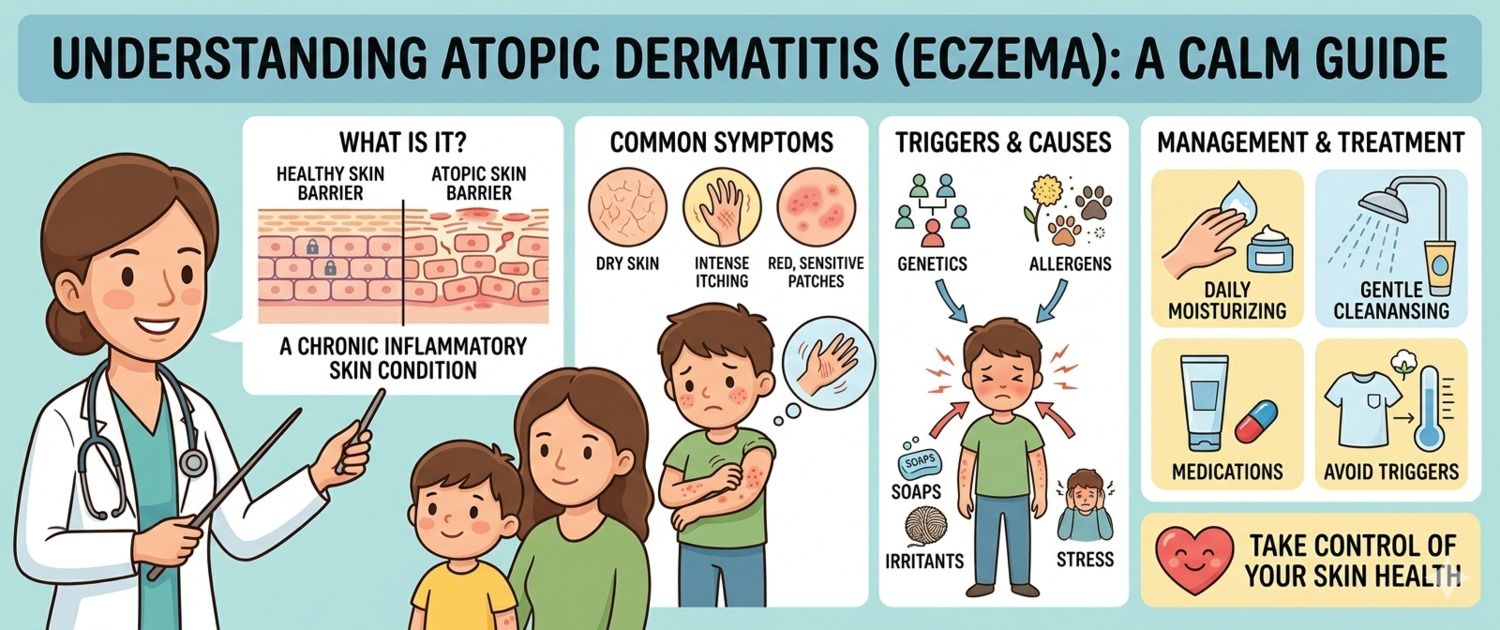
Healthy skin works like a well-laid brick wall: keratinocytes are held together by a lipid "mortar" that blocks external irritants. In AD, this mortar has genetically programmed cracks — primarily due to mutations in the filaggrin gene, which governs barrier integrity. Through these cracks, allergens, microbes, and irritants enter and trigger chronic inflammation.
The second component is immunological: in AD, the immune system is skewed toward a Th2 response. This is the "allergic" type of inflammation, driven by interleukins IL-4, IL-13, and IL-31 — the last of which directly activates itch-sensing nerve fibers in the skin. Dupilumab — the most effective modern drug for severe AD — works by blocking IL-4 and IL-13.
An important clarification: atopic dermatitis is not an allergy to any specific substance. It is a constitutional immune trait against which allergens and irritants provoke flares.
The Atopic March: Why AD Is Often Just the Beginning
Atopic dermatitis rarely exists in isolation. In a significant proportion of children it is the first step in the atopic march — the sequential development of allergic diseases:
- Atopic dermatitis — typically in the first months and years of life
- Food allergy — the impaired skin barrier becomes a gateway for food allergen sensitization
- Allergic rhinitis — in school-age children and adolescents
- Bronchial asthma — in some patients by adolescence
The earlier and more severe the AD, the higher the risk of subsequent steps. This is why early active treatment of AD is not merely a cosmetic goal — it is prevention of asthma.
Symptoms of Atopic Dermatitis in Children and Adults
The cardinal symptom is itch. In AD, itch is not a consequence of the rash — it is an independent pathological process: IL-31 directly activates cutaneous nerve endings. Scratching damages the barrier → more allergens penetrate → inflammation intensifies → itch worsens. This itch–scratch–inflammation cycle is the core of the disease.
Lesion distribution depends on age:
In infants and children under 2: cheeks, forehead, scalp, extensor surfaces of the limbs. Weeping eczema is characteristic.
In children 2–12: flexural surfaces — antecubital and popliteal fossae, wrists, neck. Skin thickens and lichenification develops — a coarse skin texture from chronic scratching.
In adolescents and adults: flexures, eyelids, perioral area, hands. Dryness and lichenification predominate over weeping.
Three stages of the process:
- Acute — oedema, erythema, vesicles, weeping, crusting
- Subacute — erythema, scaling, papules
- Chronic — lichenification, hyperpigmentation, dryness
Atopic Dermatitis Triggers: What Provokes Flares
Understanding triggers is the key to managing the disease. Triggers don't cause AD — they initiate flares in an already sensitized person.
Aeroallergens: house dust mites are the main year-round trigger for most AD patients. Tree and grass pollen cause seasonal flares.
Food allergens — relevant primarily in children under 5: cow's milk, hen's egg, peanut, wheat, soy. In adults, food triggers are far less common — see the food allergy article for the mechanism.
Irritants: soaps and detergents with surfactants, synthetic fabrics, wool, sweat, chlorinated pool water, tobacco smoke, low indoor humidity in winter.
Infections: Staphylococcus aureus colonizes the skin of 90% of AD patients and amplifies inflammation via superantigens. Herpes simplex virus can cause a severe disseminated form — eczema herpeticum (Kaposi's varicelliform eruption).
Stress — through neuroinflammatory mechanisms, directly impairs skin barrier function and intensifies itch.
Diagnosis: How Atopic Dermatitis Is Confirmed
AD diagnosis is clinical: there is no specific blood test that unequivocally confirms it. Doctors apply the Hanifin-Rajka or UK Working Party diagnostic criteria (itch + characteristic morphology + typical distribution + chronic relapsing course + atopic personal or family history).
That said, laboratory tests help assess severity, identify triggers, and exclude other conditions:
Complete blood count — elevated eosinophils indirectly confirm atopic inflammation. Eosinophil normalization during treatment is one marker of therapeutic response.
Total IgE — typically elevated in AD, especially in severe forms. However, normal IgE does not exclude the diagnosis.
Specific IgE to allergens (mites, food, pollen) — identifies significant triggers and guides elimination measures or immunotherapy.
Ferritin — iron deficiency independently intensifies skin itch, and when combined with atopy creates a compounding cycle. In persistent itch resistant to standard treatment, iron deficiency anaemia should be excluded.
Treatment of Atopic Dermatitis: From Eczema Cream to Dupilumab
Treatment follows a stepwise approach: therapy intensity matches disease severity.
Basic Skin Care: Emollients Are the Foundation
Emollients (moisturising and barrier-restoring products) are the cornerstone of treatment at any stage and any severity. Their role is to restore the skin's lipid barrier and retain moisture. Without regular emollient use, all other treatments will produce only temporary relief.
The "soak and seal" rule: applying emollient within 3 minutes of bathing to still-damp skin is the most effective way to retain moisture. In a child with widespread AD, emollient use can reach up to 250 g per week.
Step 1–2: Topical Anti-inflammatory Therapy
Topical corticosteroids (TCS) — the standard for managing flares. Potency selection depends on location and age: low-potency on face and folds; mid- to high-potency on trunk and limbs in adults. Fear of TCS often leads to undertreatment and chronification — when used correctly, they are safe.
Calcineurin inhibitors (tacrolimus, pimecrolimus) — TCS alternatives for sensitive areas (face, eyelids, folds) and for long-term maintenance. Do not cause skin atrophy.
Step 3–4: Systemic Therapy
Dupilumab — a monoclonal antibody blocking the IL-4/IL-13 receptor. A revolutionary treatment for moderate-to-severe AD: reduces itch and affected skin area in 60–70% of patients within 16 weeks. Approved from 6 months of age.
JAK inhibitors (upadacitinib, abrocitinib) — oral alternatives to biologics for adults with severe AD.
Ciclosporin, methotrexate, azathioprine — traditional immunosuppressants for severe forms when biological therapy is unavailable.
Phototherapy (UVB 311 nm) — effective for widespread AD in adults; combines well with emollients.
Trigger Control
Measures to reduce dust mite load — allergen-impermeable covers for mattress and pillows, washing bedding at 60°C, keeping humidity below 50% — reduce flare frequency in most patients. For confirmed food sensitization in young children, an elimination diet under paediatric allergist supervision may be appropriate.
When to Seek Urgent Medical Attention
Immediately if: painful blisters spreading across AD-affected skin — possible eczema herpeticum (requires antiviral treatment); signs of bacterial infection (yellow crusting, purulent discharge, rising temperature); rapidly spreading facial and neck oedema.
Routine dermatology or allergy referral: AD not controlled by basic therapy after 4–6 weeks; widespread skin involvement; recurrent skin infections; suspected food triggers in a child.
Summary
Atopic dermatitis is a chronic but manageable disease. Regular emollients restore the barrier, anti-inflammatory therapy resolves flares, trigger control reduces their frequency. In severe forms, biological therapy fundamentally changes quality of life. The key is not to "cure" but to build a daily care system and respond to flares promptly.
Telling atopic rash from infectious rash and handling the dangerous variants is covered in rash in children.
This article is for informational purposes only. Interpretation of test results and treatment decisions are the responsibility of a physician.
For informational purposes only
This article is for informational purposes only and does not constitute medical advice, diagnosis, or treatment. Please consult a healthcare professional for medical guidance.