Dust Mite Allergy: Symptoms, Diagnosis and Treatment
Reviewed by the LabReadAI medical team
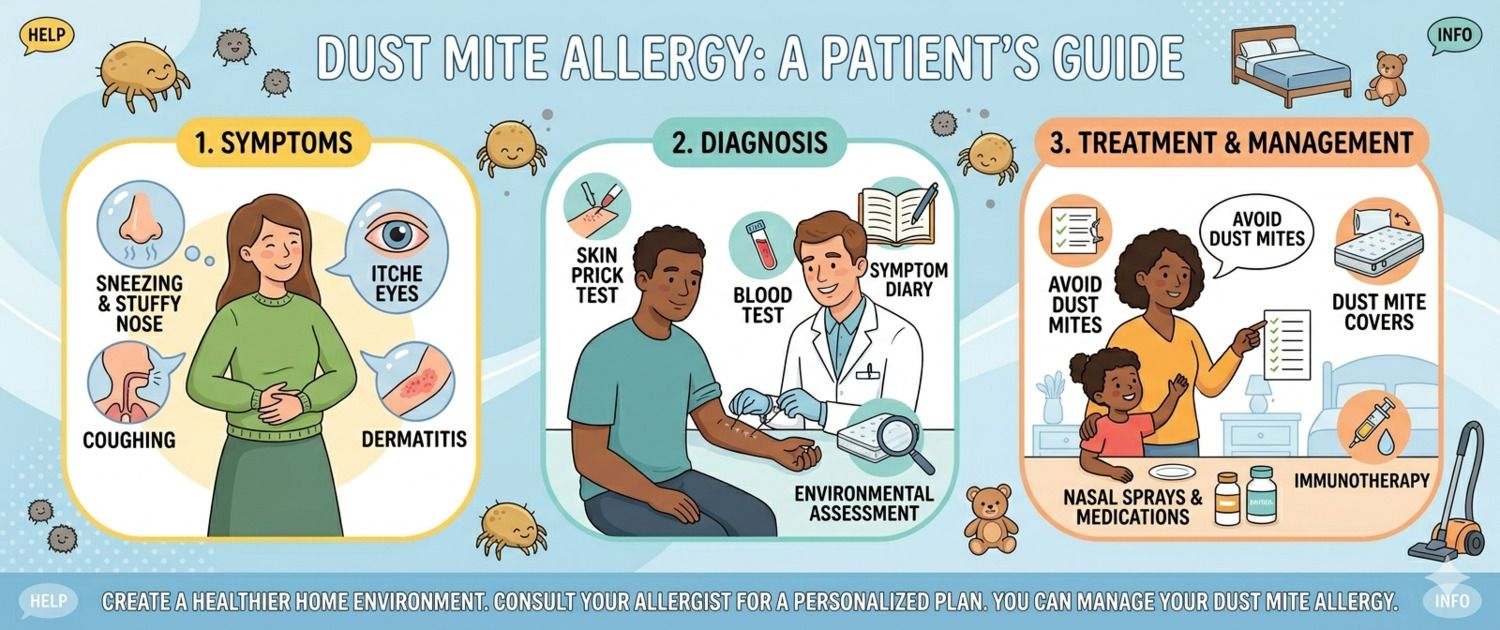
A runny nose and congestion that never lets up, a morning cough the moment you wake up, itchy eyes with no pollen in sight — this is the classic presentation of dust mite allergy. Unlike hay fever, this allergy has no season: it's with you year-round, because the mites live exactly where you do. Let's look at who these mites are, why they're so hard to avoid, and what actually helps.
What Are Dust Mites and Why Do They Cause Allergy
House dust mites are microscopic arachnids 0.1–0.3 mm in size — invisible to the naked eye. The two main species are Dermatophagoides pteronyssinus and Dermatophagoides farinae. They feed on shed skin scales from humans and pets and live wherever organic matter accumulates: mattresses, pillows, duvets, upholstered furniture, carpets, and soft toys.
The allergen is not the mites themselves but their waste products: fecal particles and fragments of dead mites. The main allergen, Der p 1, is a protease that damages the mucosal epithelial barrier, making it easier for allergen to penetrate tissue. This is why mite allergy so commonly progresses to asthma.
Optimal conditions for mites: temperature 20–25°C, humidity above 50%. A standard urban apartment is an ideal habitat.
Symptoms of Dust Mite Allergy
The key difference from hay fever: symptoms are present year-round and worsen indoors, not outside.
Typical signs:
- Morning symptoms — nasal congestion, sneezing, watery eyes immediately on waking: mites are most concentrated in bedding, and exposure is greatest during sleep
- Allergic rhinitis — chronic congestion, watery discharge, nasal itching
- Conjunctivitis — redness, itching, a gritty eye sensation
- Cough and wheezing — with lower airway involvement; some patients develop asthma
- Atopic dermatitis flares — in patients with skin manifestations
A characteristic pattern: symptoms worsen during vacuuming (dust disturbance), changing bedding, in damp rooms, or after moving into a new apartment with carpets.
Diagnosis: Confirming Dust Mite Allergy
Year-round rhinitis symptoms are nonspecific — they must be distinguished from chronic non-allergic rhinitis, nasal polyps, and vasomotor rhinitis. An allergist will order:
- Skin prick tests with mite extract (D. pteronyssinus, D. farinae) — the diagnostic standard. Results in 15–20 minutes. Performed outside flares, at least 2 weeks after stopping antihistamines
- Specific IgE blood test for mite allergens — can be done any time; antihistamines don't affect the result. Especially useful in severe dermatitis when skin tests are not feasible
- Molecular diagnostics (Der p 1, Der p 2, Der p 23) — refines the sensitization profile and helps predict AIT efficacy
- Complete blood count — elevated eosinophils indirectly support an allergic cause
Reducing Mite Exposure: Environmental Control
Complete elimination is impossible, but reducing mite concentrations several-fold is achievable — and this is the only non-drug strategy that works.
The Bedroom — Top Priority
The mattress, pillows, and duvet are the main mite reservoir:
- Allergen-impermeable (encasing) covers for the mattress, pillows, and duvet — reduce allergen load by 80–90%
- Wash bedding at 60°C weekly — temperatures above 55°C kill mites
- Replace feather pillows and duvets with synthetic ones
- Vacuum regularly with a HEPA-filter vacuum — a standard vacuum disperses allergen into the air
The Rest of the Home
- Keep indoor humidity below 50% using a dehumidifier — mites do not survive at low humidity
- Remove carpets (especially from the bedroom) or treat with acaricides
- Remove soft toys or wash them at 60°C
- Wet-dust rather than dry-dust; the allergic person should avoid being present during cleaning
Dust Mite Allergy Treatment: Medications
Environmental control reduces symptoms but does not cure the allergy. Medications manage symptoms:
- Intranasal corticosteroids (mometasone, fluticasone) — most effective for allergic rhinitis; act locally
- Second-generation antihistamines (cetirizine, loratadine, bilastine) — for symptom relief; often taken continuously for year-round allergy
- Eye drops for conjunctivitis
- Bronchodilators and inhaled corticosteroids for asthma — strictly by prescription
Immunotherapy for Dust Mite Allergy — Treating the Cause
Allergen-specific immunotherapy with mite allergens is the only treatment that modifies the immune response rather than suppressing symptoms. The course runs 3–5 years; sublingual drops or tablets (convenient, no injections) or subcutaneous injections are available.
After the first year most patients report a 30–50% symptom reduction; after completing the course many achieve lasting remission and reduced asthma risk.
Mite AIT can be started at any time of year — there is no "season" as with pollen allergy.
When to Seek Urgent Medical Attention
Immediately if: wheezing and breathlessness not relieved by a bronchodilator; progressive throat or lip swelling; sudden severe deterioration after cleaning or changing bedding.
Routine allergist visit: chronic rhinitis persisting 3 or more months; night-time cough and breathing difficulty; suspected asthma; wanting to start AIT.
Summary
Dust mite allergy is chronic but highly manageable. The combination of environmental control, medication, and AIT allows most patients to return to normal quality of life. The key is not to delay diagnosis: the earlier specific treatment starts, the lower the risk of progression to asthma.
Any year-round rhinitis symptoms warrant a consultation with an allergist. Self-treatment for allergy can be unsafe.
For informational purposes only
This article is for informational purposes only and does not constitute medical advice, diagnosis, or treatment. Please consult a healthcare professional for medical guidance.