Allergy: Types, Symptoms, Diagnosis and Modern Treatment
Reviewed by the LabReadAI medical team
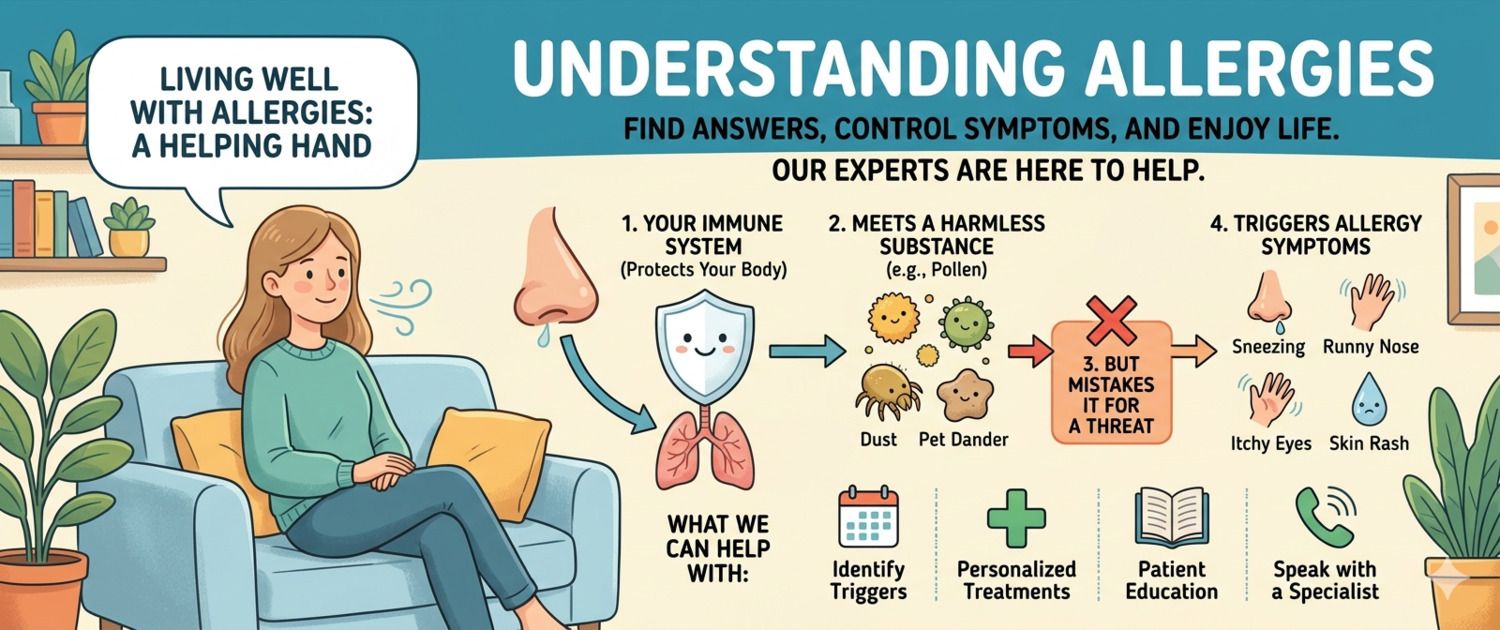
One in three people will have an allergic reaction at some point in their lives — and many find out at the worst possible moment: peak pollen season, a bite of the wrong food, a bee sting. Allergy doesn't give you advance warning, doesn't pick an age, and doesn't go away on its own. But it can be understood, accurately diagnosed, and brought under control. Here's how allergic reactions work, what forms they take, how to identify the trigger, and what modern medicine offers — from antihistamines to immunotherapy.
Why the Immune System Attacks Harmless Substances
Think of the immune system as a security service. In most people it's well-calibrated: it ignores pollen, food proteins, and pet dander, and reacts only to genuine threats like viruses and bacteria. In a person with allergy, this system misfires: it identifies harmless substances as enemies and sounds the alarm.
Allergic disease unfolds in two stages. The first is sensitization: the body encounters an allergen for the first time, remembers it, and produces specific IgE antibodies that anchor themselves to mast cells in the mucous membranes and skin. The person feels nothing. They're simply being prepared for the alarm.
The second stage — the reaction — happens on re-exposure to that same allergen. Mast cells rupture and release histamine and other inflammatory mediators. Histamine is responsible for everything we associate with allergy: swelling, itching, redness, tearing, and bronchospasm.
What triggers this malfunction isn't fully understood. Genetics matter (if both parents have allergies, the child's risk approaches 60–80%), as do early childhood environment and pollution. The "hygiene hypothesis" explains why allergies are more common in developed countries: an immune system that never faces real parasites and infections starts reacting to things it shouldn't.
Allergic reactions fall into two categories by speed. Immediate-type reactions (the majority of allergies) develop within minutes — hay fever, hives, anaphylaxis. Delayed-type reactions develop over hours or days; here it's memory T-cells, not antibodies, doing the work. Contact dermatitis from nickel or latex is the classic example.
Types of Allergy: Pollen, Food, Contact and Drugs
Allergy is not one disease but a family of reactions, classified by how the allergen enters the body.
Inhalant (respiratory) allergy is the most common form. Allergens are inhaled. Seasonal hay fever is the typical presentation — a reaction to tree pollen (birch, alder, hazel), grass pollen (timothy, orchard grass), or weed pollen (ragweed, wormwood). The perennial form involves dust mites, mold spores, and pet dander and saliva — triggers that are present all year.
Food allergy is a reaction to specific food proteins. The top eight culprits — cow's milk, eggs, peanuts, tree nuts, soy, wheat, fish, and shellfish — account for the vast majority of serious food reactions, including anaphylaxis.
Contact allergy is a skin reaction to direct physical contact: metals (nickel in jewelry and denim rivets), latex, cosmetics, household chemicals, certain plants. It always follows the delayed pattern — redness and itching appear 12–48 hours after contact, precisely at the site that touched the allergen.
Drug allergy is a reaction to medications. The most common triggers are penicillin-class antibiotics, NSAIDs (aspirin, ibuprofen), and local anesthetics. The first dose is typically tolerated; the dangerous reaction comes with re-exposure.
Insect venom allergy is a reaction to the venom of stinging insects — bees, wasps, hornets. In sensitized individuals, a single sting can cause anaphylaxis.
| Type | Common Allergens | Main Symptoms |
|---|---|---|
| Respiratory | Pollen, dust mites, mold, dander | Runny nose, sneezing, conjunctivitis, cough, wheeze |
| Food | Milk, eggs, nuts, fish | Hives, lip/tongue swelling, abdominal pain, vomiting |
| Contact | Nickel, latex, cosmetics | Redness, itching, blisters at site of contact |
| Drug | Antibiotics, NSAIDs, anesthetics | Rash, hives, angioedema, anaphylaxis |
| Insect venom | Bee/wasp venom | Local swelling, hives, anaphylaxis |
Allergy Symptoms: From a Runny Nose to Anaphylactic Shock
Allergy is good at disguising itself. It mimics a cold, food poisoning, or atopic dermatitis — and often goes unrecognized for years. The key to identifying it is pattern: symptoms appear with contact to a specific substance and disappear when contact ends.
Mild to moderate allergy targets the mucous membranes and skin. The nose responds with paroxysmal sneezing, watery discharge, and persistent itching. The eyes redden, tear, and itch — allergic conjunctivitis. The skin develops hives (raised, intensely itchy welts) or dry, scaly patches. Food allergy adds nausea, cramping, and diarrhea.
Anaphylaxis is a severe systemic reaction that develops within one to two minutes and is life-threatening. The airways narrow from bronchospasm or throat swelling, blood pressure collapses, and consciousness is lost. The most common triggers are insect venom, peanuts, latex, and medications.
How do you tell allergy from a cold? A cold brings fever, sore throat, and body aches — and resolves in five to seven days. Allergy produces no fever; its symptoms are tied to a specific situation (stepped outside on a windy day — symptoms started; came back indoors — gone), and seasonal allergy returns at exactly the same time each year.
How to Identify the Trigger: Skin Tests and IgE Blood Tests
Guessing the culprit on your own is nearly impossible — there are thousands of potential allergens, and different allergy types share similar symptoms. An allergist has two main diagnostic tools.
Skin prick tests are fast and direct. Small drops of allergen extracts are placed on the forearm, and a lancet makes a tiny prick through each drop. After fifteen to twenty minutes, positive reactions show as a wheal with surrounding redness. The advantage is same-day results; the limitation is that tests can't be done during a flare-up, in pregnancy, in young children, or while taking antihistamines — these need to be stopped five to seven days beforehand.
Specific IgE blood tests (ImmunoCAP, immunoblot) are more flexible. They measure IgE antibody levels to specific allergens in serum and can be done at any time of year, during or outside of symptoms, without stopping antihistamines. The laboratory checks whole panels: inhalant allergens (pollen, dust, animals), food allergens, or pediatric panels.
As a supporting marker of allergic inflammation, doctors look at the complete blood count: elevated eosinophils in the differential point toward an active allergic process. This finding doesn't establish a diagnosis on its own, but it helps confirm the allergic nature of symptoms and track their activity over time.
For suspected contact allergy, patch tests are used: adhesive panels loaded with allergens are applied to the back for forty-eight hours and the skin reaction is read.
How Allergy Is Treated: Antihistamines, Steroids and Immunotherapy
Treatment works on three levels. Only their combination produces lasting results.
Elimination: Remove Contact with the Allergen
The most reliable approach is removing the cause of the reaction. For hay fever that means staying indoors on dry, windy days, running HEPA air filters at home, rinsing the nose with saline after outings, and wearing wraparound sunglasses. For food allergy it means reading every ingredient label. For contact allergy it means letting go of nickel jewelry and switching away from latex gloves. The principle is simple; the practice requires rebuilding habits.
Drug Therapy
Second-generation antihistamines (cetirizine, fexofenadine, bilastine, desloratadine) are the first-line treatment for any form of allergy. They don't cause drowsiness, last up to twenty-four hours, and are safe for extended daily use. For hay fever, starting two weeks before the expected bloom produces a noticeably better effect than waiting for symptoms.
Intranasal corticosteroids (mometasone, fluticasone) are the most effective way to control swelling and congestion in allergic rhinitis. They act locally and are barely absorbed into the bloodstream. The effect builds gradually over several days of regular use.
Eye drops (azelastine, olopatadine) target allergic conjunctivitis directly. Cromones are weaker than steroid sprays but work well as preventive treatment for mild seasonal rhinitis.
Severe allergic disease may require short courses of systemic corticosteroids, prescribed and monitored by a doctor. For anyone with a history of anaphylaxis, carrying an epinephrine auto-injector is not optional — administering it within the first minutes of a reaction is the difference between life and death.
Allergen Immunotherapy — the Only Treatment That Changes the Disease
Allergen-specific immunotherapy (AIT) doesn't suppress symptoms — it changes how the immune system responds to the allergen in the first place. Patients receive gradually increasing doses of their specific allergen (as sublingual drops or injections), slowly training the immune system to stop treating it as a threat. The full course takes three to five years. Most patients see a fifty to seventy percent symptom reduction in the first year; many achieve years-long remission after completing the course.
AIT is indicated for hay fever, dust mite allergy, and insect venom allergy. It's started only during remission — outside the season and outside a flare. The approach also carries a meaningful secondary benefit: it slows the "atopic march," the progression from allergic rhinitis toward asthma.
Cross-Reactivity: When There's More Than One Trigger
Cross-reactivity baffles many patients. The logic is straightforward: if the protein structure of one allergen resembles the structure of another, the immune system reacts to both.
The most well-known example is birch allergy. Its main protein, Bet v 1, closely resembles proteins found in apples, pears, peaches, cherries, carrots, celery, and hazelnuts. During the birch season, many patients notice itching in the mouth and tingling in the throat after eating fresh fruit — this is oral allergy syndrome. Heat destroys the allergenic protein, which is why cooked carrots are usually fine while raw ones trigger a reaction.
Similar chains exist with ragweed (cross-reacts with banana, melon, and cucumber), latex allergy (avocado, banana, kiwi), and cat allergy (some cuts of pork). The longer allergy goes untreated, the wider the list of cross-reactive triggers tends to grow — another reason early diagnosis and treatment matter.
When to Seek Emergency Care
Call emergency services immediately if, after contact with a possible allergen, you or someone nearby develops:
- Difficulty breathing, wheezing, or a feeling of suffocation.
- Swelling of the lips, tongue, or throat — with the risk of airway obstruction.
- A sudden drop in blood pressure, severe dizziness, or loss of consciousness.
- Widespread hives across the body combined with any of the above.
This is anaphylaxis. The only effective immediate step is epinephrine. Every minute matters.
A routine appointment with an allergist is warranted if symptoms recur with contact to the same substance, if antihistamines stop providing adequate relief, or if you want a full workup and are considering immunotherapy.
Conclusion
Allergy is not something to simply live with. Without treatment it tends to progress: the list of triggers expands, reactions intensify, and the risk of asthma rises. Modern allergology can not only suppress symptoms but retrain the immune response — and that's exactly what immunotherapy is designed to do. The earlier an accurate diagnosis is established, the greater the chances of reclaiming a normal quality of life.
In children allergy most often shows on the skin — telling it from infectious rash is covered in rash in children.
The first trace of allergy is often found on an ordinary blood count taken for an entirely different reason: a line reporting high eosinophils is a common prompt to think of an allergist for the first time. The neighbouring line behaves more quietly: high basophils can also echo an allergic reaction, though their range of causes is wider.
This article is for informational purposes only. Allergy diagnosis and treatment planning are carried out by a licensed allergist.
For informational purposes only
This article is for informational purposes only and does not constitute medical advice, diagnosis, or treatment. Please consult a healthcare professional for medical guidance.