Ragweed Allergy: Symptoms, Cross-Reactivity and Treatment
Reviewed by the LabReadAI medical team
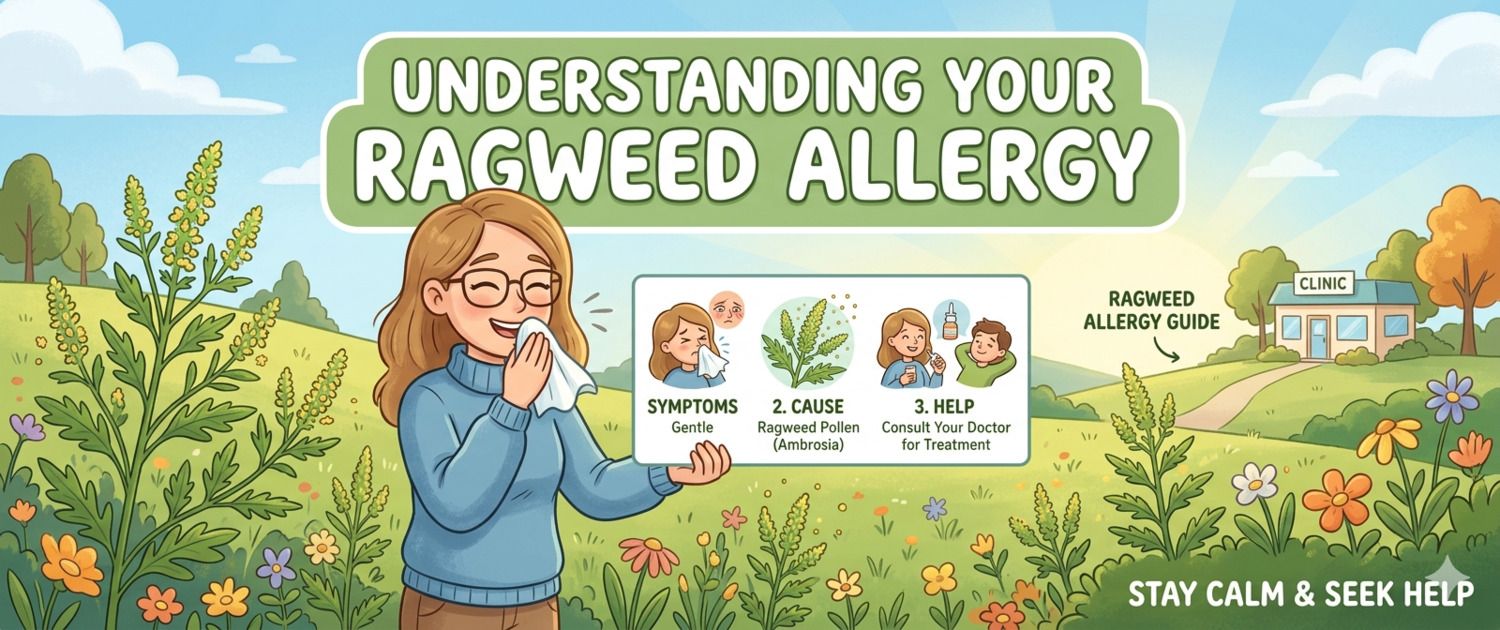
If every August brings relentless sneezing, watery eyes, and a cough that won't quit — ragweed is likely the cause. This invasive weed has become the primary allergological quarantine plant: its pollen is so fine and light that it travels 400 or more kilometres on the wind — causing symptoms in regions where ragweed doesn't even grow. Let's look at why ragweed is so aggressive, which foods trigger cross-reactions, and what to do about it.
Why Ragweed Causes Allergy
Ragweed (Ambrosia) belongs to the daisy family (Asteraceae) — the same family as wormwood. Its main allergen is Amb a 1, one of the most potent plant allergens known: its sensitising capacity significantly exceeds that of birch's Bet v 1. This is why ragweed allergy often follows a more severe course than birch hay fever.
A single ragweed plant produces up to one billion pollen grains per season. The grains are extremely small — 18–22 µm — and travel on wind for 400–700 kilometres. This means people in cities where ragweed doesn't grow can suffer symptoms during its flowering season in neighbouring regions. Peak airborne pollen concentrations occur in the morning hours on dry, windy days.
Ragweed is an invasive species that has expanded its range significantly over recent decades — growing on wastelands, roadsides, and near residential buildings, making avoidance difficult.
Ragweed Flowering Season
Ragweed blooms from late July through October, peaking in August–September. This is one of the latest pollen seasons, ending with the first frosts.
Important context: the ragweed season overlaps with wormwood and late grass pollens. Patients sensitised to all three may have uninterrupted hay fever from June through October. This polysensitised group benefits most from early AIT.
Symptoms of Ragweed Allergy
The clinical picture does not differ from other hay fevers, but is often more intense due to the high allergenicity of Amb a 1.
Allergic rhinitis — abundant clear discharge, paroxysmal sneezing, nasal congestion, nasal and palatal itch. In severe cases — near-complete blockage, postnasal drip, headache.
Allergic conjunctivitis — redness, itch, tearing, gritty eye sensation, light sensitivity. In some patients conjunctivitis dominates over nasal symptoms.
Bronchospasm — in 30–40% of ragweed-allergic patients, asthma develops or worsens. Ragweed is one of the most common pollen triggers for asthma.
General symptoms — marked fatigue, reduced productivity, sleep disruption from constant congestion. In severe cases, significantly impaired quality of life for 2–3 months a year.
Characteristic pattern: symptoms worsen in the morning and in dry, windy weather; ease after rain and indoors with windows closed and an air purifier running.
Cross-Reactivity: The Ragweed–Melon–Banana Syndrome
Food cross-reactivity in ragweed pollinosis involves a distinctive set of foods. The main mechanism is structural similarity between Amb a 1 and proteins of certain fruits and vegetables — primarily cucurbits and bananas.
| Group | Foods |
|---|---|
| Asteraceae | Wormwood, chrysanthemum, chamomile, sunflower, Jerusalem artichoke |
| Cucurbits | Melon, watermelon, cucumber, courgette, pumpkin |
| Bananas | Banana |
| Other | Avocado, kiwi, peaches (via panallergen), honey from Asteraceae |
Reactions present as oral allergy syndrome: itching, burning, and tingling in the mouth, lips, and throat within minutes of eating raw foods. Usually mild and brief.
A distinctive feature of ragweed cross-reactivity: reactions to melon are the most common and can be pronounced. In some patients — not only oral syndrome but urticaria or swelling. Heat destroys most cross-reactive proteins — cooked or processed versions of listed foods are usually well tolerated.
Diagnosing Ragweed Allergy
Skin prick tests with ragweed pollen extract — the diagnostic standard. Performed outside the season, at least 2 weeks after stopping antihistamines. Wormwood and grasses are often tested simultaneously — co-sensitisation to autumn allergens is very common.
Specific IgE blood test for Amb a 1 — done any time of year. Advantage over prick testing: unaffected by antihistamine use, safe in severe atopic dermatitis.
Molecular diagnostics (Amb a 1, Amb a 8, Amb a 11) — refines the sensitisation profile. Amb a 8 is a profilin (panallergen), linked to reactions across a wide range of plants. Amb a 11 is a cysteine protease associated with more severe reactions.
Complete blood count — elevated eosinophils indirectly confirm allergic inflammation, particularly notable during the flowering season.
Treatment of Ragweed Allergy
Reducing Pollen Exposure
- During the season, avoid outdoor activity in the morning (6–10 am) on dry, windy days
- Keep windows closed; use a HEPA air purifier
- After every outing: shower, rinse nose with saline, change clothes
- Monitor pollen count maps — on high-concentration days, limit outdoor time
- Wear wraparound sunglasses
- When travelling: in southern regions ragweed concentrations peak in August–September
Medication
Second-generation antihistamines (cetirizine, fexofenadine, bilastine) — start 1–2 weeks before the expected season; take daily throughout the flowering period.
Intranasal corticosteroids (mometasone, fluticasone) — most effective for rhinitis; start 2 weeks before the season.
Antileukotriene agents (montelukast) — when rhinitis is combined with asthma.
Eye drops (azelastine, olopatadine) — for significant conjunctivitis.
AIT for Ragweed Allergy
Allergen-specific immunotherapy with ragweed allergen is the only treatment that modifies the immune response rather than suppressing symptoms. Sublingual or subcutaneous forms; course 3–5 years. Most patients report 40–70% symptom reduction after the first year.
AIT is started during remission — in winter or spring, at least 3 months before the expected bloom. With co-sensitisation to ragweed and wormwood, an allergist may prescribe AIT targeting both allergens simultaneously.
A distinctive benefit of ragweed AIT: in some patients, cross-reactive food reactions to melon and banana also diminish — an additional effect of specific therapy.
When to Seek Urgent Medical Attention
Immediately if: difficulty breathing or wheezing; swelling of lips, tongue, or throat; sudden drop in blood pressure, loss of consciousness — signs of anaphylaxis.
Routine allergist visit: symptoms recur every summer-autumn and reduce quality of life; antihistamines no longer provide adequate relief; reactions to melon, banana, or other cross-reactive foods have appeared; you want to start AIT.
Summary
Ragweed allergy is among the most severe hay fevers in terms of symptom intensity and season length. AIT offers a real path to remission — with particularly strong evidence for ragweed. If hay fever is complicated by co-sensitisation to wormwood and grasses, evaluation should begin as early as possible — not at the start of the next season. For more on allergy mechanisms, see the complete allergy guide.
This article is for informational purposes only. Interpretation of test results and treatment decisions are the responsibility of a physician.
For informational purposes only
This article is for informational purposes only and does not constitute medical advice, diagnosis, or treatment. Please consult a healthcare professional for medical guidance.