Grass Pollen Allergy: Symptoms, Diagnosis and Treatment of Hay Fever
Reviewed by the LabReadAI medical team
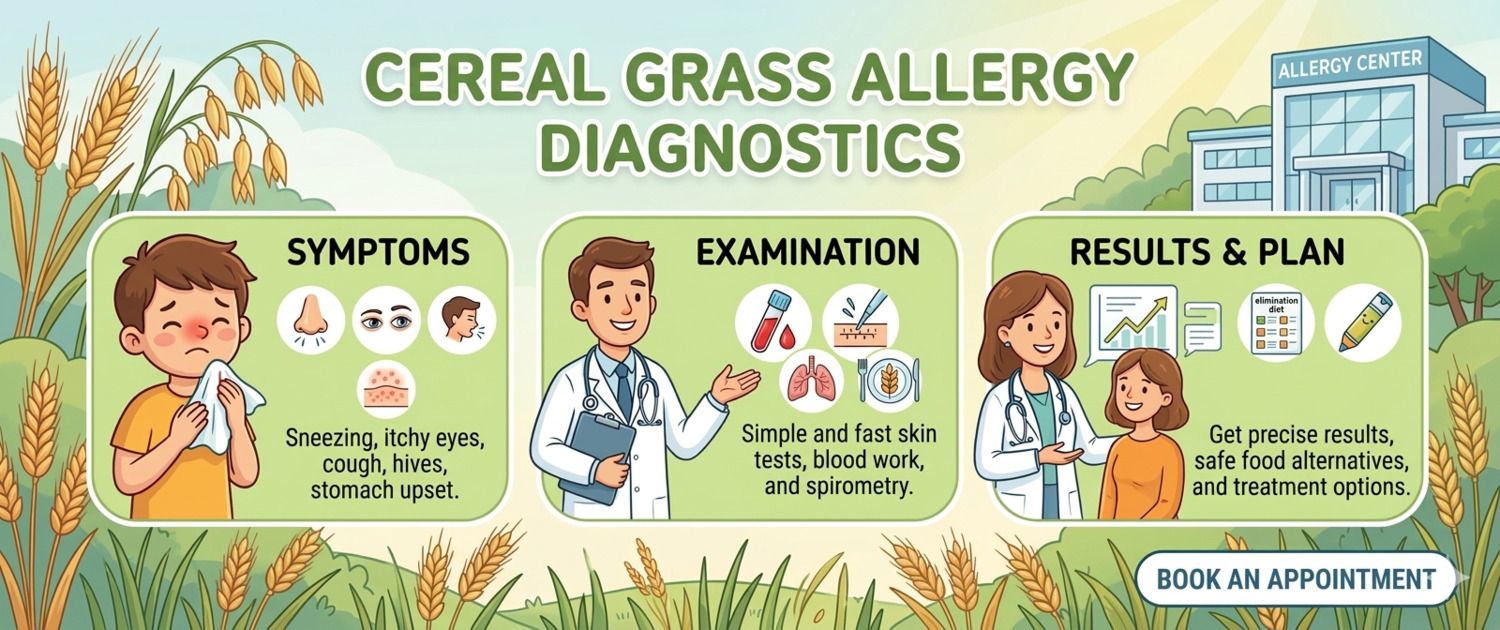
Sneezing and watery eyes in June that arrive like clockwork every year — most likely grass pollen allergy. It is the second most common hay fever in temperate climates: grasses surround us everywhere — lawns, meadows, roadsides, parks. Let's look at exactly which grasses are responsible, why one positive test covers the entire family, and how to treat this hay fever effectively.
Which Grasses Cause Allergy
The grass family (Poaceae/Gramineae) contains thousands of species, most of which produce allergenic pollen. The most clinically relevant in temperate climates:
- Timothy grass (Phleum pratense) — the "gold standard" for diagnosis and AIT product manufacturing. Its allergens Phl p 1 and Phl p 5 cross-react with equivalent proteins in all grass species
- Cocksfoot / orchard grass (Dactylis glomerata) — an early-flowering grass that opens the season
- Rye (Secale cereale) — one of the most allergenic grasses
- Kentucky bluegrass / meadow grass (Poa pratensis)
- Meadow fescue (Festuca pratensis)
- Meadow foxtail (Alopecurus pratensis)
- Perennial ryegrass (Lolium perenne) — especially relevant in Western Europe
Key fact: all grasses cross-react with each other. A patient sensitised to timothy grass reacts to rye, cocksfoot, bluegrass, and all other grass pollens. This is why testing one or two species is sufficient for diagnosis — there is no need to test all two hundred.
The primary allergen is Phl p 1 (β-expansin): present in all grass pollens and cross-reactive in 95% of grass-allergic patients. Phl p 5 is the second most important — more specific to timothy.
Grass Pollen Season
Grasses flower from late April through July, peaking in May–June. Exact timing depends on climate zone and weather: a warm spring advances the season.
Important context: the grass season begins as the birch pollen season ends. Patients allergic to both birch and grasses may have uninterrupted hay fever from late March through July. At the end of the grass season, wormwood and ragweed begin. Polysensitised patients can suffer throughout virtually the entire warm season.
Peak airborne grass pollen concentrations occur in the morning hours (6–11 am) on dry, windy days. After rain and in overcast weather, concentrations are minimal.
Symptoms of Grass Pollen Allergy
The clinical picture of grass pollinosis is typical of seasonal allergic rhinitis, but often intense due to high airborne pollen concentrations.
Allergic rhinitis — paroxysmal sneezing in runs, abundant clear nasal discharge, congestion, nasal and soft palate itch. In some patients, congestion dominates over rhinorrhoea.
Allergic conjunctivitis — redness, burning, itch, tearing, a "gritty" eye sensation. Often as prominent as rhinitis.
Bronchospasm — in patients with asthma or predisposition to it. Grass pollen is one of the leading triggers of summer asthma.
Contact reactions — skin itch and redness with direct grass contact (walking barefoot through grass, mowing, lying on a lawn).
Systemic symptoms — fatigue, headache, reduced concentration, sleep disruption. Quality of life can fall significantly at peak season.
Characteristic pattern: symptoms worsen in the morning, intensify outdoors in windy weather and during grass cutting, ease after rain and indoors with windows closed.
Cross-Reactivity in Grass Pollinosis
Food cross-reactivity in grass pollinosis is less pronounced than in birch or ragweed allergy, but present in some patients.
The main mechanism is the panallergen Phl p 12 (profilin): a structurally conserved cytoskeletal protein present in all eukaryotic cells. Profilin is associated with reactions to a wide range of foods, but reactions are usually mild (oral allergy syndrome).
| Group | Foods |
|---|---|
| Grains | Wheat, rye, barley, oats (raw or as bran) |
| Vegetables | Tomatoes, potatoes, peppers |
| Legumes | Peanuts (via profilin) |
| Fruits | Melon, watermelon (via profilin) |
| Other | Grass herbal teas |
Important: reactions to grain foods (bread, pasta, porridge) in grass-pollen patients are rare. Cooking destroys profilin. Grass pollen allergy and gluten intolerance (coeliac disease) are entirely different mechanisms with no connection between them.
Diagnosing Grass Pollen Allergy
Skin prick tests with a grass mix or timothy (Phleum pratense) — the diagnostic standard. One positive test on any grass confirms allergy to the entire family. Performed outside the season, at least 2 weeks after stopping antihistamines.
Specific IgE blood test for Phl p 1 and Phl p 5 — done any time of year, regardless of antihistamine use. Particularly valuable when prick testing is not possible (severe atopic dermatitis, beta-blocker therapy).
Molecular diagnostics (Phl p 1, Phl p 2, Phl p 4, Phl p 5, Phl p 12) — refines sensitisation profile. High Phl p 1 and/or Phl p 5 — specific grass sensitisation, good AIT response predicted. Isolated Phl p 12 (profilin) elevation — panallergen, less specific, poorer AIT response.
Complete blood count — elevated eosinophils during peak season indirectly confirm allergic inflammation.
Treatment of Grass Pollen Allergy
Reducing Pollen Exposure
- During flowering (May–June), avoid outdoor activity in the morning (6–11 am) on dry, windy days
- Keep windows closed; use a HEPA air purifier
- After every outing: shower, rinse nose with saline, change clothes
- Avoid walking through long grass and being present during lawn mowing
- Monitor pollen count forecasts and adjust outdoor plans accordingly
- Wear wraparound sunglasses
Medication
Second-generation antihistamines (cetirizine, fexofenadine, bilastine, loratadine) — start 1–2 weeks before expected bloom; take daily throughout the season.
Intranasal corticosteroids (mometasone, fluticasone) — most effective for rhinitis; start 2 weeks before the season; effect builds gradually.
Eye drops (azelastine, olopatadine, cromoglicate) — for significant allergic conjunctivitis.
Antileukotriene agents (montelukast) — when rhinitis is combined with asthma.
AIT for Grass Pollen Allergy
AIT with grass allergens is the only treatment that modifies the underlying immune response. Course: 3–5 years; sublingual drops or tablets (no injections needed) or subcutaneous injections.
Grass AIT has the strongest evidence base of any allergen-specific immunotherapy: sublingual timothy tablets are among the best-studied AIT products available. After the first year most patients report 30–50% symptom reduction; after a full course — lasting multi-year remission.
AIT is started during remission — in autumn or winter, at least 4 months before the expected bloom. With co-sensitisation to grasses and birch, an allergist may prescribe AIT targeting both allergens simultaneously.
When to Seek Urgent Medical Attention
Immediately if: difficulty or wheezing breathing; swelling of lips, tongue, or throat; sudden blood pressure drop, loss of consciousness.
Routine allergist visit: symptoms recur every summer and reduce quality of life; antihistamines no longer provide adequate relief; asthma symptoms have appeared; you want to start AIT.
Summary
Grass pollen allergy is one of the most manageable hay fevers: AIT with timothy grass has the strongest evidence base of any pollen immunotherapy, and sublingual tablets make treatment highly convenient. All grasses cross-react — a positive test for one species means allergy to the entire family. With co-sensitisation to grasses, birch, wormwood, and ragweed — AIT planning should begin as early as possible. For more on allergy mechanisms, see the complete allergy guide.
This article is for informational purposes only. Interpretation of test results and treatment decisions are the responsibility of a physician.
For informational purposes only
This article is for informational purposes only and does not constitute medical advice, diagnosis, or treatment. Please consult a healthcare professional for medical guidance.