White Blood Cells (WBC): Normal Range, Causes of High and Low Count
Reviewed by the LabReadAI medical team
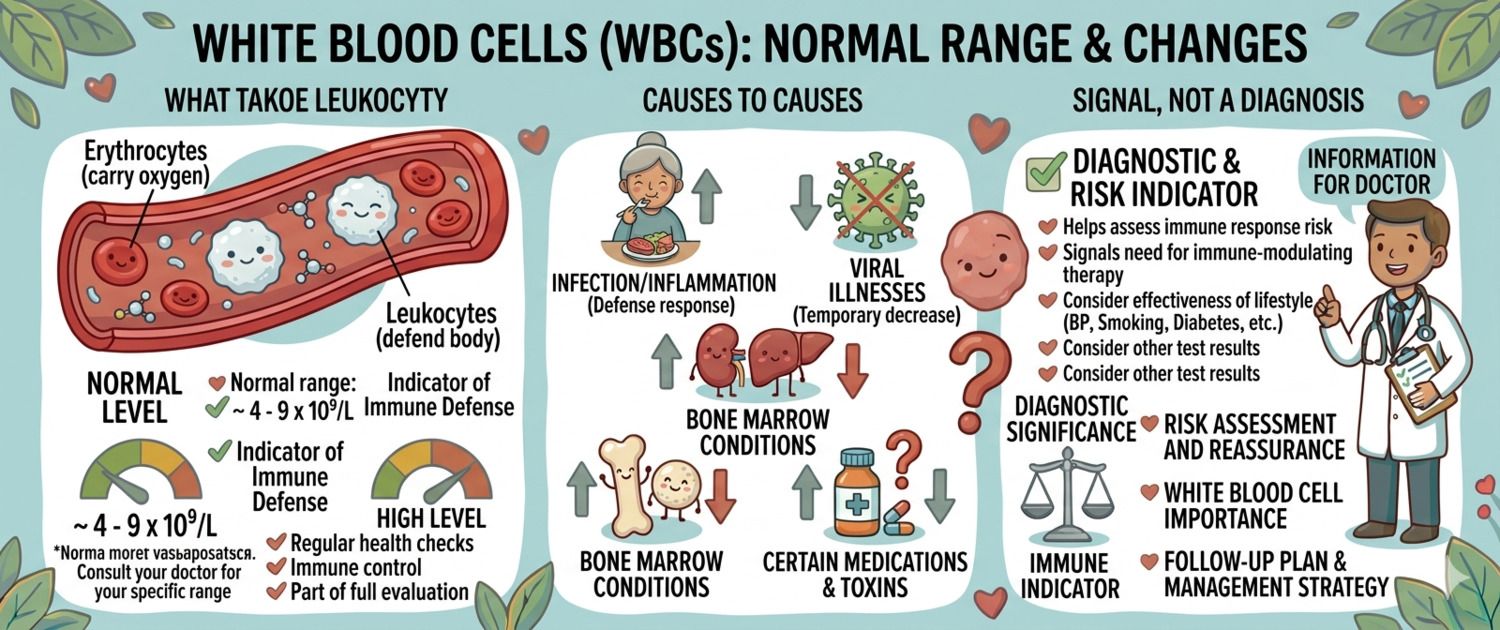
If you open a complete blood count and immediately look for "high or low" — you're probably checking the white blood cells. Their level and composition directly reflect what's happening in the immune system right now. Here's what the normal range looks like, how to read the differential, and what abnormalities in either direction mean.
What Are White Blood Cells and How Do They Work
White blood cells (leukocytes) are immune system cells. They identify bacteria, viruses, fungi, and parasites, destroy them, and remove damaged cells. Unlike red blood cells, WBCs don't just drift through the bloodstream — they actively migrate to sites of inflammation, engulf foreign particles, and coordinate the immune response.
Blood is just the transit route. The actual work happens in the tissues: lymph nodes, liver, spleen, and mucous membranes. So the WBC count in blood is a visible fraction of the immune response — not the whole picture.
Normal WBC Count in Adults
Total white blood cells (WBC): 4.0–9.0 × 10⁹/L.
WBC levels are not constant — they fluctuate by 15–20% throughout the day. After eating, during stress, or after exercise they temporarily rise. That's why the test is done fasting in the morning in a rested state.
Special cases: in the 2nd–3rd trimester of pregnancy, WBC physiologically rises to 10–12 × 10⁹/L. In newborns and children, normal ranges are higher than in adults.
Normal WBC in Children by Age
Children's ranges are noticeably wider and higher than adults' — "leukocytosis" by the adult chart often turns out to be a child's age norm. The ranges are approximate:
| Age | Normal (× 10⁹/L) |
|---|---|
| Newborns | 9–30 |
| 1 month | 6–19 |
| 6–12 months | 6–17.5 |
| 1–6 years | 5–15.5 |
| 6–12 years | 4.5–13.5 |
| 12–18 years | 4.5–13 |
The second pediatric peculiarity is the differential: in toddlers lymphocytes normally dominate over neutrophils, and the ratio "crosses over" twice with age (around day 4–5 of life and at 4–5 years). These crossovers are exactly what scares parents reading adult charts. A child's report should be read as a whole against age-specific ranges — you can upload it and get every marker explained on the child lab test decoding page.
CBC Differential: What Each Cell Type Means
The total WBC count is just the first level. The differential — the percentage breakdown of white blood cell types — tells you far more. Each type has a specific job, and the composition points to the nature of what's happening.
| Cell type | Normal (%) | Function |
|---|---|---|
| Segmented neutrophils | 47–72 | Kill bacteria and fungi |
| Band neutrophils | 1–6 | Immature forms — few in normal blood |
| Lymphocytes | 18–40 | Viral immunity, immune memory |
| Monocytes | 2–9 | Phagocytosis, cellular clean-up |
| Eosinophils | 0.5–5 | Allergic reactions, parasites |
| Basophils | 0–1 | Allergic response mediators |
Left Shift and Right Shift
Left shift — band neutrophils above 6%, sometimes with even more immature forms (metamyelocytes, myelocytes). It signals acute bacterial infection: the body urgently releases immature cells. The more pronounced the shift, the more severe the infection.
Right shift — hypersegmented neutrophils (5 or more lobes). Characteristic of B12 or folate deficiency, chronic kidney disease, or radiation exposure.
Blast cells — immature blood cell precursors that normally remain in the bone marrow. Their presence in peripheral blood is an alarming sign requiring immediate exclusion of leukemia.
High WBC: Causes of Leukocytosis
Leukocytosis (WBC > 9.0 × 10⁹/L) means the immune system is activated. The differential tells you what's driving it:
- Neutrophilia with left shift — acute bacterial infection (pneumonia, pyelonephritis, appendicitis, abscess, sepsis). The more pronounced the shift, the more severe the process.
- Lymphocytosis — viral infection (flu, mononucleosis, COVID-19, chickenpox) or chronic infections (tuberculosis).
- Eosinophilia — allergic reactions, parasitic infestations, certain medications. Eosinophils above 15% warrant a parasitology workup.
- Monocytosis — chronic inflammatory diseases, autoimmune conditions, recovery phase after infections.
- WBC > 30 × 10⁹/L — leukemia must be ruled out, urgent hematology referral.
Physiological leukocytosis (temporary, no pathology): after eating, exercise, stress, in the 2nd–3rd trimester of pregnancy, post-surgery.
Low WBC: Causes of Leukopenia
Leukopenia (WBC < 4.0 × 10⁹/L) reduces immune defense and increases vulnerability to infections. The lower the count, the more serious the risk.
- Viral infections — flu, hepatitis A and B, HIV, rubella. Viruses can directly suppress WBC production in the bone marrow.
- Medications — chemotherapy agents, certain antibiotics, thyroid drugs, NSAIDs, antipsychotics. Drug-induced leukopenia is common and usually reversible.
- Autoimmune diseases — systemic lupus erythematosus, Felty's syndrome in rheumatoid arthritis.
- Bone marrow disorders — aplastic anemia, myelodysplasia, leukemia.
- B12 and folate deficiency — impairs production of all blood cells.
Leukopenia can be asymptomatic but significantly raises the risk of serious infections that a healthy person would handle easily.
When to Seek Urgent Medical Attention
Mild fluctuations (9–12 × 10⁹/L or 3–4 × 10⁹/L) without symptoms call for a routine visit. Don't delay when:
- WBC > 30 × 10⁹/L — rule out leukemia, urgent hematology referral
- WBC < 1.0 × 10⁹/L — critically low immunity
- Blast cells in the differential — hematologist the same day
- Leukopenia + fever — the body can't fight infection properly
- Simultaneous drop in WBC, hemoglobin, and platelets (pancytopenia) — emergency
Conclusion
White blood cells aren't just "immunity" — they're a complex system of five different cell types, each responding to a different threat. A rise or fall in total WBC is only the first signal. The differential answers: what is actually happening — bacteria or virus, inflammation or allergy, acute or chronic process.
Leukocytosis or leukopenia is a symptom, not a diagnosis. The same result can reflect a simple infection or a blood disease. Always have it interpreted by a doctor.
For informational purposes only
This article is for informational purposes only and does not constitute medical advice, diagnosis, or treatment. Please consult a healthcare professional for medical guidance.