Enterobiasis (Pinworms): Symptoms, Diagnosis and Treatment
Reviewed by the LabReadAI medical team
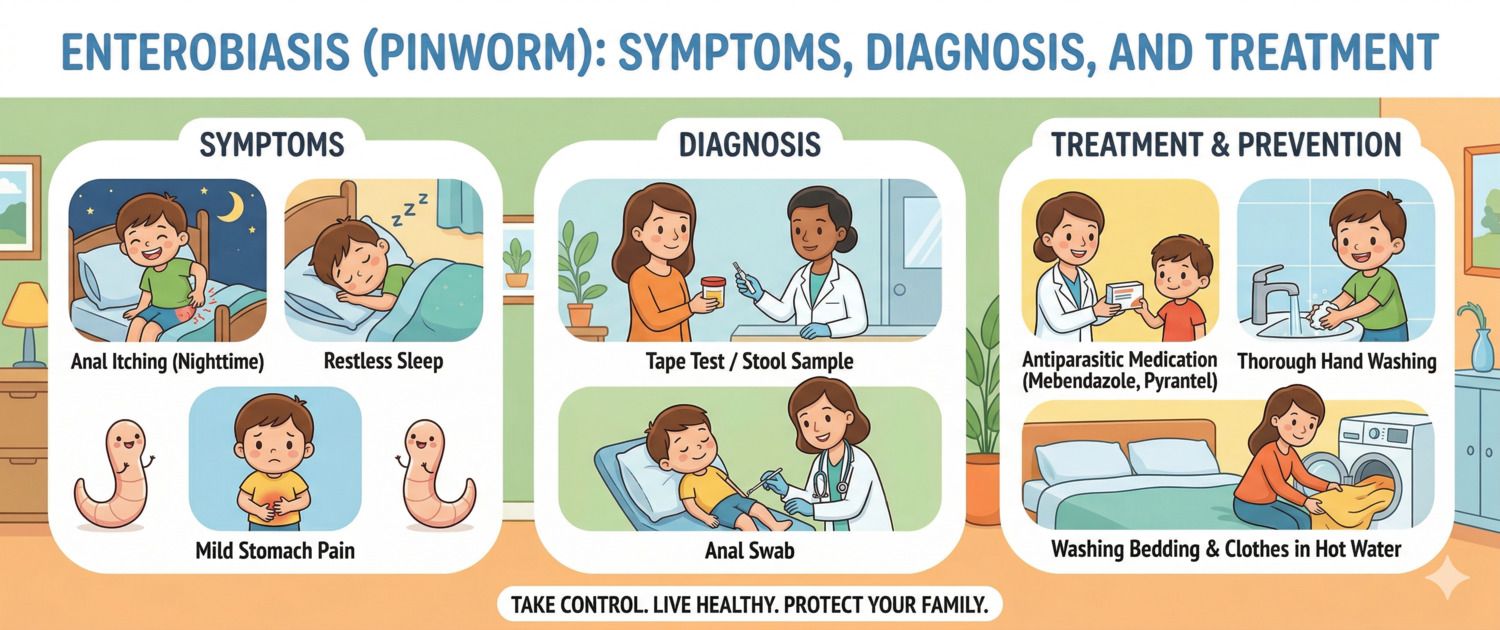
Nocturnal itching in a child, restless sleep, irritability without obvious cause — parents often spend weeks searching for an explanation, not suspecting that a worm a few millimetres long could be responsible. Enterobiasis is the world's most common helminthic infection: according to the WHO, hundreds of millions of people are infected, most of them preschool and school-age children. The good news: it responds well to treatment. The difficult part — it comes back very easily without strict preventive measures.
What Pinworms Are and How They Live in the Body
The pinworm (Enterobius vermicularis) is a small white roundworm. Females reach 9–13 mm in length; males, 2–5 mm. They live in the lower small intestine and upper large intestine, clinging to the mucous membrane.
The pinworm life cycle is simple — and that is precisely what makes it so persistent. At night, the fertilised female migrates out through the rectum and deposits thousands of eggs in the perianal folds. Eggs become infectious within 4–6 hours and can remain viable in the environment for up to three weeks. The entire cycle from egg to adult takes 3–4 weeks.
Adult pinworms live for about three months. Without reinfection, the infestation would theoretically resolve on its own. In practice, reinfection almost always occurs — via hands, bed linen, and household objects.
How Enterobiasis Spreads
The route of transmission is faecal-oral and contact-based. Pinworm eggs from the perianal skin transfer to hands during scratching, then to objects, toys, door handles, bed linen and food — and from there into another person's mouth.
Pinworms are among the most contagious of all helminths. Only a few eggs are needed to establish infection. This is why:
- in children's settings (nursery, school) enterobiasis spreads extremely rapidly
- when one family member is infected, the rest are typically infected too
- self-reinfection (autoinfection) occurs constantly when a child scratches the itchy area and immediately puts their hands in their mouth
Adults are infected less frequently but are not immune — especially those in close contact with infected children.
Symptoms of Enterobiasis
The primary and most characteristic symptom is perianal itching, which intensifies in the evening and at night. This is precisely when females emerge to deposit eggs, causing local irritation.
Other symptoms:
- Sleep disturbance — difficulty falling asleep, frequent waking, restlessness
- Irritability and mood changes — a consequence of chronic sleep disruption
- Teeth grinding (bruxism) — the link is unproven but frequently reported
- Bedwetting (enuresis) — particularly in girls: pinworms can migrate to the perineal and urinary tract area, causing irritation
- Abdominal pain — cramping, often in the right iliac region
- Reduced appetite, nausea — with heavy infestation
- Visible pinworms — thin white threads a few millimetres long, visible on inspection of the perianal area at night or early morning
With light infestation, symptoms may be minimal or absent. Some studies associate chronic enterobiasis with reduced concentration and school performance in children.
Diagnosis: How to Confirm Infection
Clinical symptoms support suspicion but cannot confirm enterobiasis. Confirmation requires laboratory testing.
Perianal swab — the primary diagnostic method. Material is collected from the perianal folds in the morning before any hygiene or toilet visit, using adhesive tape (Scotch tape test) or a cotton swab. Detailed collection and interpretation rules are covered in the enterobiasis test article. A general overview of all the methods is in the article on testing for worms and parasites.
Importantly: a single swab detects infection in only about 50% of cases. When symptoms are present, three tests on consecutive or alternate days are recommended — sensitivity of this protocol exceeds 95%.
Stool test for helminth eggs is not suitable for diagnosing enterobiasis: pinworms deposit eggs outside the bowel, not inside it. Eggs are rarely and only incidentally found in stool.
A full blood count may show mild eosinophilia — elevated eosinophils. This is an indirect sign of parasitic infection but is non-specific and does not replace the swab.
Treatment of Enterobiasis
Treatment is pharmacological and highly effective. Anthelmintic drugs from the benzimidazole group (mebendazole, albendazole) or pyrantel are used. Each drug has age-specific restrictions and dosing — these are determined by the physician.
Critical treatment rules:
Treat the entire household simultaneously. Treating only the infected child while other family members remain a source of eggs guarantees reinfection within weeks.
Repeat course after 2 weeks. Most drugs act on adult worms but not on eggs. Within two weeks, surviving eggs hatch into new larvae — a second course eliminates them before they reach maturity.
Simultaneous hygiene measures (see next section) are a mandatory complement to medication.
Control swabs — three tests two weeks after completing the course. Negative results confirm successful treatment.
Prevention of Reinfection
Treatment without hygiene measures is ineffective — pinworm eggs are distributed throughout the home of an infected person. During and after treatment:
- Nails — keep short to prevent egg accumulation underneath
- Hands — wash with soap after using the toilet, before eating, after playing
- Bed linen — change daily during treatment, wash at 60 °C or above (heat kills eggs)
- Underwear — change twice daily, wear close-fitting styles (prevents scratching during sleep)
- Toys and household objects — damp clean with disinfectant
- Toilet and bathroom — daily disinfection during treatment
Pinworm eggs are resistant to chlorine at standard concentrations. They are effectively destroyed by boiling and heat above 60 °C.
When to See a Doctor
See a paediatrician or GP in the following situations:
- positive swab result — prescription of an appropriate drug requires medical assessment by age and weight
- symptoms persist for more than 2 weeks with negative tests — other causes of itching and sleep disturbance should be excluded, as well as other forms of helminthiasis
- repeat swabs remain positive after two treatment courses — consider ongoing reinfection from environment or an untreated contact
- a girl develops discharge or burning in the perineal area — pinworms can cause vulvovaginitis
Following a positive result in a child, the doctor issues a note excluding the child from group settings until negative control swabs are obtained.
If a child complains of stomach pain, separate benign from surgical causes first — see abdominal pain in children.
This article is for informational purposes only. Diagnosis and treatment are provided exclusively by a qualified physician.
For informational purposes only
This article is for informational purposes only and does not constitute medical advice, diagnosis, or treatment. Please consult a healthcare professional for medical guidance.