Giardiasis: Symptoms, Diagnosis and Treatment in Children and Adults
Reviewed by the LabReadAI medical team
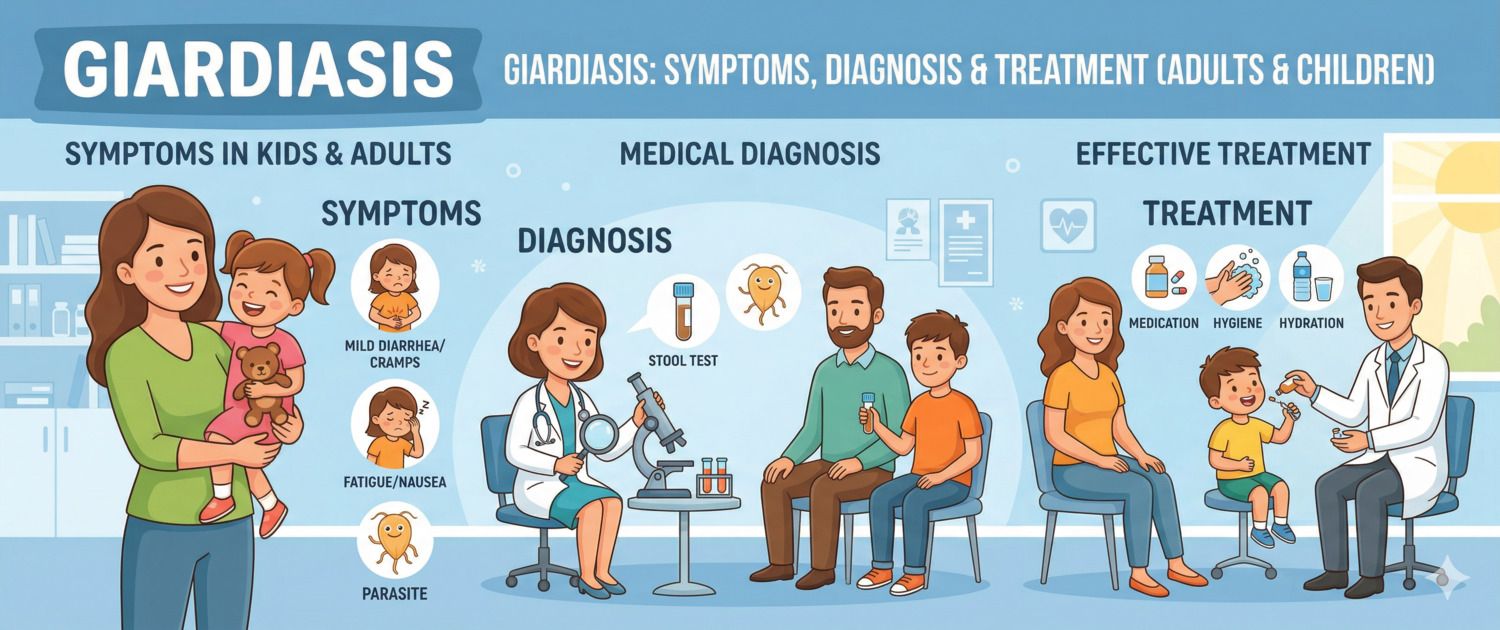
Persistent diarrhoea, abdominal bloating, and unexplained fatigue that last for weeks — this is the classic picture of giardiasis. Yet many people carrying Giardia have no idea they are infected: in roughly half of cases, the infection is completely asymptomatic. Giardiasis is the most common protozoan intestinal infection in the world, and it is highly prevalent in both developing and developed countries. Here is how Giardia enters the body, what symptoms it causes, and how to reliably diagnose it.
What Giardia Is and How It Lives in the Intestine
Giardia (Giardia lamblia, also known as Giardia intestinalis or Giardia duodenalis) is a single-celled flagellate protozoan. It exists in two forms:
Trophozoite (active form) — mobile, actively feeding. Lives in the duodenum and upper small intestine, attaching to intestinal villi with a suction disc. Trophozoites cause all the symptoms: they mechanically damage the villi and impair absorption of fats and carbohydrates.
Cyst (dormant form) — resistant to the environment. Forms as contents pass through the large bowel and is excreted in faeces. Cysts survive in cold water for up to three months and are resistant to chlorination at standard concentrations. Cysts are the infective form.
As few as 10–25 cysts are sufficient to establish infection — an exceptionally low infectious dose that explains the high transmissibility of giardiasis.
How Giardiasis Spreads
Transmission routes are waterborne, foodborne, and contact-based.
Waterborne — the most significant route. Giardia cysts resist standard water chlorination. Infection occurs through drinking unboiled water from open sources or wells, or accidentally swallowing water while swimming.
Foodborne — eating unwashed fruit and vegetables or contaminated food. Flies and cockroaches can transfer cysts onto food.
Contact transmission — through unwashed hands, shared household objects, and toys. Particularly relevant in childcare settings.
Risk groups: preschool and primary school-age children, travellers to countries with poor sanitation, immunocompromised individuals, and childcare workers.
Symptoms of Giardiasis
Giardiasis is deceptive: approximately 50–75% of infected people have no symptoms at all — they remain asymptomatic carriers and a source of infection for others. In the remainder, clinically apparent disease develops.
Acute form (first 1–3 weeks):
- sudden watery diarrhoea without blood, 3–10 times per day
- cramping pain in the upper and mid abdomen
- pronounced bloating and gurgling
- nausea, reduced appetite
- low-grade fever (37.0–37.5 °C)
- weakness, headache
Chronic form (infestation lasting more than 3 weeks):
- alternating diarrhoea and constipation
- persistent abdominal bloating and flatulence
- malabsorption syndrome — impaired absorption of fats and vitamins
- weight loss despite normal appetite
- chronic fatigue, irritability
- in children — growth faltering with prolonged disease
Extra-intestinal manifestations are less common but clinically important:
- allergic reactions — urticaria, atopic dermatitis — Giardia may trigger or worsen atopic disease
- cholecystitis and biliary dyskinesia — when Giardia penetrates the bile ducts
Diagnosis: How to Detect Giardia
Clinical symptoms are non-specific — diarrhoea and bloating can have dozens of other causes. Diagnosis is made only by laboratory testing.
Stool microscopy for Giardia cysts (coproscopy) — the basic method. The microscopist looks for oval cysts with 2–4 nuclei. The main problem: cysts are shed intermittently, with "silent" periods during which they are absent from stool. Sensitivity of a single examination is 50–70%. Three-sample testing at 1–2 day intervals is required. Trophozoites in stool break down rapidly — the sample must reach the laboratory within 30–60 minutes, or a preservative container must be used. Detailed collection rules are in the stool parasite examination article. An overview of all parasite diagnostic methods is in the material on testing for worms and parasites.
PCR of stool for Giardia lamblia — significantly more sensitive than microscopy (90–95%), detecting parasite DNA even with low cyst counts. The preferred method when giardiasis is suspected after negative microscopy results.
Serum ELISA for Giardia antibodies — detects specific IgG and IgM. Antibodies appear 2–4 weeks after infection and persist after recovery, making it difficult to distinguish active infection from past exposure.
An indirect marker is eosinophilia — elevated eosinophils on a full blood count. Present in 20–30% of patients with giardiasis, but non-specific.
Treatment of Giardiasis
Treatment is pharmacological. Drugs of choice are nitroimidazole derivatives (metronidazole, tinidazole, ornidazole) or nitrofuran compounds (nifuratel). Treatment regimen, dosage and duration are determined by the physician according to age, weight and comorbidities.
Self-treating with antiparasitic drugs without a confirmed diagnosis is inadvisable: similar symptoms occur in irritable bowel syndrome, lactose intolerance and other conditions that require entirely different management.
After treatment — a control stool test 3–4 weeks later. If symptoms persist and the test remains positive, a repeat course with a different drug is indicated: Giardia resistance to metronidazole occurs in 10–20% of cases.
Diet during treatment: limit simple carbohydrates (sugar, sweets, white bread) — they fuel Giardia growth. Increasing protein and fibre intake is recommended.
Prevention of Giardiasis
- Drink only boiled or bottled water, especially when travelling
- Wash fruit and vegetables thoroughly; scald with boiling water when necessary
- Wash hands with soap after using the toilet and before eating
- Avoid swallowing water when swimming in open water
- Regular wet cleaning, especially in children's rooms
Standard chlorination does not kill Giardia cysts — only boiling or UV disinfection is effective.
When to See a Doctor
See a GP or infectious disease specialist for diarrhoea lasting more than two weeks, particularly with bloating and weight loss. See a paediatrician if a child's symptoms persist for more than a week after possible contact with contaminated water, or during an outbreak in a childcare setting. When giardiasis is diagnosed in a child, all family members are screened, including asymptomatic contacts.
This article is for informational purposes only. Diagnosis and treatment are provided exclusively by a qualified physician.
For informational purposes only
This article is for informational purposes only and does not constitute medical advice, diagnosis, or treatment. Please consult a healthcare professional for medical guidance.