Helminthiasis: Types of Worms, Symptoms and Treatment
Reviewed by the LabReadAI medical team
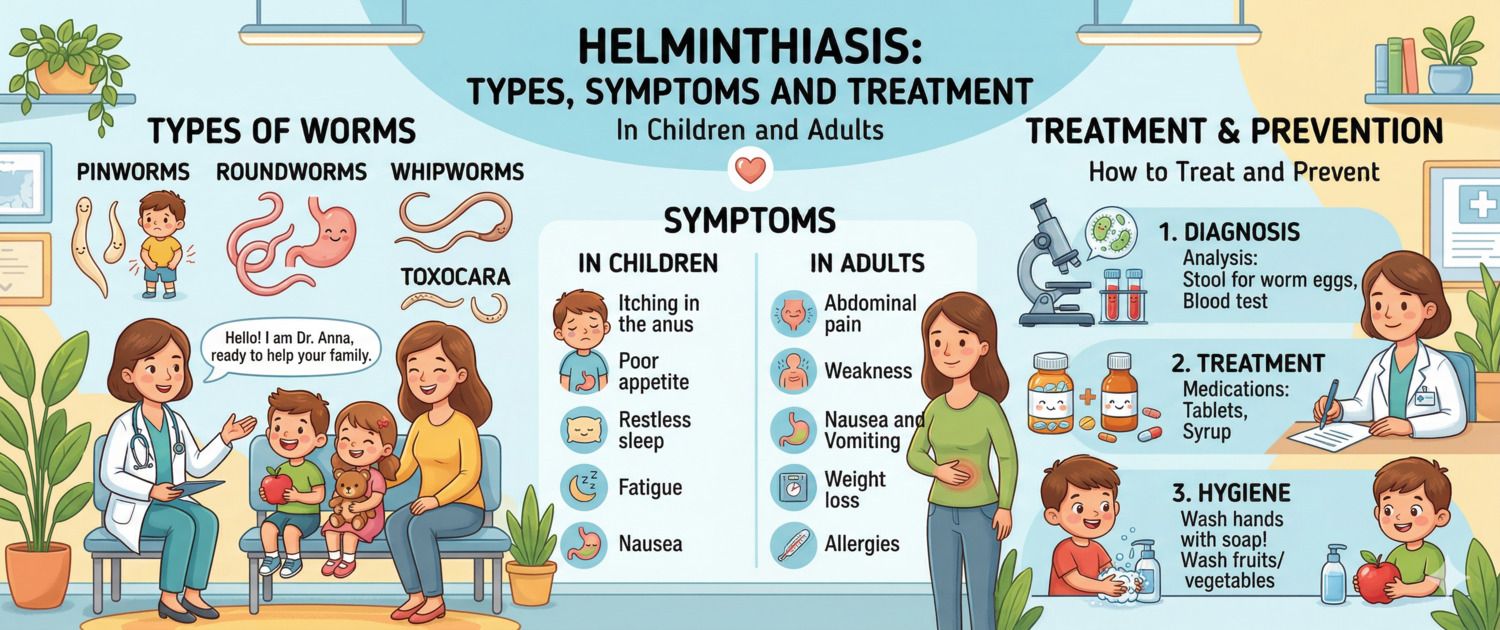
According to WHO estimates, more than one billion people worldwide are infected with intestinal helminths. Helminthiasis does not always cause obvious symptoms — many carriers have no idea they are infected. Chronic parasitism silently depletes the body, impairs absorption of nutrients and weakens the immune system. Here is an overview of the main helminth types, how to recognise infection and when laboratory testing is needed.
What Helminthiasis Is and the Main Types of Helminths
Helminths are parasitic worms that live and reproduce inside the human body. They fall into three main groups:
Nematodes (roundworms) — the most widespread group:
- Ascaris lumbricoides — causes ascariasis
- Enterobius vermicularis — pinworm, causes enterobiasis — the most common helminthiasis in children
- Trichuris trichiura — whipworm, causes trichuriasis
- Toxocara canis/cati — causes toxocariasis
- Ancylostoma — hookworm, causes hookworm disease
Cestodes (tapeworms):
- Taenia solium — pork tapeworm (taeniasis, cysticercosis)
- Taenia saginata — beef tapeworm (taeniasis)
- Diphyllobothrium latum — broad fish tapeworm (diphyllobothriasis)
- Echinococcus granulosus — causes echinococcosis
Trematodes (flukes):
- Opisthorchis felineus — cat liver fluke (opisthorchiasis) — endemic to Siberia
- Fasciola hepatica — liver fluke (fascioliasis)
Note: Giardia, strictly speaking, is not a helminth but a protozoan — however, it is commonly discussed in the same context due to similar transmission routes and symptoms. See the giardiasis article for detail.
How Helminth Infection Spreads
Each helminth species specialises in a particular transmission route:
Faecal-oral route — the most common. Eggs or larvae enter the mouth via contaminated hands, unwashed vegetables and fruit, or contaminated water. This is how roundworms, pinworms, whipworms and toxocara spread.
Foodborne route through meat and fish — infection from undercooked pork (pork tapeworm, Trichinella), beef (beef tapeworm), or freshwater fish (broad tapeworm, opisthorchiasis). Strict temperature control during food preparation is the primary defence against these parasites.
Contact transmission — via household objects, toys and bed linen. Characteristic of pinworms.
Percutaneous route (through skin) — hookworm larvae and certain other nematode larvae can penetrate intact skin on contact with contaminated soil.
Zoonotic route — from animals. Toxocara is transmitted from dogs and cats; Echinococcus from dogs and wild carnivores.
Symptoms of Helminthiasis
Symptoms depend on the parasite species, intensity of infestation and the host's immune status. Many infestations remain asymptomatic for years. Nevertheless, certain patterns should prompt investigation.
Intestinal symptoms (common to most intestinal helminthiases):
- intermittent abdominal pain, often cramping
- diarrhoea, sometimes alternating with constipation
- abdominal bloating and flatulence
- nausea, reduced appetite
- weight loss despite normal or increased appetite
General symptoms (toxicity and allergic sensitisation):
- chronic fatigue and weakness
- headaches, irritability
- skin itching, urticaria, worsening of atopic dermatitis — helminths release toxins that trigger allergic reactions
- low-grade fever without a clear infectious focus
Species-specific symptoms:
- pinworms — nocturnal perianal itching, restless sleep
- roundworms (larval migration phase) — cough, shortness of breath (Löffler syndrome)
- toxocariasis — ocular involvement (reduced vision), fever, hepatomegaly
- opisthorchiasis — right upper quadrant pain, jaundice, cholangitis
- broad tapeworm — vitamin B12 deficiency, megaloblastic anaemia
In children, helminthiasis symptoms often masquerade as other conditions: poor school performance, growth faltering, recurrent abdominal pain, nocturnal enuresis, teeth grinding.
Laboratory marker — eosinophilia. Elevated eosinophils on a full blood count are present in most tissue helminthiases (toxocariasis, roundworm larval migration, trichinellosis). In established intestinal infestation, eosinophilia may be mild or absent.
Diagnosing Helminthiasis
There is no single universal test for "all worms". The diagnostic method depends on the suspected parasite species.
Stool examination for helminth eggs (coproscopy) — the basic method for intestinal forms (roundworms, whipworm, hookworms, tapeworms, broad tapeworm). A single test is unreliable — three-sample testing is recommended. Detailed rules for collection and interpretation are in the stool parasite examination article. How to choose the method for a specific parasite is in the overview on testing for worms and parasites.
Perianal swab for enterobiasis — the only reliable method for pinworms, as they deposit eggs outside the bowel. See the enterobiasis test article.
Serological methods (ELISA) — essential for tissue helminthiases where the parasite is not in the intestine: toxocariasis, echinococcosis, trichinellosis. They detect specific IgG and IgM antibodies in blood.
PCR — high-sensitivity method used for certain parasites (toxocara, Opisthorchis, Echinococcus). Detects pathogen DNA even at low parasite burden.
Abdominal ultrasound — when echinococcosis (liver cysts), opisthorchiasis (bile duct changes) or biliary ascariasis is suspected.
Full blood count — a screening tool. Eosinophilia above 5–7% combined with compatible symptoms is a strong indication for targeted parasitological testing.
Treatment of Helminthiasis
Treatment depends on the parasite species. There is no universal "all-worm" drug — different helminths require different agents and regimens.
Main drug groups:
- Benzimidazoles (albendazole, mebendazole) — broad spectrum: roundworms, pinworms, whipworm, hookworms, some cestodes and tissue forms
- Pyrantel — roundworms, pinworms, hookworms; ineffective against eggs
- Praziquantel — cestodes (tapeworms, broad tapeworm) and trematodes (opisthorchiasis, fascioliasis)
- Ivermectin — strongyloidiasis, onchocerciasis
Self-treatment with anthelmintics without a confirmed diagnosis and parasite identification is inadvisable and potentially harmful. These drugs have contraindications, age restrictions and risks when used incorrectly. Treatment must be prescribed by a physician.
After treatment, follow-up testing is mandatory — repeat tests 3–4 weeks after completion to confirm elimination of the parasite.
Prevention of Helminthiasis
Most helminthiases can be prevented by basic hygiene:
- Wash hands with soap after using the toilet, going outdoors, touching animals, and before eating
- Wash vegetables, fruit and herbs thoroughly; scald with boiling water when necessary
- Cook meat and fish to safe internal temperatures (at least 63 °C in the centre)
- Do not drink water from open sources without boiling
- Deworm pets (cats and dogs) regularly — at least every three months
- Limit children's contact with stray animals; wash hands after playing in sandpits
Preventive anthelmintic treatment without laboratory-confirmed diagnosis is not recommended — it is unnecessary and creates the risk of resistance.
When to See a Doctor
See a GP, infectious disease specialist or parasitologist in the following situations:
- elevated eosinophils on blood count with any of the symptoms described above
- chronic diarrhoea, abdominal pain or weight loss lasting more than two weeks without identified cause
- nocturnal perianal itching in a child (characteristic of pinworms)
- reduced vision, fever and liver enlargement — possible toxocariasis
- right upper quadrant pain and jaundice in a person who eats freshwater fish — exclude opisthorchiasis
- helminthiasis identified in a child's group — screen all close contacts
It is often the plain blood count that first hints at a parasite when nobody is yet thinking of one: in tissue helminthiases the line reporting high eosinophils rises furthest during larval migration and can by itself turn the search towards parasitology.
This article is for informational purposes only. Diagnosis and treatment are provided exclusively by a qualified physician.
For informational purposes only
This article is for informational purposes only and does not constitute medical advice, diagnosis, or treatment. Please consult a healthcare professional for medical guidance.