High Cortisol: Symptoms, Causes of Elevation and Tests
Reviewed by the LabReadAI medical team
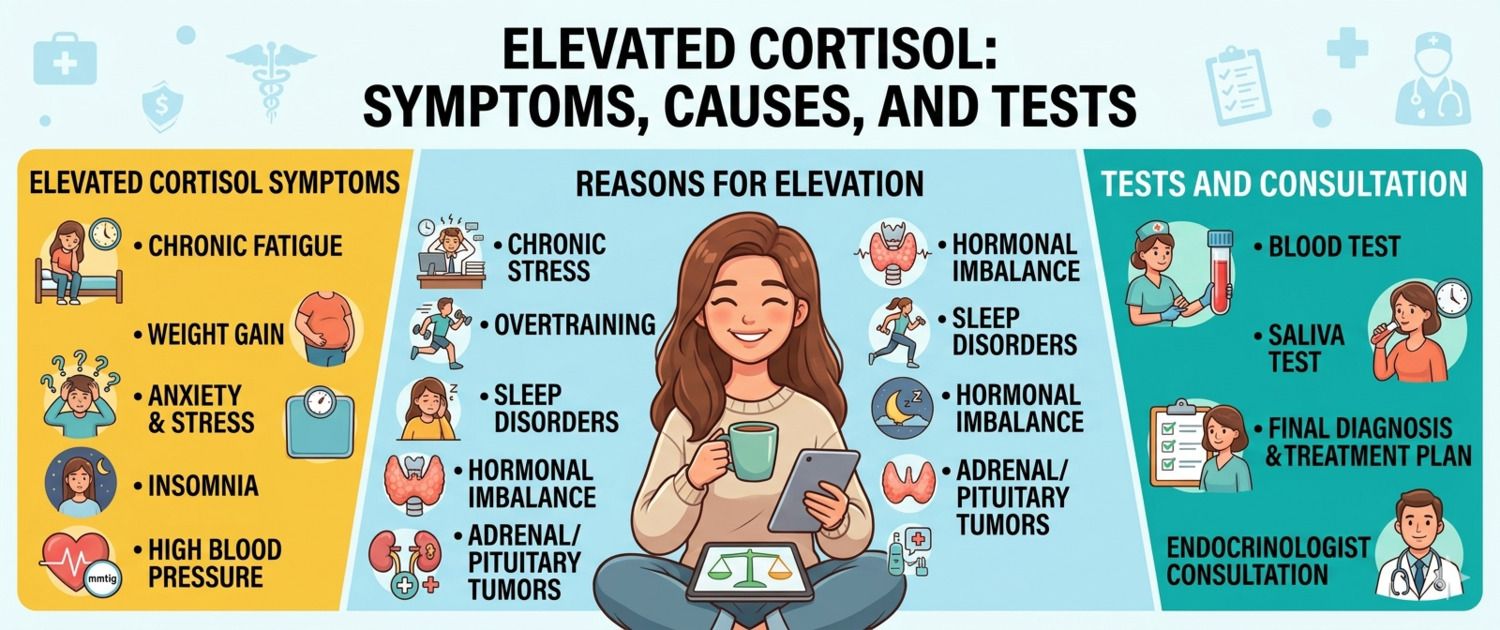
Elevated cortisol rarely arrives as a chief complaint. More often it is a "diagnosis inside other diagnoses": the patient comes in with hypertension, central weight gain, insomnia, and mood swings — and only on deeper workup does it become clear that chronic hypercortisolism underlies many of these symptoms. The symptoms of elevated cortisol are widely known but not always interpreted correctly. Here's what should raise suspicion, what causes of elevation exist, and how to test cortisol properly.
Symptoms of High Cortisol
Chronically elevated cortisol creates a characteristic, though nonspecific, syndrome. The full picture of hypercortisolism includes:
Metabolic:
- Central obesity — abdomen, neck, face ("moon face," "buffalo hump")
- Thin arms and legs alongside an enlarged abdomen
- Striae wider than 1 cm, purple-red
- Hyperglycemia, impaired glucose tolerance, or diabetes
- Hypertension poorly responsive to standard medications
Psychiatric:
- Insomnia, especially with awakenings at 3–4 AM
- Anxiety, irritability
- Depression, emotional lability
- Cognitive complaints — forgetfulness, scattered thinking
Immune and skin:
- Frequent infections, slow healing
- Skin thinning, capillary fragility
- Adult acne
- Hirsutism in women
Musculoskeletal:
- Proximal muscle weakness (difficulty rising from a chair without support)
- Osteoporosis with fractures from minimal load
- Back pain
Endocrine:
- Reduced libido
- Menstrual cycle disruption, amenorrhea
- Erectile dysfunction in men
- Infertility
With 4–5 of these features, serious workup is warranted. The combination of wide purple striae + central obesity + resistant hypertension is high probability of Cushing's syndrome — endocrinology consultation is mandatory.
Causes of Cortisol Elevation
Broadly grouped:
Endogenous (internal):
- Cushing's disease — pituitary ACTH-secreting adenoma (~70% of true hypercortisolism)
- Cushing's syndrome — adrenal corticosteroma autonomously secreting cortisol
- Ectopic ACTH — non-pituitary tumors (small-cell lung cancer, carcinoid)
Exogenous:
- Long-term glucocorticoids (prednisolone, dexamethasone, hydrocortisone), including high-dose inhaled or topical
- Oral contraceptives (raise cortisol-binding globulin — total cortisol artifactually elevated)
Functional (pseudo-Cushing's):
- Chronic psychoemotional stress
- Depression and anxiety disorders
- Alcohol use disorder
- Severe obesity
- Pregnancy (physiological elevation)
- Training-induced hypercortisolism in overtrained athletes
Most cortisol elevation in general practice is functional. True Cushing's syndrome is rare (1–2 cases per 100,000 per year). But it's exactly that rare group that must not be missed.
Functional Hypercortisolism vs Cushing's Syndrome
This differential is the central task with elevated cortisol.
Functional (pseudo-Cushing's):
- Cortisol modestly elevated (20–50% above normal)
- Circadian rhythm partly preserved (evening still below morning)
- Dexamethasone suppression test shows suppression
- No pathological Cushingoid stigmata (no wide purple striae, no proximal weakness)
- 11 PM salivary cortisol normal
- Linked to a clear trigger (stress, depression, obesity)
Cushing's syndrome:
- Cortisol significantly elevated (often > 700 nmol/L morning)
- Circadian rhythm lost (evening close to morning)
- Dexamethasone suppression test fails
- Characteristic stigmata — purple striae, proximal weakness, osteoporosis
- 11 PM salivary cortisol elevated (> 4.3 nmol/L)
- No clear trigger
For details and management of Cushing's syndrome, see the dedicated article on Cushing's syndrome.
Which Tests to Take
Starter set:
Morning cortisol (8:00–10:00 AM) — two measurements on separate days. Normal 138–690 nmol/L.
Evening cortisol (4:00–6:00 PM) — circadian rhythm assessment.
DHEA-S — for the cortisol/DHEA-S ratio. Low DHEA-S with high cortisol — functional hypercortisolism; normal or high — usually ACTH-dependent.
ACTH — critically needed when true hypercortisolism is suspected. High ACTH + high cortisol → pituitary tumor or ectopic secretion; low ACTH + high cortisol → adrenal tumor.
Late-night salivary cortisol (11 PM) — most sensitive Cushing's screen. Normal < 4.3 nmol/L.
24-hour urinary free cortisol — reflects integrated daily output.
Convenient as a comprehensive adrenal stress panel.
Additional: glucose + insulin (insulin resistance), calcium + vitamin D + osteocalcin (osteoporosis risk), TSH (often parallel disturbance).
Dexamethasone Suppression Test
The low-dose overnight dexamethasone test is the gold-standard screen for hypercortisolism.
Procedure: 1 mg dexamethasone at 11 PM; cortisol drawn at 8 AM.
Interpretation:
- Suppression to < 50 nmol/L — no autonomous secretion, hypercortisolism unlikely
- Cortisol > 50 nmol/L — abnormal, further workup required
High-dose dexamethasone test (8 mg over 2 days) differentiates Cushing's disease (pituitary tumor — partial suppression) from ectopic ACTH or corticosteroma (no suppression).
These tests are interpreted by an endocrinologist; self-interpretation is unproductive.
Morning vs Evening Cortisol
Sample timing is a critical part of diagnosis because the physiological rhythm produces an eight-fold morning-to-evening difference.
Morning peak — normal 138–690 nmol/L (8:00–10:00 AM). Diagnostically meaningful: a drop signals adrenal insufficiency, while elevation in the upper range with flattened circadian rhythm signals hypercortisolism.
Evening sample — normal 69–345 nmol/L (4:00–6:00 PM). Should be 2–3-fold lower than morning. If evening is close to morning — the rhythm is lost, suspicion of hypercortisolism rises sharply.
Late-night salivary cortisol — normal < 4.3 nmol/L (10:00–11:00 PM). The most sensitive marker of autonomous secretion.
A standalone cortisol value without timing — diagnostically useless.
When to See an Endocrinologist
In-person consultation is indicated for:
- Morning cortisol > 690 nmol/L on two measurements with proper conditions
- Flattened circadian rhythm (evening > 75% of morning)
- Positive dexamethasone test (failure to suppress)
- 11 PM salivary cortisol > 4.3 nmol/L
- Any of these features combined with Cushingoid stigmata
- Long glucocorticoid use with attempted withdrawal
Emergency care — for hypertensive crisis with BP > 180/110, severe muscle weakness, hypoglycemia.
How Cortisol Is Lowered
Strategy depends on cause:
- Functional — lifestyle (sleep, nutrition, caffeine restriction, exercise); adaptogens where appropriate. Details in how to lower cortisol and the practical women's guide how to lower cortisol in women.
- Cushing's syndrome — medications (metyrapone, ketoconazole), surgery (adenomectomy, adrenalectomy), radiotherapy — choice by endocrinologist and surgeon.
- Exogenous glucocorticoids — gradual taper under cortisol and ACTH monitoring to avoid secondary adrenal insufficiency.
One thing is worth stating separately: there is no laboratory test for burnout — a systematic review of 38 biomarkers, cortisol included, found none usable. What that state actually is is in the article on burnout; how nervous exhaustion and asthenia differ from it is in a separate piece.
This article is for informational purposes only and does not replace professional medical advice. Suspected hypercortisolism requires in-person endocrinology evaluation.
For informational purposes only
This article is for informational purposes only and does not constitute medical advice, diagnosis, or treatment. Please consult a healthcare professional for medical guidance.