How to Increase Haemoglobin: Foods, Supplements and Causes
Reviewed by the LabReadAI medical team
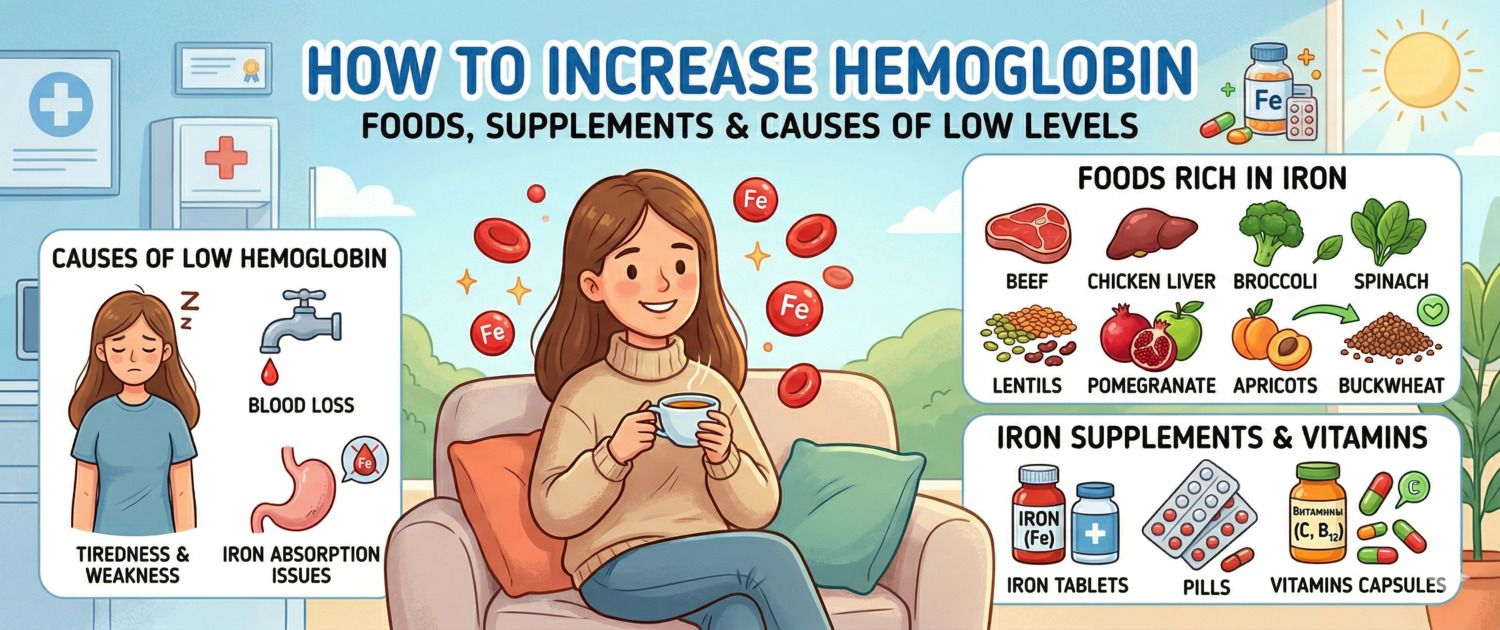
Unexplained fatigue, persistent pallor, breathlessness on a single flight of stairs — and then a blood test comes back with haemoglobin flagged low. A familiar picture? Low haemoglobin affects roughly one in five adults worldwide and remains one of the most common laboratory findings. But to raise haemoglobin effectively, you need to understand the cause first — otherwise treatment is like filling a bucket with a hole in it. This article covers the mechanism of haemoglobin decline, the right tests to order, and concrete steps from dietary changes to medical therapy.
Why Haemoglobin Falls: Causes and Mechanisms
Haemoglobin is the protein inside red blood cells that carries oxygen from the lungs to every cell in the body. Its decline is not a standalone disease — it is a symptom. The underlying causes are fundamentally different from one another.
Iron deficiency — the most common cause. Iron is the raw material for haem, the part of the haemoglobin molecule that binds oxygen. Without enough iron, red blood cells are produced small and pale — clinicians call this microcytic hypochromic anaemia. Iron deficiency develops through chronic blood loss (heavy periods, gastrointestinal bleeding), inadequate dietary intake, impaired absorption (coeliac disease, gastric surgery), or sharply increased demand (pregnancy, adolescent growth spurts). This is the pathway for the majority of patients with iron deficiency anaemia.
Vitamin B12 or folate deficiency — the second most common mechanism. These vitamins are essential for normal division of red blood cell precursors in the bone marrow. Without them, cells enlarge and become non-functional — megaloblastic anaemia. Unlike iron-deficiency anaemia, here the haemoglobin content per cell may actually be normal or high; there are simply too few viable cells.
Chronic disease. Chronic inflammation — rheumatoid arthritis, Crohn's disease, chronic kidney disease, malignancy — blocks iron utilisation even when iron stores are adequate. This is the anaemia of chronic disease: iron supplements are ineffective and targeting the cause is what matters.
Acute or chronic blood loss directly reduces red cell mass and haemoglobin. Sometimes the source is obvious (trauma, childbirth); sometimes it is hidden (peptic ulcer, bowel polyps).
Understanding the cause is the key to correct treatment. The same haemoglobin of 90 g/L requires completely different approaches in a patient with iron deficiency and in a patient with chronic kidney failure.
Which Blood Tests to Order for Low Haemoglobin
The first step is not to reach for iron supplements — it is to establish the cause. A minimal set of investigations does this efficiently.
A complete blood count is the starting point. It shows not only haemoglobin but also the size of red blood cells (MCV): small cells point to iron deficiency; large cells to B12 or folate deficiency; normal-sized cells to chronic disease or blood loss. This alone significantly narrows the diagnostic search at the first step.
An iron panel is essential when iron deficiency is suspected. It includes serum iron, total iron-binding capacity (TIBC), and transferrin saturation. The most critical value is ferritin: the body's iron storage protein. Ferritin falls first — long before haemoglobin drops. Normal serum iron alongside low ferritin means reserves are already depleted; the body is still compensating.
Vitamin B12 and folate in blood are ordered when MCV is normal or elevated — to exclude megaloblastic anaemia. This is particularly important in vegans, strict vegetarians, and older adults, in whom B12 absorption from food declines with age.
Depending on the clinical picture, the doctor may also request reticulocytes (bone marrow response), C-reactive protein, and TSH — to exclude chronic inflammation and hypothyroidism as contributing causes.
Foods That Raise Haemoglobin
Diet is effective in mild anaemia and is a mandatory complement to medical treatment in moderate cases. But there is a critical distinction: food contains two fundamentally different forms of iron.
Haem iron (from meat and fish) — absorbed at 15–35%. Best sources: beef and pork liver (6–7 mg per 100 g), beef and lamb (2–3 mg/100 g), mussels and oysters (up to 6 mg/100 g), dark turkey and duck meat.
Non-haem iron (from plants) — absorbed at only 2–8%, but found abundantly in lentils, spinach, tofu, pumpkin seeds, and fortified cereals. To raise non-haem iron absorption to near-meat levels, vitamin C is essential.
Vitamin C is iron's most important ally. It converts iron from the ferric form (poorly absorbed) to the ferrous form. A bowl of lentils with a glass of fresh orange juice absorbs 2–4 times more iron than lentils alone. Adding bell pepper to buckwheat achieves the same effect.
What blocks iron absorption matters just as much. Tea, coffee, and red wine contain tannins and polyphenols that bind iron directly in the gut. Milk and dairy products — calcium competes with iron at the same intestinal transporter. Wholegrains, legumes, and nuts contain phytates and oxalates that form insoluble complexes with iron. None of these foods need to be eliminated — simply avoid eating them at the same meal as iron-rich foods. A 1–2-hour gap is sufficient.
| Increases iron absorption | Decreases iron absorption |
|---|---|
| Vitamin C (citrus, peppers) | Tea and coffee |
| Meat broth | Milk and calcium |
| Acidic foods (fermented veg) | Wholegrains with phytates |
| Cooked legumes | Red wine |
Iron Supplements: When Diet Is Not Enough
At haemoglobin below 100–110 g/L, or with low ferritin (< 15–20 ng/mL), diet alone cannot keep up with the body's need to replenish stores. Supplements are required.
Iron preparations fall into two broad categories. Ferrous salts (ferrous sulphate, fumarate, gluconate) — less expensive and well studied, but more likely to cause gastrointestinal side effects: nausea, constipation, dark stools. Ferric compounds (ferric polymaltose complex) and chelated forms (ferrous bisglycinate) — better tolerated, less gut irritation, but more expensive.
How to take them correctly. On an empty stomach or 30 minutes before food — absorption is up to 40% higher than with meals. Take with water or vitamin C-containing juice. Avoid co-administration with calcium supplements, antacids, and certain antibiotics (tetracyclines, fluoroquinolones) — these block iron absorption. If the stomach cannot tolerate fasting doses, take with food, accepting reduced but still clinically useful absorption.
Dosing. For treating iron-deficiency anaemia in adults, 100–200 mg of elemental iron per day is standard (not the total tablet weight — elemental iron content is stated separately in the product information). For prevention and latent deficiency, 30–60 mg/day is sufficient.
Duration. After haemoglobin normalises, supplements continue for another 2–3 months — to replenish tissue stores (ferritin). Stopping at haemoglobin normalisation is one of the most common errors: ferritin remains at zero, and anaemia returns within months.
In severe cases (oral iron intolerance, malabsorption, haemoglobin below 70–80 g/L), intravenous iron is given — rapid and highly effective, but only in a clinical setting under observation.
Raising Haemoglobin When B12 or Folate Is Low
When the CBC shows enlarged red blood cells (MCV > 100 fL), the problem is not iron. This is megaloblastic anaemia, and iron supplements are not only unhelpful but can be harmful if taken without indication.
Vitamin B12 comes exclusively from animal foods: meat, fish, eggs, dairy. Vegans and strict vegetarians are at inherent risk and need continuous B12 supplementation. A second high-risk group is older adults: gastric production of intrinsic factor — required for B12 absorption — declines with age. Long-term use of metformin and proton pump inhibitors also suppresses B12 levels.
For moderate deficiency, high-dose oral B12 (1000–2000 mcg/day) is effective — at these doses, passive diffusion bypasses the need for intrinsic factor. For severe deficiency, neurological symptoms, or absorption disorders, intramuscular injections of cyanocobalamin or hydroxocobalamin are used.
Folate (vitamin B9) is found in leafy greens, legumes, citrus fruits, and liver. Its deficiency is especially dangerous in pregnancy — low folate in the first weeks after conception increases the risk of neural tube defects. This is why folic acid is recommended for all women planning pregnancy, starting 1–3 months before conception.
In vitamin B12 deficiency it is critical not to prescribe folic acid in isolation without first ruling out B12 deficiency: folate corrects the blood picture but does not protect against the neurological damage of B12 deficiency, which can be irreversible.
How Long Does It Take for Haemoglobin to Rise
This is one of the most frequently asked questions — and the most frequent source of disappointment. Haemoglobin does not normalise in a week. Here is a realistic timeline.
2–4 weeks. The first sign of treatment response is a rise in reticulocytes (young red blood cells) in the blood. This means the bone marrow has received iron and has begun actively producing new cells. Patients often feel better at this stage before haemoglobin itself has visibly changed.
4–8 weeks. Haemoglobin begins rising steadily — typically 10–20 g/L per month with correct treatment. The target is to reach the lower limit of the reference range (120 g/L in women, 130 g/L in men).
2–4 months. Full haemoglobin normalisation and the start of ferritin recovery. Treatment continues beyond haemoglobin normalisation — the goal now is to raise ferritin above 30–50 ng/mL.
If haemoglobin has not risen by at least 10 g/L after 4 weeks of treatment, this is a signal: either the diagnosis is incorrect (not iron-deficiency anaemia), the supplement is not being absorbed, or there is an ongoing hidden blood loss. A repeat medical visit is needed.
When to See a Doctor Urgently
Not all low haemoglobin situations can be managed independently. Some require immediate medical attention.
Seek emergency care if: haemoglobin is below 70 g/L in an adult — at this level the heart is under severe strain and hospitalisation is often needed; haemoglobin is falling rapidly over days or weeks — possible acute bleeding; low haemoglobin is accompanied by abdominal pain, black tarry stools, or visible blood in the stool — signs of gastrointestinal haemorrhage; anaemia fails to respond to iron supplements after 4 weeks — a different cause needs to be found; multiple blood counts are simultaneously low (haemoglobin, white cells, and platelets) — possible bone marrow pathology requiring specialist evaluation.
Self-treatment for anaemia is appropriate only in mild cases with an obvious cause such as heavy periods. In all other situations — tests first, treatment second.
This article is for informational purposes only and does not replace medical consultation. Result interpretation and diagnosis are made by a qualified physician.
For informational purposes only
This article is for informational purposes only and does not constitute medical advice, diagnosis, or treatment. Please consult a healthcare professional for medical guidance.