Bipolar Disorder: Symptoms and Types Explained Simply
Reviewed by the LabReadAI medical team
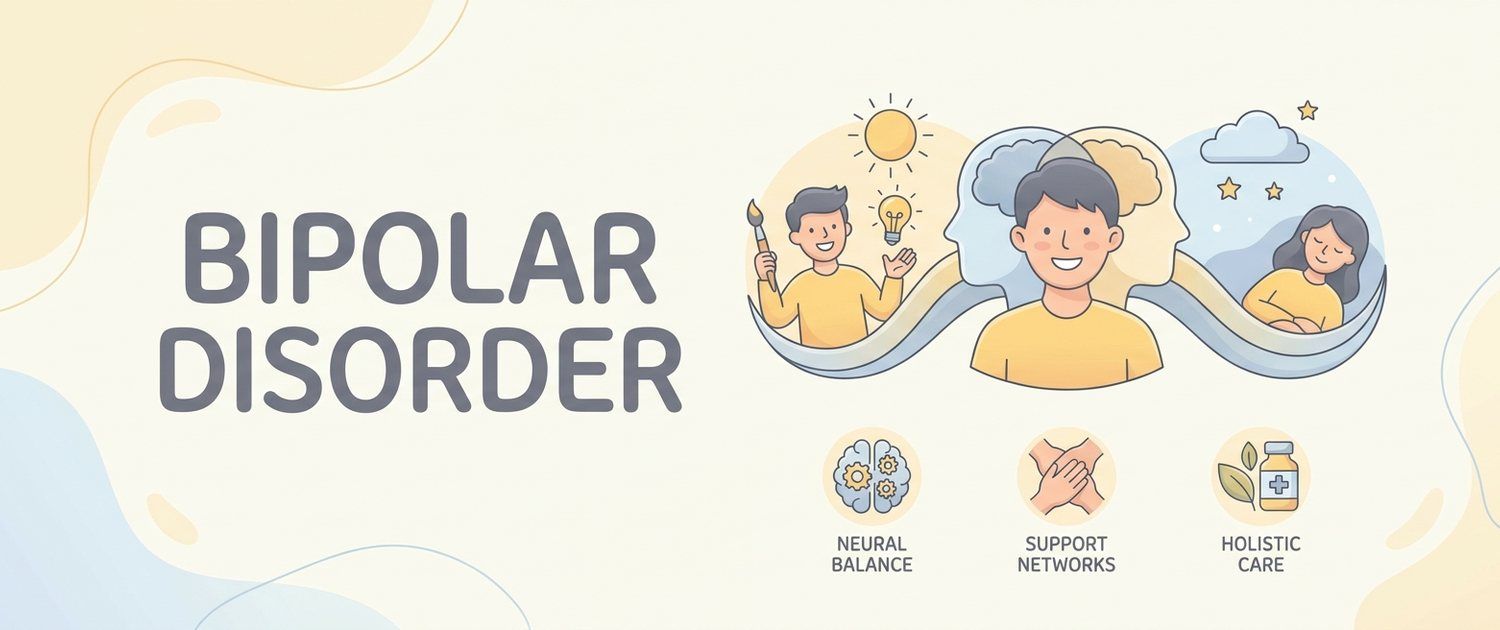
Bipolar disorder (bipolar affective disorder) is a mental disorder in which mood and energy swing between two poles: a pathological up (mania or hypomania) and a down (depression). It's not "sad now, happy an hour later" — phases last days and weeks, dramatically change behaviour and disrupt life. Bipolar disorder is well studied and treatable, but it's often recognised late — on average years after the first symptoms — because people seek help when depressed, while the ups feel like "just a good spell."
What bipolar disorder is, in plain words
Picture a dial for mood and energy that lurches up and then down, and the person can't return it to the middle by willpower. In the up phase — excess energy, racing thoughts, reduced need for sleep; in the down phase — severe depression. Between phases there are often periods of relatively even mood.
Note: bipolar disorder is not the same as being hot-tempered or moody, and it's not a "personality disorder," though people sometimes say so casually.
Symptoms of mania and hypomania
Mania (type I) — a marked up phase lasting a week or more that seriously disrupts life:
- elevated or irritable mood, a sense of omnipotence;
- sharply reduced need for sleep (sleeps 2–3 hours and feels fine);
- rapid speech and racing thoughts;
- impulsive decisions: spending, risky acts, ventures;
- sometimes psychotic symptoms (delusions, hallucinations).
Hypomania (type II) — a milder up phase: noticeable to others but without gross disruption of life and without psychosis. It's easy to mistake for a "productive period" and not connect it to illness.
Symptoms of the depressive phase
Depression in bipolar disorder looks much like ordinary depression:
- low mood, loss of interest and pleasure;
- low energy, slowing, mental "fog";
- changes in sleep and appetite;
- guilt, hopelessness;
- thoughts of death or suicide.
Telling bipolar depression from unipolar depression from a single episode is hard — which is why a history of ups matters so much.
Types of bipolar disorder
A frequent separate question is how to tell these types from ADHD: there the swings are short and tied to events rather than bounded into episodes lasting days and weeks; the walk-through is in ADHD or burnout, anxiety, depression.
- Type I — at least one episode of full mania (depressions are usually present too).
- Type II — hypomanias + recurrent severe depressions, without full mania.
- Cyclothymia — years of mild swings that don't reach the threshold of mania or major depression.
An important trap: antidepressants without a stabiliser
People with bipolar disorder often first see a doctor while depressed, and the bipolar nature can be missed. Prescribing an antidepressant without a mood stabiliser can trigger a switch into mania or speed up phase cycling. So if antidepressants "don't work," cause agitation or a paradoxical effect, the diagnosis should be reconsidered. More in why antidepressants don't work and how neurotransmitters function.
What to check
There's no lab test for bipolar disorder — the diagnosis is clinical. But tests matter to rule out mimicking conditions and for safe treatment:
- thyroid — both hypo- and hyperthyroidism change mood and energy (TSH, thyroid panel);
- vitamin B12 and vitamin D deficiency;
- on lithium therapy — monitoring kidney and thyroid function.
If you already have results, our service can read them in plain language and point out what to discuss with your doctor.
When to see a doctor
See a psychiatrist if you or someone close notices alternating periods of unusual highs (little sleep, racing thoughts, impulsivity) and severe lows. Early diagnosis and the right mood stabiliser dramatically change the course.
Urgent help is needed immediately if thoughts of suicide or self-harm appear, or in mania with dangerous behaviour. Contact a local crisis line or emergency services in an immediate life-threatening situation.
This article is for information only and does not replace a psychiatrist's consultation. Diagnosis and treatment are determined only by a doctor.
For informational purposes only
This article is for informational purposes only and does not constitute medical advice, diagnosis, or treatment. Please consult a healthcare professional for medical guidance.