Formula · 3.3
Brand · 5.6
Klorane · pomegranate pericarp extract · France
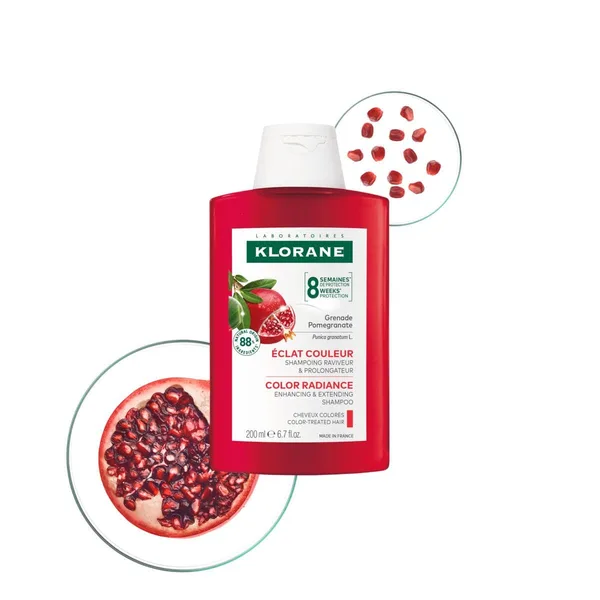
Klorane Pomegranate Colour-Protecting Shampoo
LabReadAI label score
How the score is calculated- Actives and evidence0.1No proven effect when applied: pomegranate extract
- Completeness for the purpose0.2For “colour protection for dyed hair” — 20 %; without a film that keeps the pigment in the hair; no UV filter — though in a rinse-off product it barely works anyway; could be added without conflict: benzophenone-4 (sulisobenzone); a narrow formula for one purpose
- Cleansing base0.8Mild surfactants: coco-betaine, decyl glucoside, disodium laureth sulfosuccinate; irritation potential of the base — 25 % of SLS
- Tolerance0.8Rinse-off product; debatable groups: denatured alcohol, fragrance and its allergens (skin test positive in 13 of 100 tested)
- adults
- colour-treated hair
- dry skinmay dry
- sensitive skinirritation possible
- atopic skinfragrance is a common trigger
Ingredients — 17 components, 1 of them active
The rest is the formula base: it holds texture, shelf life and application, and is not meant to act.
What works: 1 of 17 ingredients: pomegranate extract. Dye is washed out by water and cleansing surfactants rather than “faded”: colour loss is slowed by a mild base, acidic pH and a film on the hair — silicones or hydrolysed proteins that smooth the cuticle. A UV filter in a rinse-off shampoo barely stays on the hair, so its contribution is weak.
What lowers the score: actives and evidence: no proven effect when applied: pomegranate extract; completeness for the purpose: for “colour protection for dyed hair” — 20 %; cleansing base: mild surfactants: coco-betaine, decyl glucoside, disodium laureth sulfosuccinate; tolerance: rinse-off product
Questions: denatured alcohol: alcohol — evaporates fast and degreases; frequent contact can dry the skin — a tolerance question, not a regulatory one; does not clog pores; fragrance and its allergens: fragrance — the fragrance and its aromatic components; the EU requires 26 of them to be listed separately — matters to people allergic to fragrance, does not affect how the product works
- WATER (AQUA)* base: coating, fillers · water — the solvent and base; listed first because there is more of it than anything else; in supplements — part of the capsule shell
- DISODIUM LAURETH SULFOSUCCINATE base: coating, fillers · a mild anionic surfactant: it foams almost like the sulfates but is tolerated far better. Common in baby products.
- CETEARETH-60 MYRISTYL GLYCOL base: coating, fillers · keeps the water and oil parts from separating
- DECYL GLUCOSIDE* base: coating, fillers · one of the gentlest cleansing ingredients: a sugar surfactant that barely disturbs the skin barrier.
- COCO-BETAINE base: coating, fillers · an amphoteric surfactant from coconut oil: it cleanses and stabilises foam. Slightly harsher than cocamidopropyl betaine, yet clearly milder than the sulfates.
- PUNICA GRANATUM PERICARP EXTRACT* works · the active ingredient — what the product is for; form: pomegranate pericarp extract
- ALCOHOL* questions · evaporates fast and degreases; frequent contact can dry the skin — a tolerance question, not a regulatory one; does not clog pores
- CAPRYLYL GLYCOL base: coating, fillers · a humectant that also holds bacteria back, which is why it often replaces part of the preservative.
- CITRIC ACID* base: coating, fillers · acidity regulator
- FRAGRANCE (PARFUM questions · the fragrance and its aromatic components; the EU requires 26 of them to be listed separately — matters to people allergic to fragrance, does not affect how the product works
- HEXAMETHYLINDANOPYRAN base: coating, fillers · gives the product its scent
- POLYQUATERNIUM-22 base: coating, fillers · soften, condition and carry the actives; the backbone of the texture
- RED 33 (CI 17200 base: coating, fillers · a red colorant of decorative cosmetics; does not clog pores
- RED 40 (CI 16035 base: coating, fillers · a red colorant (allura red); rarely clogs pores in leave-on face products
- SODIUM BENZOATE base: coating, fillers · a preservative both in cosmetics and in supplements: a salt of benzoic acid that works in an acidic medium. Permitted as food additive E211 and in cosmetics up to 0.5 %.
- TETRAMETHYL ACETYLOCTAHYDRONAPHTHALENES base: coating, fillers · softens the skin and helps it hold water — the most common role in creams
- TRISODIUM ETHYLENEDIAMINE DISUCCINATE base: coating, fillers · bind hard-water metals so the formula stays stable and the foam works
- YELLOW 6 (CI 15985 base: coating, fillers · give the product its colour; do not affect how it works
Klorane Pomegranate Colour-Protecting Shampoo is a product whose active ingredient is pomegranate extract. The concentration is not declared, but the active sits above the 1 % line in the list — a working share is likely. There is no evidence of effect: pomegranate peel is rich in tannins and binds free radicals in a test tube. There is no work in which pomegranate extract kept dye in the hair: in shampoos for colour-treated hair the colour is preserved not by it but by a mild cleansing base that strips less dye. The formula has 17 ingredients, 1 of which does the work; the rest is the formula base. Worth noting: ALCOHOL* (evaporates fast and degreases; frequent contact can dry the skin — a tolerance question, not a regulatory one; does not clog pores); FRAGRANCE (PARFUM (the fragrance and its aromatic components; the EU requires 26 of them to be listed separately — matters to people allergic to fragrance, does not affect how the product works). Dye is washed out by water and cleansing surfactants rather than “faded”: colour loss is slowed by a mild base, acidic pH and a film on the hair — silicones or hydrolysed proteins that smooth the cuticle. A UV filter in a rinse-off shampoo barely stays on the hair, so its contribution is weak. By the list, no sulfates (SLS/SLES), formaldehyde releasers, isothiazolinones (MIT/MCI), parabens, mineral oils and petrolatum, soap, silicones, gelatin in the coating, toning dyes, tar. Suitable for: adults, colour-treated hair. dry skin, sensitive skin, atopic skin — ask a doctor. fragrance allergy — not without a doctor. Use: when washing colour-treated hair. When to expect an effect: do not expect a separate effect from pomegranate — judge the product by how mild its base is. Label score — 3.3 out of 10 (no proven effect when applied: pomegranate extract; for “colour protection for dyed hair” — 20 %; without a film that keeps the pigment in the hair; no uv filter — though in a rinse-off product it barely works anyway; could be added without conflict: benzophenone-4 (sulisobenzone); a narrow formula for one purpose; mild surfactants: coco-betaine, decyl glucoside, disodium laureth sulfosuccinate; irritation potential of the base — 25 % of sls; rinse-off product; debatable groups: denatured alcohol, fragrance and its allergens (skin test positive in 13 of 100 tested)). Per the pack: for external use, avoid contact with the eyes. A restatement of the label, not an assessment.
Who it does not suit
- fragrance allergyrisk of reaction
Per the maker's leaflet: Per the pack: for external use, avoid contact with the eyes. A restatement of the label, not an assessment.
Is this product right for your hair?
The score describes the formula, not your hair: a sulfate shampoo suits an oily scalp and fails a dry, sensitive one. Tell us about your hair, scalp and the problem — shedding, dandruff, oiliness, dryness — and we will build a routine and say whether this product suits you.