Formula · 6.5
Brand · 6.8
L’Oréal Paris · ceramide R · Russia
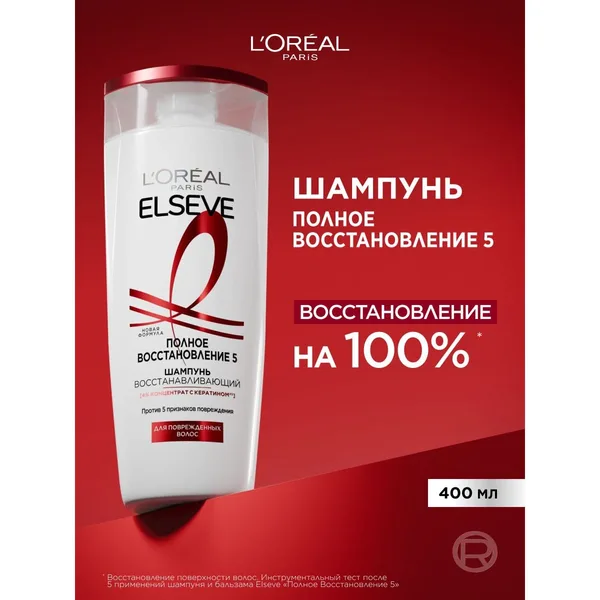
L’Oréal Paris Elseve “Full Repair 5” reviving shampoo
LabReadAI label score
How the score is calculated- Actives and evidence0.4Little evidence of effect
- Completeness for the purpose1.0For “dry and damaged hair” — 100 %; without coconut oil — the only oil proven to reduce protein loss; could be added without conflict: coconut oil; a narrow formula for one purpose
- Cleansing base0.6Harsh surfactants: sodium laureth sulfate (SLES); mild surfactants: cocamidopropyl betaine, coco-betaine, mild surfactants and emulsifiers; irritation potential of the base — 42 % of SLS; film: silicones
- Tolerance0.9Rinse-off product; debatable groups: benzyl alcohol, fragrance and its allergens (skin test positive in 13 of 100 tested)
- adults
- children
- pregnancytopical, in a rinse-off product — allowed
- colour-treated hair
- sensitive skinirritation possible
- atopic skinfragrance is a common trigger
- dry scalpmay dry
Ingredients — 33 components, 1 of them active
The rest is the formula base: it holds texture, shelf life and application, and is not meant to act.
What works: 1 of 33 ingredients: ceramide r. Damaged hair is helped on two fronts: oils that penetrate the shaft (only coconut oil is proven) and a film on the outside — silicones, panthenol, hydrolysed proteins. One from each front is enough; “collagen” and “biotin” in a shampoo work only on the label.
Strengths: completeness for the purpose, tolerance
What lowers the score: actives and evidence: little evidence of effect; cleansing base: harsh surfactants: sodium laureth sulfate
Questions: sodium laureth sulfate (SLES): sodium laureth sulfate — the main cleansing surfactant; can dry a sensitive scalp — the reason people look for «sulfate-free»; unrestricted in rinse-off products; fragrance and its allergens: fragrance, limonene, linalool, alpha-isomethyl ionone, citronellol, hexyl cinnamal — the fragrance and its aromatic components; the EU requires 26 of them to be listed separately — matters to people allergic to fragrance, does not affect how the product works; titanium dioxide (E171): titanium dioxide; benzyl alcohol
- Aqua / Water base: coating, fillers · water — the solvent and base; listed first because there is more of it than anything else; in supplements — part of the capsule shell
- Sodium Laureth Sulfate questions · the main cleansing surfactant; can dry a sensitive scalp — the reason people look for «sulfate-free»; unrestricted in rinse-off products
- Sodium Chloride base: coating, fillers · tune the acidity and texture; salt is a common shampoo thickener
- Cocamidopropyl Betaine base: coating, fillers · a mild amphoteric surfactant: it builds dense foam and softens the harsh sulfates next to it. It occasionally causes contact allergy, and the culprit is a manufacturing impurity rather than the ingredient itself.
- Dimethicone base: coating, fillers · form a smooth film and shine; inert and not absorbed — a preference question, not a safety one
- Parfum / Fragrance questions · the fragrance and its aromatic components; the EU requires 26 of them to be listed separately — matters to people allergic to fragrance, does not affect how the product works
- CI 77891 / Titanium Dioxide questions · white coating pigment; banned as a food additive in the EU since 2022, permitted in Russia and the US
- Guar Hydroxypropyltrimonium Chloride base: coating, fillers · hold the texture: gels, creams and foam do not separate
- Mica base: coating, fillers · mineral flakes that give shimmer and softly scatter light. They do not affect how the product works.
- Lactic Acid base: coating, fillers · tune the acidity and texture; salt is a common shampoo thickener
- Coco-Betaine base: coating, fillers · an amphoteric surfactant from coconut oil: it cleanses and stabilises foam. Slightly harsher than cocamidopropyl betaine, yet clearly milder than the sulfates.
- Sodium Hydroxide base: coating, fillers · tune the acidity and texture; salt is a common shampoo thickener
- Sodium Benzoate base: coating, fillers · a preservative both in cosmetics and in supplements: a salt of benzoic acid that works in an acidic medium. Permitted as food additive E211 and in cosmetics up to 0.5 %.
- Phenoxyethanol base: coating, fillers · the most widespread cosmetic preservative: it keeps the product sterile. Permitted in the EU up to 1 %, recognised as safe at that level.
- Steareth-6 base: coating, fillers · keeps the water and oil parts from separating
- Acetic Acid base: coating, fillers · keeps the acidity of the product within the right range
- PEG-100 Stearate base: coating, fillers · a highly ethoxylated emulsifier, the usual partner of glyceryl stearate; does not clog pores
- Trideceth-10 base: coating, fillers · cleanse and bind water with oils; milder than the sulfate ones
- Trideceth-3 base: coating, fillers · keeps the water and oil parts from separating
- Salicylic Acid base: coating, fillers · holds back the fungus and the flaking of the scalp
- Limonene questions · the fragrance and its aromatic components; the EU requires 26 of them to be listed separately — matters to people allergic to fragrance, does not affect how the product works
- Fumaric Acid base: coating, fillers · keeps the acidity of the product within the right range
- Linalool questions · the fragrance and its aromatic components; the EU requires 26 of them to be listed separately — matters to people allergic to fragrance, does not affect how the product works
- Benzyl Alcohol questions · a preservative and solvent permitted in the EU up to 1 %. It is also on the list of 26 fragrance allergens that must be declared separately, which matters to people allergic to fragrance.
- Amodimethicone base: coating, fillers · form a smooth film and shine; inert and not absorbed — a preference question, not a safety one
- 2-Oleamido-1,3-Octadecanediol works · the active ingredient — what the product is for; form: ceramide R
- Alpha-Isomethyl Ionone questions · the fragrance and its aromatic components; the EU requires 26 of them to be listed separately — matters to people allergic to fragrance, does not affect how the product works
- Carbomer base: coating, fillers · hold the texture: gels, creams and foam do not separate
- Citric Acid base: coating, fillers · acidity regulator
- Citronellol questions · the fragrance and its aromatic components; the EU requires 26 of them to be listed separately — matters to people allergic to fragrance, does not affect how the product works
- Hexylene Glycol base: coating, fillers · humectants and solvents — hold water and help actives dissolve
- Hexyl Cinnamal questions · the fragrance and its aromatic components; the EU requires 26 of them to be listed separately — matters to people allergic to fragrance, does not affect how the product works
- Glycerin base: coating, fillers · a humectant: coats the tablet, holds moisture in creams and shampoos; does not clog pores
- Glycol Distearate base: coating, fillers · humectants and solvents — hold water and help actives dissolve
L’Oréal Paris Elseve “Full Repair 5” reviving shampoo is a product whose active ingredient is ceramide r. The concentration is not declared and the active sits after the 1 % line — more for the label than for the effect. There is little evidence of effect: a synthetic analogue of hair ceramides: it fills the gaps between cuticle scales and makes the surface smoother. The data are laboratory and manufacturer studies; there are no clinical trials. The formula has 33 ingredients, 1 of which does the work; the rest is the formula base. Worth noting: Sodium Laureth Sulfate (the main cleansing surfactant; can dry a sensitive scalp — the reason people look for «sulfate-free»; unrestricted in rinse-off products); Parfum / Fragrance, Limonene, Linalool, Alpha-Isomethyl Ionone, Citronellol, Hexyl Cinnamal (the fragrance and its aromatic components; the EU requires 26 of them to be listed separately — matters to people allergic to fragrance, does not affect how the product works); CI 77891 / Titanium Dioxide; Benzyl Alcohol. Damaged hair is helped on two fronts: oils that penetrate the shaft (only coconut oil is proven) and a film on the outside — silicones, panthenol, hydrolysed proteins. One from each front is enough; “collagen” and “biotin” in a shampoo work only on the label. By the list, no alcohol (alcohol denat), formaldehyde releasers, isothiazolinones (MIT/MCI), parabens, mineral oils and petrolatum, soap, gelatin in the coating, toning dyes, tar. Suitable for: adults, children, pregnancy, colour-treated hair. sensitive skin, atopic skin, dry scalp — ask a doctor. fragrance allergy — not without a doctor. Use: in shampoo and conditioner at every wash. When to expect an effect: smoothness — right away, until the next wash. Label score — 6.5 out of 10 (little evidence of effect; harsh surfactants: sodium laureth sulfate (sles); mild surfactants: cocamidopropyl betaine, coco-betaine, mild surfactants and emulsifiers; irritation potential of the base — 42 % of sls; film: silicones; rinse-off product; debatable groups: benzyl alcohol, fragrance and its allergens (skin test positive in 13 of 100 tested)). Per the pack: avoid contact with eyes; rinse thoroughly with water on contact. A restatement of the label, not an assessment.
Who it does not suit
- fragrance allergyrisk of reaction
Per the maker's leaflet: Per the pack: avoid contact with eyes; rinse thoroughly with water on contact. A restatement of the label, not an assessment.
Is this product right for your hair?
The score describes the formula, not your hair: a sulfate shampoo suits an oily scalp and fails a dry, sensitive one. Tell us about your hair, scalp and the problem — shedding, dandruff, oiliness, dryness — and we will build a routine and say whether this product suits you.
Similar products
Same nutrient and the same purpose — closest by form and dose. Each has its own score by the same method, so you can see whether there is an option nearby that is more honest or simpler in composition.