Blackheads and Enlarged Pores: Causes and How to Reduce Them
Reviewed by the LabReadAI medical team
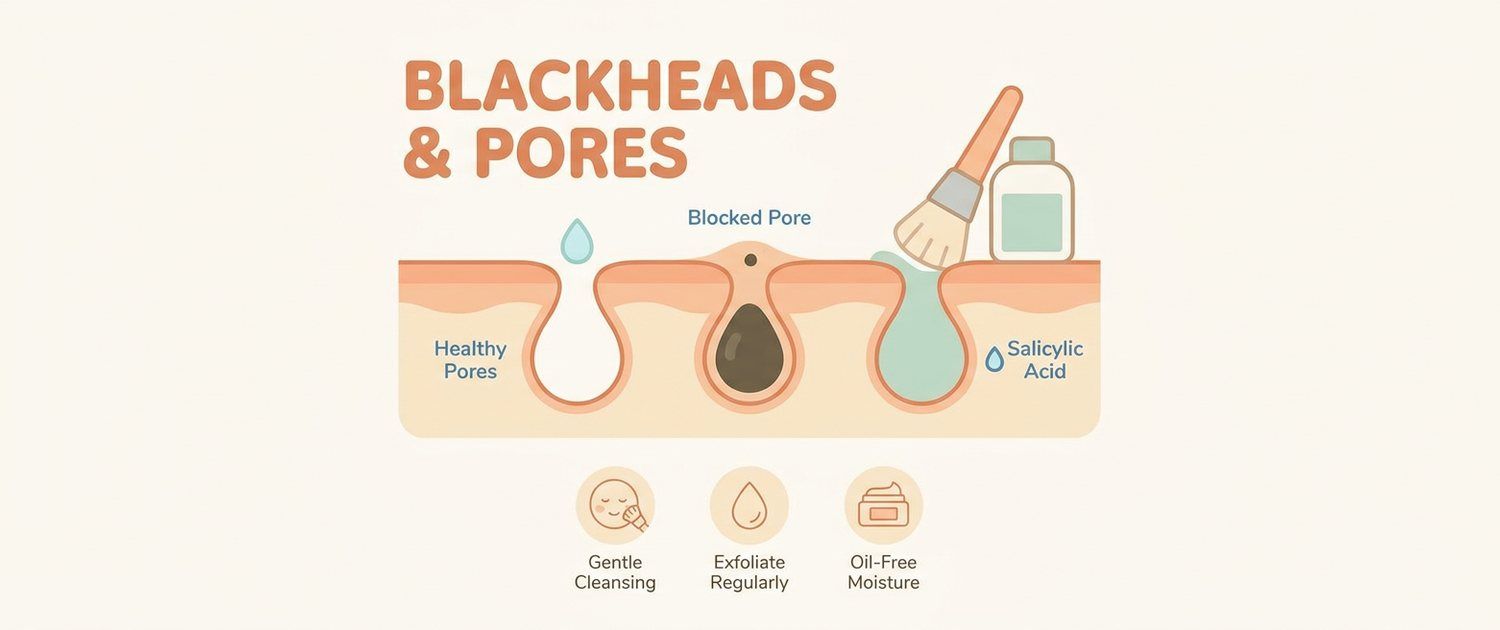
Blackheads and enlarged pores accompany oily and combination skin, and there are many myths around them: they are "pulled out" with strips, "closed" with ice, and squeezed. In reality, these are clogged sebaceous glands, and entirely different tools work on them. Let's break down where blackheads and pores come from, what really helps, and what not to do.
Where Blackheads and Pores Come From
A pore is the opening of a sebaceous gland. When a lot of sebum is produced and dead cells do not shed in time, the duct clogs and a comedone forms. If it is closed — a whitehead; if open and the sebum oxidizes in air — a blackhead (the dark color comes not from dirt but from oxidized melanin and lipids).
Pore size is largely genetic and depends on:
- sebaceous gland activity (oily skin — more visible pores)
- age and loss of skin firmness
- photodamage (UV weakens the framework around the pore)
Why You Shouldn't Squeeze
Squeezing injures the skin, introduces inflammation, and often leaves post-acne marks and pigmentation. One comedone easily turns into an inflamed pimple. So mechanical extraction should be done carefully and preferably by a specialist, while at home the focus is on ingredients.
What Really Helps
- Salicylic acid (BHA) — oil-soluble, penetrates the pore and dissolves sebaceous plugs; a key ingredient. More on acids in acids for the face
- Retinoids — normalize shedding, reduce comedones
- Niacinamide — reduces sebum production, makes pores less visible; see niacinamide: what it is for
- Regular gentle cleansing and SPF (photoprotection preserves the skin framework)
If there is inflammation alongside the pores, it is important to address acne itself — see acne: causes. Matching non-aggressive care to oily skin is helped by cosmetics matching by composition.
How to Care for Oily Skin
- Cleanse twice a day with a gentle product, without over-drying
- BHA 1–2 times a week, then as tolerated
- Light non-comedogenic textures (though "non-comedogenic" is a marketing term without a strict standard; see how to check cosmetics ingredients)
- Mandatory SPF, preferably a light fluid
Myths About Pores
- "Pores open and close" — no, a pore is not a muscle; heat only softens the contents
- "Pores can be shrunk forever" — size is genetic; it can be made less visible but not removed
- "Strips and peel-off masks treat them" — they remove the top of the plug but not the cause; the effect is cosmetic and short-lived
- "Oily skin should be dried with alcohol" — over-drying increases sebum production
When to See a Cosmetologist or Dermatologist
If pores come with persistent inflammation, cysts, or scars — that is already acne, and it needs dermatologist therapy (retinoids, sometimes systemic treatment). Professional cleansings and procedures (chemical peels, laser) help when home care is not enough.
This information is for educational purposes and does not replace a specialist consultation.
For informational purposes only
This article is for informational purposes only and does not constitute medical advice, diagnosis, or treatment. Please consult a healthcare professional for medical guidance.