H. pylori Tests: the Breath Test, Stool and Blood Test
Reviewed by the LabReadAI medical team
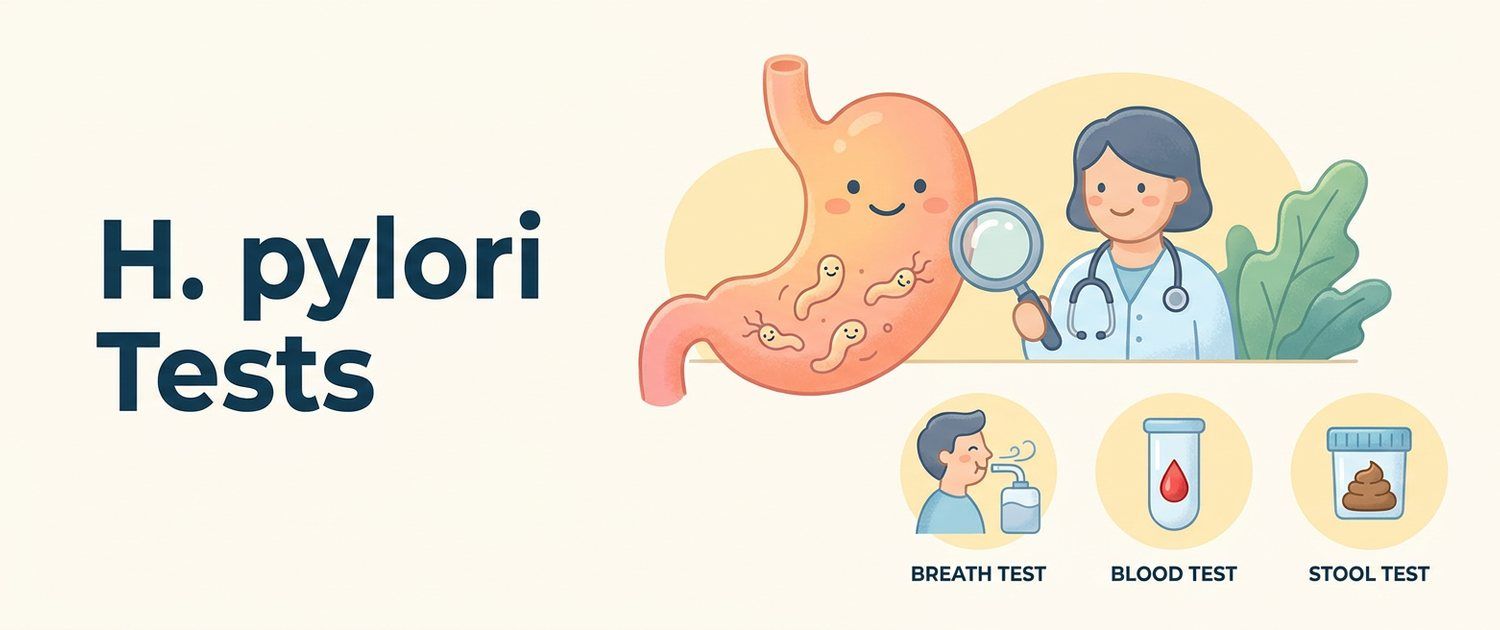
A doctor sends you "to get tested for H. pylori," and at the lab there are several different tests at once, and it is unclear which to choose. This is a common situation. H. pylori tests really do differ a lot in meaning: some show an active infection right now, others only a trace of contact. Let us go through it step by step: which tests exist, how to prepare, and which to choose in your situation.
Which H. pylori Tests Exist
There are four main methods: the urea breath test, a stool antigen test, a blood antibody (IgG) test, and a biopsy of the lining during gastroscopy. They differ not only in convenience but in which question they answer. What a positive result of each one means is covered in detail in the article on H. pylori and reading the tests.
The Urea Breath Test
This is a non-invasive and accurate method: you drink a urea solution and breathe into a tube. If the bacterium is present, it breaks down the urea, and the device detects this. The breath test shows an ACTIVE infection and is well suited to follow-up after treatment. Its high accuracy (sensitivity and specificity above 95%) makes it one of the methods of choice.
The Stool Antigen Test
The stool test detects antigens (particles) of H. pylori and also shows an active infection. Its accuracy is comparable to the breath test, it is convenient (no special equipment needed), and it is equally suitable for confirming cure after a course of antibiotics. It is a good alternative to the breath test, especially for children.
The Blood Antibody Test (and Its Limit)
A blood IgG antibody test is the most "familiar" test, but it has an important limitation: it does NOT distinguish a current infection from a past one. Antibodies remain in the blood for years after successful treatment, so a positive IgG does not prove the bacterium is present now and is unsuitable for follow-up. Leading societies no longer recommend serology as a test of active infection.
Biopsy During Gastroscopy
If gastroscopy is already planned (for example, with suspected ulcer or gastritis), a piece of the lining is taken during it — for a rapid urease test and histology. This allows the state of the stomach to be seen and H. pylori checked at the same time. The method is accurate but invasive, so it is not done just to look for the bacterium.
How to Prepare for the Test
The key rule: some drugs give a false-negative breath test, stool test and biopsy. So in advance (in agreement with a doctor) you stop: proton pump inhibitors (omeprazole and the like) about 2 weeks before, antibiotics and bismuth about 4 weeks before. The blood antibody test does not depend on this. Always check the exact timing and tactics with a doctor.
Which Test to Choose and Follow-up After Treatment
For the initial diagnosis of active infection and for follow-up after treatment, the breath test or stool test is chosen. The blood antibody test is auxiliary and unsuitable for follow-up. After a course of treatment, the check is usually done 4 weeks or more later, off antibiotics and PPIs. With stomach complaints it is also worth reading about the causes of gastritis, and with anemia — checking ferritin.
This article is for informational purposes only and does not replace a doctor's consultation.
For informational purposes only
This article is for informational purposes only and does not constitute medical advice, diagnosis, or treatment. Please consult a healthcare professional for medical guidance.