Couperose and Rosacea: Care, Triggers and What to Look For
Reviewed by the LabReadAI medical team
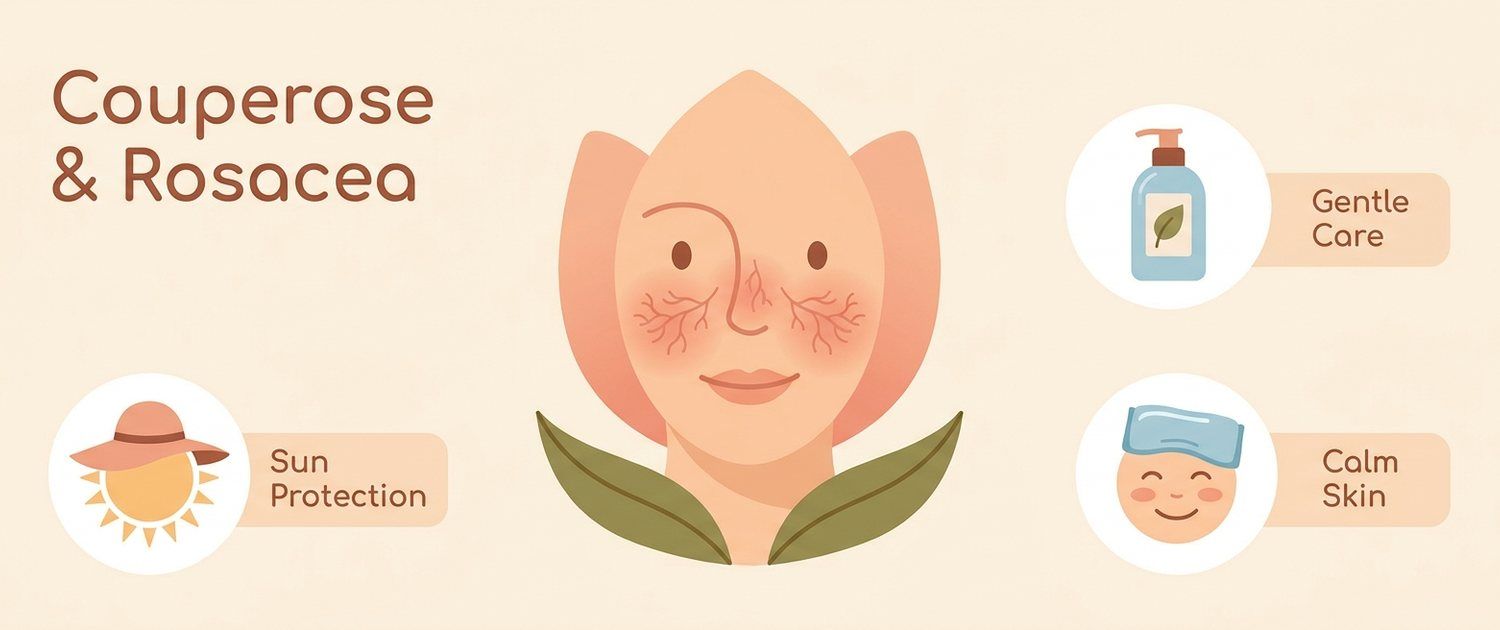
Persistent facial redness, visible vessels, hot flushes — a common and very distressing problem. It is often confused: "couperose" means visible dilated vessels, while rosacea is a chronic inflammatory skin disease that often starts precisely with redness. Let's break down how they differ, which triggers worsen redness, what care and composition really help, and when medical therapy is needed.
What Couperose and Rosacea Are
- Couperose — dilated superficial vessels (telangiectasias) showing through the skin. It is a cosmetic sign, not a diagnosis.
- Rosacea — a chronic disease: persistent redness of the central face, flushing, sometimes papules and pustules, burning, heightened sensitivity. Couperose is often one of its manifestations.
How Couperose Differs From Rosacea
Couperose is about vessels, mostly removed with devices (laser). Rosacea is about inflammation and vessel instability, and it is managed comprehensively: care + medication + trigger control. So with persistent redness, flushing, and breakouts, it is important not to "mask" it but to find out whether rosacea is present.
Triggers That Worsen Facial Redness
Rosacea almost always has personal triggers — identifying them is half the success:
- Sun (the main trigger), heat and cold, sharp temperature changes
- Spicy food, hot drinks, alcohol
- Stress
- Aggressive skincare, scrubs, alcohol in the formula
- Sometimes the Demodex mite intensifies inflammation
A trigger diary and avoidance often reduce flares more than any cream.
Sensitive Skin Care: What to Look For in the Composition
The goal of care is to restore the barrier and calm the skin, not to "exfoliate":
- Gentle cleansing without sulfates and alcohol
- Azelaic acid — reduces inflammation and redness (proven in rosacea); more on acids in acids for the face
- Niacinamide — strengthens the barrier and reduces sensitivity; see niacinamide: what it is for
- Ceramides, panthenol — barrier repair
- SPF 30–50 daily — mandatory
Matching products that will not provoke a flare is helped by cosmetics matching by composition, and how to read the label is in how to check cosmetics ingredients.
What to Avoid
- Scrubs, harsh peels, brushes
- Alcohol, menthol, essential oils, fragrances in the formula
- Hot water and steaming
- If skin tends toward dryness and flaking — especially gentle barrier care (see dry and flaky skin)
When Medical Therapy Is Needed (Azelaic Acid, Ivermectin)
Rosacea is a diagnosis made by a dermatologist, and it has proven therapy: topical azelaic acid, ivermectin, metronidazole, if needed oral antibiotics or isotretinoin, and for vessels and persistent redness — laser/IPL. Self-treatment with "couperose creams" often just delays effective treatment.
Ivermectin is on this list for a reason: in rosacea the skin often carries an excess of Demodex mites, and sometimes they are what lies behind "rosacea that does not respond to skincare". How this is checked and how the two differ is covered in demodicosis (face mites).
This information is for educational purposes and does not replace a specialist consultation.
For informational purposes only
This article is for informational purposes only and does not constitute medical advice, diagnosis, or treatment. Please consult a healthcare professional for medical guidance.