Retinol and Retinoids: How to Start, Who Shouldn't, the Difference
Reviewed by the LabReadAI medical team
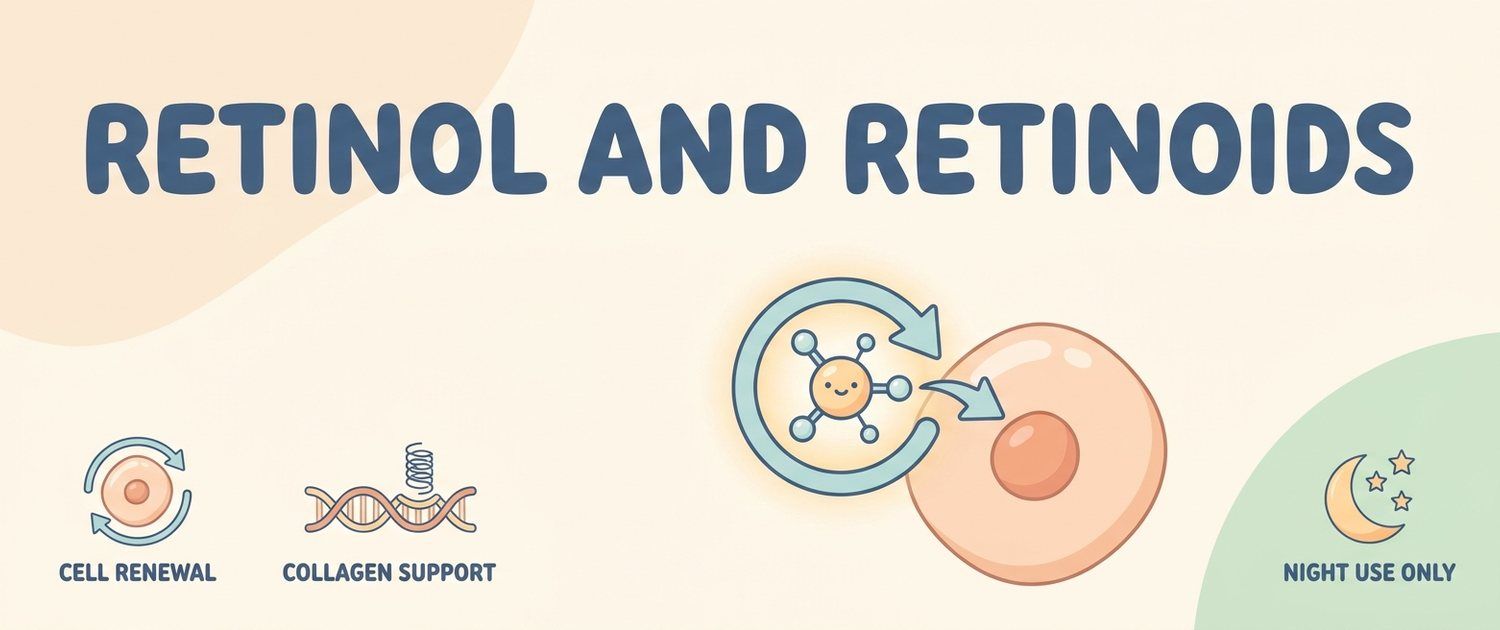
Retinol and retinoids are the most proven class of skincare actives: they work on wrinkles, acne, and pigmentation. But they are also where people most often start incorrectly — and get irritation, flaking, and disappointment. Let's break down how retinol differs from retinoids, the types, how to start, and who they are contraindicated for.
What Retinol and Retinoids Are
Retinoids are a family of vitamin A derivatives. In the skin they all eventually convert to the active form (retinoic acid), which speeds up cell renewal, stimulates collagen, and normalizes sebaceous gland function. "Retinol" is one of the mild cosmetic forms; "retinoids" is the umbrella name for the whole class, including prescription ones.
Types of Retinoids (Strength and Difference)
By strength and speed of action (and irritation):
- Retinol, retinal (retinaldehyde) — cosmetic forms, milder, sold over the counter
- Adapalene — a mild prescription/OTC retinoid, popular for acne
- Tretinoin (retinoic acid) — prescription, the most studied for wrinkles and acne, stronger and more irritating
- Esters (retinyl palmitate) — the weakest
The stronger the form, the faster the effect but the higher the irritation risk — so beginners start with mild ones.
What Retinol Does for Skin
- Reduces wrinkles and improves texture (detail in wrinkles: care)
- Treats acne and normalizes pores
- Lightens pigmentation and post-acne (see dark spots)
- Stimulates collagen synthesis
How to Start Retinol Without Burning Your Skin
The main rule is slow:
- Start with a low concentration, 1–2 times a week in the evening, gradually increasing
- Apply to dry skin, a small amount (a "pea" for the whole face)
- The first weeks may bring light flaking and dryness (the adaptation period, "retinoid dermatitis")
- Moisturizing and barrier care are a must
- In the morning — mandatory SPF: retinoids increase sun sensitivity
Retinol and Pregnancy — Important
Retinoids (including cosmetic retinol) are not used in pregnancy or when planning it: systemic retinoids are proven to cause birth defects, and although topical absorption is minimal, they are stopped as a precaution. Safe alternatives in this period are azelaic acid, acids (with approval), and moisturizing. This is part of the safety rules that cosmetics matching by composition accounts for.
What to Pair It With and What to Avoid
- Good: niacinamide (eases irritation), moisturizers, SPF
- Careful: acids and strong exfoliants on the same evening — frequent irritation, better split across days
- Don't combine at the start with aggressive procedures
Who Retinoids Are For
Almost everyone for anti-aging and acne — but start carefully. With very sensitive skin, rosacea, or eczema — cautiously and ideally after a dermatologist consult. How to read a retinoid product's composition is in how to check cosmetics ingredients.
This information is for educational purposes and does not replace a specialist consultation.
For informational purposes only
This article is for informational purposes only and does not constitute medical advice, diagnosis, or treatment. Please consult a healthcare professional for medical guidance.