Tick Bite: What to Do, How to Remove It and Where to Test It
Reviewed by the LabReadAI medical team
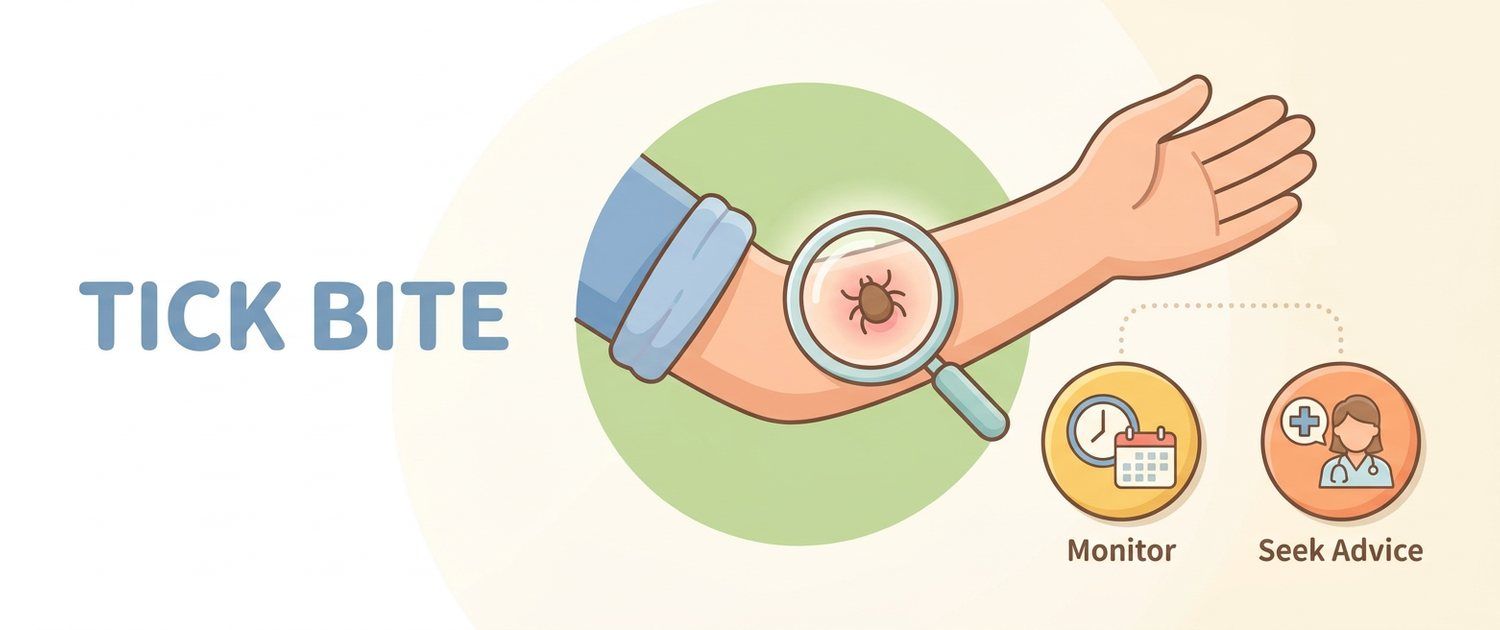
A tick bite itself is not dangerous and is often painless — the concern is that ticks carry serious infections. The good news: correct, prompt action sharply lowers the risk. Here, step by step, is what to do after a tick bite, how to remove it, where to submit it for testing and which symptoms to watch.
What to Do Right After a Tick Bite
The main rule is not to panic and to act quickly: the longer the tick stays on the skin, the higher the risk of transmission. The tick should be removed as soon as possible — correctly by yourself or at a clinic. After removal the bite site is treated with antiseptic and hands are washed. Do not crush the tick with your fingers.
How to Remove a Tick Correctly
Grasp the tick as close to the skin as possible — with tweezers or a special tool — and pull steadily, without jerks or twisting, trying not to crush it or leave the head behind. Do not smear the tick with oil, alcohol or burn it — this does not help and may increase the release of saliva with pathogens. If the head stays in the skin, treat it with antiseptic; see a doctor if it becomes inflamed.
Where to Submit the Tick for Testing
Keep the removed tick (in a closed container with a moist cotton pad) and submit it to a lab for testing — alive or intact. Testing the tick shows whether it carried the encephalitis virus, Borrelia and other pathogens, and helps the doctor decide whether prophylaxis is needed. This does not replace watching how you feel.
Which Symptoms to Watch After a Bite
Watch the bite site and your general state for 2–4 weeks. Warning signs: an expanding ring-shaped redness (erythema migrans — a sign of Lyme disease), fever, headache, weakness, muscle pain, swollen lymph nodes. Any of these is a reason to see a doctor, even if the tick was removed correctly.
Which Diseases Ticks Carry
The most significant are tick-borne encephalitis (a virus that attacks the nervous system, with a vaccine) and Lyme disease (a bacterium treated with antibiotics). Less often, other infections. One tick can carry several pathogens, so monitoring and, if needed, testing matter.
When a Vaccine or Emergency Prophylaxis Is Needed
In regions endemic for encephalitis, a doctor may prescribe emergency prophylaxis for an unvaccinated person after a bite — started within the first days. For Lyme disease, in select cases a doctor considers a preventive antibiotic. The routine tick-borne encephalitis vaccine is given in advance, before the season, and is the most reliable protection.
Which Blood Tests to Take After a Bite
Right after a bite, blood tests are usually uninformative — antibodies appear later. They are taken when symptoms appear or at the times the doctor indicates (usually 2–4 weeks later): antibodies to the encephalitis virus and to Borrelia. A complete blood count is used as support. A confusing result can be uploaded for decoding.
When to See a Doctor Urgently
Urgently — for fever, severe headache, vomiting, muscle weakness, impaired consciousness or an expanding redness on the skin within a few weeks of a bite. Also see a doctor if the tick could not be fully removed or the bite site became inflamed. If unsure, you can describe your symptoms.
This article is for informational purposes only and does not replace a doctor's consultation. The need for prophylaxis and tests is determined by a specialist.
For informational purposes only
This article is for informational purposes only and does not constitute medical advice, diagnosis, or treatment. Please consult a healthcare professional for medical guidance.