Lyme Disease (Borreliosis): Symptoms, Rash and Tests
Reviewed by the LabReadAI medical team
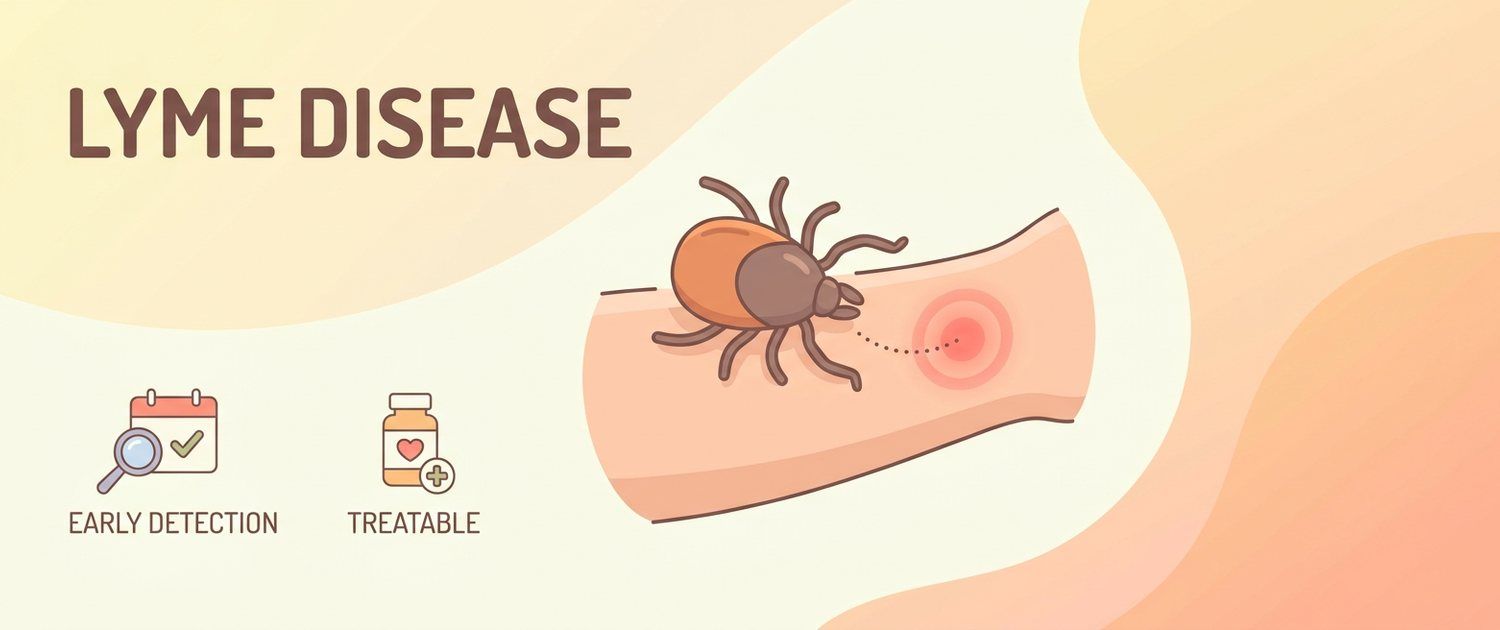
Lyme disease, or borreliosis, is the most common infection carried by ticks. The good news: unlike tick-borne encephalitis, this is a bacterial infection and it responds well to antibiotics, especially early. The bad news: untreated, Lyme disease can drag on for months and years, affecting the joints, heart and nerves. Here are the symptoms of borreliosis, what the migrating rash is and which tests are needed.
What Borreliosis Is and How You Catch It
Borreliosis is caused by bacteria of the genus Borrelia, transmitted through the bite of an infected ixodid tick. The longer the tick stays on the skin, the higher the risk of transmission, so early tick removal protects you. The same tick can also carry the tick-borne encephalitis virus — these are different diseases with different management.
The Migrating Rash — the Main Early Sign
The classic and most recognizable symptom is erythema migrans: a redness at the bite site that gradually expands into a ring (sometimes with central clearing, a "bull's-eye"), often painless. It appears days to weeks after the bite. If you notice such a ring-shaped rash after time outdoors, that is a reason to see a doctor, even without other complaints.
Stages and Symptoms of Lyme Disease
Early stage: the rash, a flu-like state (fever, weakness, muscle aches, swollen lymph nodes). Without treatment — late stages with joint involvement (Lyme arthritis), the heart (rhythm disturbances) and the nervous system (neuropathies, facial nerve palsy). The later treatment starts, the harder and longer it is.
Which Tests Are Used
An important point: with a typical migrating rash after a bite, the diagnosis is clinical and treatment starts at once — tests are unnecessary and are often still negative early on. In late stages a blood antibody test is used (two-step: ELISA, then a confirmatory immunoblot). A complete blood count has no specific changes, but CRP sometimes rises. A confusing report can be uploaded for decoding.
Treatment of Borreliosis
Borreliosis is treated with antibiotics prescribed by a doctor; early on the course is usually short and effective. Late forms need longer treatment. The key is not to ignore an early rash: a timely antibiotic course prevents progression to severe stages. Self-treatment is unacceptable.
Consequences and Prevention
With early treatment the outlook is good and there are usually no consequences. Prolonged forms can cause lasting joint and neurological problems. There is no widely used vaccine against borreliosis (unlike encephalitis), so prevention means protection from bites and early, correct tick removal.
When to See a Doctor
See a doctor for an expanding redness at the bite site, flu-like symptoms after a tick bite, and later for joint pain and swelling, facial asymmetry or heart palpitations. Do not wait: an early antibiotic solves the problem, while late stages are harder to treat. What to do right after a bite is in tick bite: what to do.
This article is for informational purposes only and does not replace a doctor's consultation. The antibiotic and its course are prescribed by a specialist.
For informational purposes only
This article is for informational purposes only and does not constitute medical advice, diagnosis, or treatment. Please consult a healthcare professional for medical guidance.