Formula · 6.8
Brand · 6.8
L’Oréal Professionnel · vitamin E + glycine · Spain
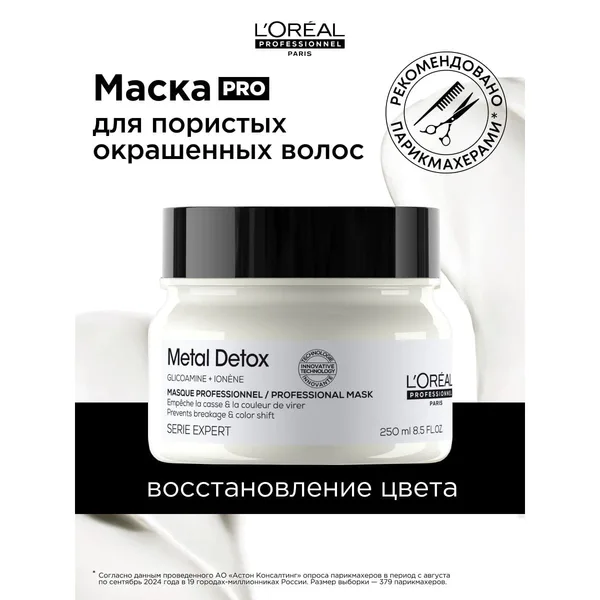
L’Oréal Professionnel Metal Detox mask for coloured hair
LabReadAI label score
How the score is calculated- Actives and evidence0.4Little evidence of effect
- Completeness for the purpose1.0For “colour protection for dyed hair” — 100 %; no UV filter — though in a rinse-off product it barely works anyway; pomegranate extract; could be added without conflict: benzophenone-4 (sulisobenzone), pomegranate extract; a formula with one main purpose
- Tolerance0.9Rinse-off product; debatable groups: fragrance and its allergens (skin test positive in 13 of 100 tested)
- adults
- pregnancyallowed per the leaflet
- dry skin
- sensitive skinirritation possible
- atopic skinfragrance is a common trigger
Ingredients — 19 components, 1 of them active
The rest is the formula base: it holds texture, shelf life and application, and is not meant to act.
What works: 1 of 19 ingredients: vitamin e. Dye is washed out by water and cleansing surfactants rather than “faded”: colour loss is slowed by a mild base, acidic pH and a film on the hair — silicones or hydrolysed proteins that smooth the cuticle. A UV filter in a rinse-off shampoo barely stays on the hair, so its contribution is weak.
Strengths: completeness for the purpose, tolerance
What lowers the score: actives and evidence: little evidence of effect
Questions: fragrance and its allergens: fragrance, limonene, hexyl cinnamal, linalool, citral, geraniol — the fragrance and its aromatic components; the EU requires 26 of them to be listed separately — matters to people allergic to fragrance, does not affect how the product works
- Aqua / Water base: coating, fillers · water — the solvent and base; listed first because there is more of it than anything else; in supplements — part of the capsule shell
- Cetearyl Alcohol base: coating, fillers · a fatty-alcohol blend (C16–C18), an emulsifier and thickener, does not dry the skin; paired with ceteareth-20 — 4 of 5; rarely clogs pores in leave-on face products
- Amodimethicone base: coating, fillers · form a smooth film and shine; inert and not absorbed — a preference question, not a safety one
- Behentrimonium Chloride base: coating, fillers · soften, condition and carry the actives; the backbone of the texture
- Cetyl Esters base: coating, fillers · a wax-ester blend (spermaceti substitute), gives creams body; does not clog pores
- Parfum / Fragrance questions · the fragrance and its aromatic components; the EU requires 26 of them to be listed separately — matters to people allergic to fragrance, does not affect how the product works
- Isopropyl Alcohol base: coating, fillers · a volatile solvent alcohol, evaporates without residue; does not clog pores
- Trideceth-6 base: coating, fillers · keeps the water and oil parts from separating
- Phenoxyethanol base: coating, fillers · the most widespread cosmetic preservative: it keeps the product sterile. Permitted in the EU up to 1 %, recognised as safe at that level.
- Limonene questions · the fragrance and its aromatic components; the EU requires 26 of them to be listed separately — matters to people allergic to fragrance, does not affect how the product works
- Cetrimonium Chloride base: coating, fillers · soften, condition and carry the actives; the backbone of the texture
- Hexyl Cinnamal questions · the fragrance and its aromatic components; the EU requires 26 of them to be listed separately — matters to people allergic to fragrance, does not affect how the product works
- Linalool questions · the fragrance and its aromatic components; the EU requires 26 of them to be listed separately — matters to people allergic to fragrance, does not affect how the product works
- Chlorhexidine Dihydrochloride base: coating, fillers · holds back the growth of bacteria and fungi
- Citral questions · the fragrance and its aromatic components; the EU requires 26 of them to be listed separately — matters to people allergic to fragrance, does not affect how the product works
- Geraniol questions · the fragrance and its aromatic components; the EU requires 26 of them to be listed separately — matters to people allergic to fragrance, does not affect how the product works
- Glycine base: coating, fillers · amino acids, lipids and sugars akin to the skin’s own components — support for its barrier
- Tocopherol works · the active ingredient — what the product is for; form: tocopherol (in cosmetics)
- Polyquaternium-7 base: coating, fillers · a conditioning polymer: it removes static, makes combing easier and softens the foam.
- Sodium Benzoate base: coating, fillers · a preservative both in cosmetics and in supplements: a salt of benzoic acid that works in an acidic medium. Permitted as food additive E211 and in cosmetics up to 0.5 %.
L’Oréal Professionnel Metal Detox mask for coloured hair is a product whose active ingredient is vitamin e. The concentration is not declared; the active sits after the 1 % line, but works at small shares. There is little evidence of effect: an antioxidant: protects the formula oils from going rancid; alone changes skin little. The formula has 19 ingredients, 1 of which does the work; the rest is the formula base. Worth noting: Parfum / Fragrance, Limonene, Hexyl Cinnamal, Linalool, Citral, Geraniol (the fragrance and its aromatic components; the EU requires 26 of them to be listed separately — matters to people allergic to fragrance, does not affect how the product works). Dye is washed out by water and cleansing surfactants rather than “faded”: colour loss is slowed by a mild base, acidic pH and a film on the hair — silicones or hydrolysed proteins that smooth the cuticle. A UV filter in a rinse-off shampoo barely stays on the hair, so its contribution is weak. By the list, no alcohol (alcohol denat), sulfates (SLS/SLES), formaldehyde releasers, isothiazolinones (MIT/MCI), parabens, mineral oils and petrolatum, soap, gelatin in the coating, toning dyes, tar. Suitable for: adults, pregnancy, dry skin. sensitive skin, atopic skin — ask a doctor. fragrance allergy — not without a doctor. Use: morning and evening. When to expect an effect: gives no visible effect alone — protects the formula's oils. Label score — 6.8 out of 10 (little evidence of effect; rinse-off product; debatable groups: fragrance and its allergens (skin test positive in 13 of 100 tested)). Per the pack: avoid contact with eyes; rinse thoroughly with water on contact. A restatement of the label, not an assessment.
Who it does not suit
- fragrance allergyrisk of reaction
When to stop: rarely — contact allergy: rash, itching — stop
Per the maker's leaflet: Per the pack: avoid contact with eyes; rinse thoroughly with water on contact. A restatement of the label, not an assessment.
Is this product right for your hair?
The score describes the formula, not your hair: a sulfate shampoo suits an oily scalp and fails a dry, sensitive one. Tell us about your hair, scalp and the problem — shedding, dandruff, oiliness, dryness — and we will build a routine and say whether this product suits you.
Similar products
Same nutrient and the same purpose — closest by form and dose. Each has its own score by the same method, so you can see whether there is an option nearby that is more honest or simpler in composition.