Tachycardia and Military Service: Articles 42 and 47 Explained
Reviewed by the LabReadAI medical team
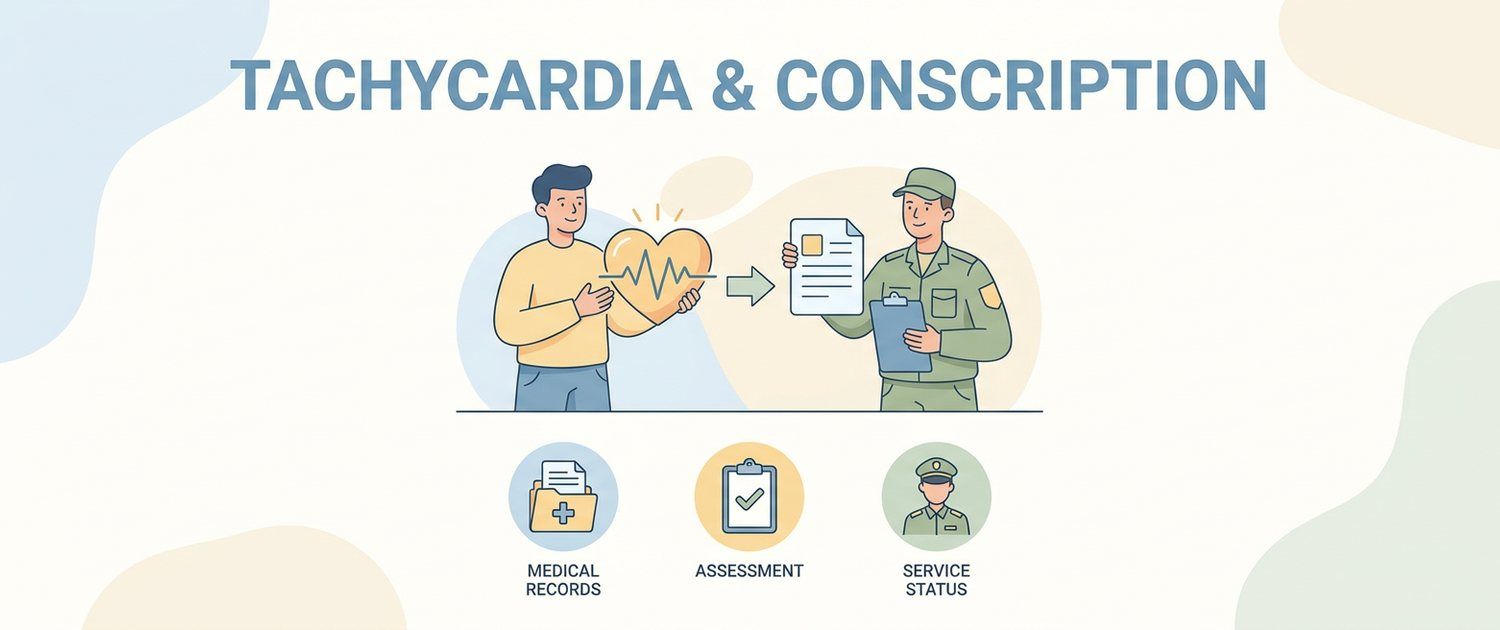
The short answer: everything depends on what lies behind the fast heartbeat. If it is paroxysmal supraventricular tachycardia or another persistent rhythm disturbance, assessment follows article 42 and usually leads to category V. If the heart is structurally healthy and the rhythm accelerates against a background of autonomic disturbance, article 47 applies with different categories. And sinus tachycardia by itself often provides no grounds for applying an article at all.
Which fitness category tachycardia yields
Article 42 covers rheumatic and non-rheumatic heart disease, including rhythm and conduction disorders. Heart failure is graded by NYHA functional class.
| What the records show | Clause | Column I (conscription) |
|---|---|---|
| Heart failure class IV; malignant ventricular tachyarrhythmias; sick sinus syndrome | «a» | D — unfit |
| Heart failure class III; long QT syndrome (QTc from 480 ms) or short QT (340 ms or less) | «b» | D — unfit |
| Heart failure class II; persistent rhythm disturbances without failure or with class I–II | «v» | V — limited fitness |
| Idiopathic "benign" ventricular tachyarrhythmias; first-degree AV block; minor cardiac anomalies | «g» | B-4 — fit with restrictions |
Paroxysmal tachycardia and WPW
The regulation devotes a separate paragraph to this group:
Persons with persistent cardiac rhythm and conduction disturbances lasting more than 7 days, requiring antiarrhythmic therapy or catheter ablation and recurring after treatment ceases, with paroxysmal supraventricular tachyarrhythmias, Wolff-Parkinson-White syndrome… are assessed under clause «a» or «b» depending on the functional class of heart failure. In the absence of heart failure or with class I or II, assessment is carried out under clause «v».
The practical consequence: with paroxysmal supraventricular tachycardia and no pronounced heart failure the category will be V. The operative words are "persistent", "more than 7 days" and "recurring after treatment ceases": a single recorded episode does not meet that definition.
When article 47 applies instead of 42
Where there is no structural heart disease and the complaints and rhythm relate to autonomic regulation, assessment follows article 47, "Neurocirculatory asthenia":
- clause «a» — persistent, markedly expressed autonomic-vascular disturbances → category V;
- clause «b» — moderately expressed manifestations, including transient rhythm disturbances → category B-3.
For conscripts the regulation adds a condition: the disturbances must resist treatment for at least 6 months, confirmed by medical documents. Moreover, at initial registration for military service a diagnosis of neurocirculatory asthenia makes a citizen temporarily unfit under article 48 and subject to treatment.
Article 47 ends with a direct referral back: where rhythm disturbances result from organic myocardial changes, assessment follows article 42.
What the regulation disregards
This is the most practically important list — half of the findings people bring to the board land here:
Rare isolated resting extrasystoles and functional sinus arrhythmia are not grounds for applying this article, do not prevent military service or admission to military educational institutions.
Article 42 treats the following as equally physiological: incomplete right bundle branch block, functional (vagal) first-degree AV block, additional or anomalously placed left ventricular chordae, atrial septal aneurysm, and mitral valve prolapse with first-degree regurgitation without heart failure.
How heart failure is confirmed
The regulation asks for measurements, not complaints:
Heart failure of class I or II must be confirmed by cardiohaemodynamic parameters detected on echocardiography (reduced ejection fraction, increased systolic and diastolic dimensions of the left ventricle and atrium, regurgitant flows over the mitral and aortic valves, impaired left ventricular diastolic function), by results of bicycle ergometry or a treadmill test, and by a 6-minute walk test combined with analysis of clinical manifestations.
Separately, when assessing rhythm the regulation requires mandatory measurement of the PQ interval and calculation of the corrected QT interval — the QTc is exactly what decides whether clause «b» applies.
What your records must contain
- A resting ECG with the PQ interval and corrected QT calculated.
- Holter monitoring — without it the persistence of a rhythm disturbance cannot be shown; how such recordings read is covered in the piece on reading an ECG.
- Echocardiography with ejection fraction and chamber dimensions.
- An exercise test — bicycle ergometry or treadmill.
- Dates and durations of episodes, the antiarrhythmic therapy prescribed and its outcome.
- The chart code is I47 for paroxysmal tachycardia.
- For an autonomic origin — neurologist and ophthalmologist conclusions: article 47 requires their participation.
What is usually missing
- There is one ECG showing a fast rhythm but no Holter and no episode durations.
- The corrected QT was not calculated, although the regulation requires it outright.
- No echocardiography — nothing to establish the functional class with.
- Organic and autonomic origins are not separated, and the article itself depends on that.
- Palpitations are not linked to any work-up; what generally lies behind them is collected in the review of rapid heartbeat.
- Thyroid disorders and anaemia were not excluded — common causes of persistent tachycardia.
Questions for your doctor
- What is the nature of my tachycardia — is there structural heart disease?
- Were episodes captured on Holter monitoring, and how long did they last?
- What is my corrected QT interval?
- What is my ejection fraction, and are there signs of heart failure?
- Was antiarrhythmic therapy prescribed, and did episodes return after it stopped?
The heart at departmental boards
The above concerns assessment under Government Decree No. 565. The Interior Ministry, National Guard, Federal Security Service and Emergencies Ministry use their own schedules of diseases with their own cardiovascular requirements. A review under articles 42 and 47 shows how complete your records are but is not their regulation.
The short version
A fast heartbeat is not a diagnosis, and the board starts not with it but with the question of origin: organic leads to article 42, autonomic to article 47. Paroxysmal supraventricular tachycardia without pronounced heart failure yields category V; functional sinus tachycardia and rare extrasystoles yield nothing. Holter monitoring, echocardiography and a calculated corrected QT are what separate these worlds. Only the military medical board determines the fitness category.
For informational purposes only
This article is for informational purposes only and does not constitute medical advice, diagnosis, or treatment. Please consult a healthcare professional for medical guidance.