Varicocele and Varicose Veins at the Board: Article 45
Reviewed by the LabReadAI medical team
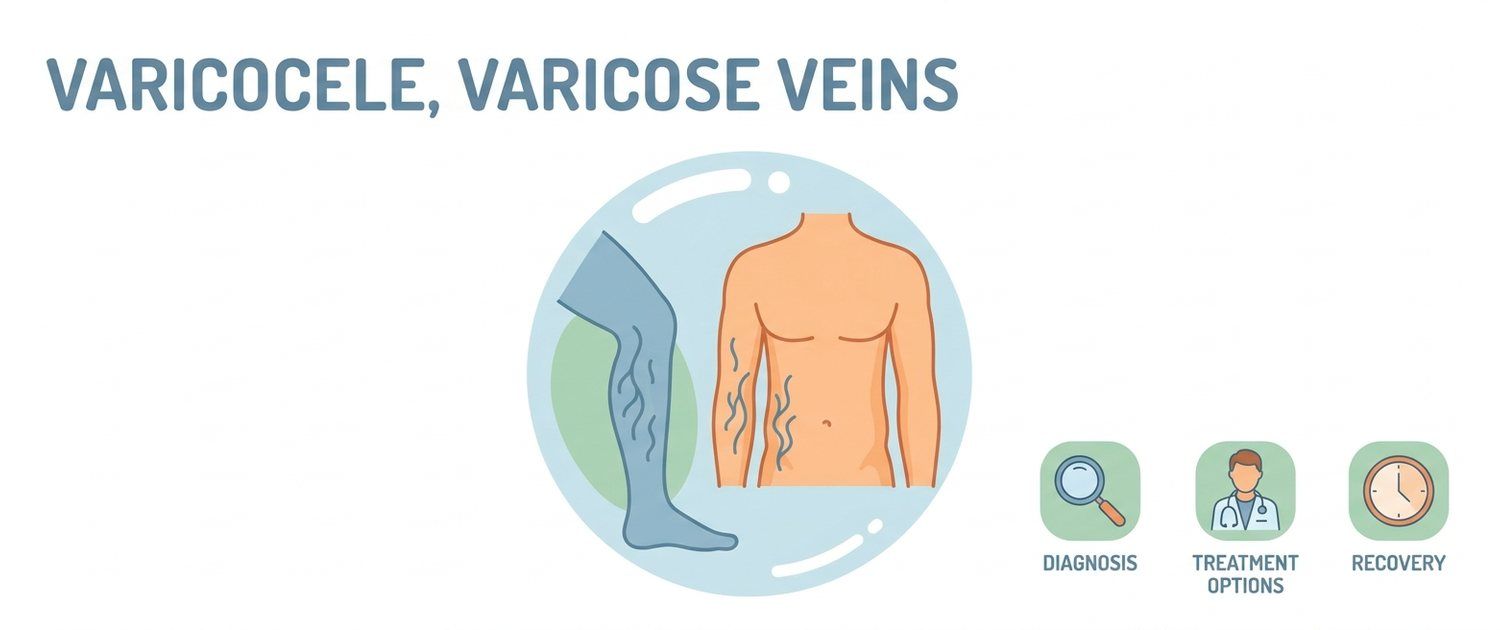
The short answer: both varicocele and varicose disease of the leg veins are assessed under a single article, 45, of the Schedule of Diseases, and what decides there is impaired circulation, not the presence of dilated veins. Moreover, the regulation names two conditions that are not grounds for the article — and the first is grade I varicocele.
Which fitness category venous disease yields
Article 45 is titled "Diseases, congenital anomalies and consequences of injuries of the aorta, major and peripheral arteries and veins, and lymphatic vessels".
| What the records show | Clause | Column I (conscription) |
|---|---|---|
| Significant impairment of circulation and function | «a» | D — unfit |
| Moderate impairment of circulation and function | «b» | V — limited fitness |
| Minor impairment of circulation and function | «v» | V — limited fitness |
| Objective findings without impairment of circulation and function | «g» | B-3 — fit with restrictions |
What the regulation excludes outright
This is the article's most practically important line:
Dilation of the veins of the lower limbs in isolated segments in the form of cylindrical or tortuous elastic protrusions without signs of venous insufficiency, and grade I varicocele, are not grounds for applying this article…
Two exclusions at once. First, dilated leg veins without signs of venous insufficiency — no oedema, trophic changes, pain or heaviness — do not trigger the article. Second, grade I varicocele is named explicitly.
The practical consequence: a diagnosis of "varicocele" without a grade is almost useless to the board. The grade must appear in the report, and it is established by examination and ultrasound with a Valsalva manoeuvre.
What "impaired circulation" means
All four clauses of article 45 rest on this concept and differ only in its severity — significant, moderate, minor or absent. For leg veins it means signs of venous insufficiency: oedema, hyperpigmentation, skin induration, trophic changes. A general overview of why legs swell is collected in the review of causes of oedema.
For varicocele what matters is the degree of dilation of the spermatic cord veins, the presence of pain, and changes in the testis, including hypotrophy.
Varicocele: what matters in the records
Since the regulation excludes grade I, the report must state grade II or III. Varicocele also raises the question of reproductive function: a semen analysis is not among the criteria of article 45, but its result explains the severity of the situation and justifies treatment. What such investigations show is covered in the piece on male infertility testing.
After varicocele surgery a recovery period is usually allowed — that is a separate logic of temporary unfitness rather than a category under article 45.
Varicose veins: where the line runs
Isolated dilated veins without venous insufficiency are not grounds for the article. A category appears where there are objective signs of impaired circulation: persistent oedema, skin changes, and reflux with valve incompetence confirmed by duplex ultrasound.
It is worth separating varicose disease from deep vein thrombosis — different conditions with different prognoses; the thrombosis code is I80, and what it means is covered in the piece on deep vein thrombosis.
What your records must contain
- A report stating the grade of varicocele — grade I does not trigger the article.
- Doppler or duplex ultrasound: reflux, vein diameter, valve competence.
- A description of venous insufficiency signs: oedema, skin changes, pain.
- For varicocele — data on testicular volume and structure.
- A history of visits and details of treatment, including surgery.
- What the condition is and why it develops is covered in the piece on varicocele.
What is usually missing
- The report says "varicocele" without a grade — and grade I is excluded by the regulation.
- There is no Doppler ultrasound, so impaired circulation cannot be confirmed.
- Signs of venous insufficiency are not described for varicose veins — only "dilated veins".
- There is no follow-up: a single examination without history.
- Varicose disease and deep vein thrombosis are not distinguished.
Questions for your doctor
- Which grade of varicocele is stated in my report?
- Does the ultrasound show reflux and valve incompetence?
- Are signs of venous insufficiency recorded — oedema, skin changes?
- Are there changes in testicular volume or structure?
- Was treatment given, and with what result?
Vessels at departmental boards
The above concerns assessment under Government Decree No. 565. The Interior Ministry, National Guard, Federal Security Service and Emergencies Ministry use their own schedules of diseases with their own requirements. A review under article 45 shows how complete your records are but is not their regulation.
The short version
Article 45 looks not at veins but at circulation. Grade I varicocele and dilated veins without venous insufficiency are excluded in plain words, so the grade and the objective signs in the report decide everything. Moderate and minor impairment give category V; no impairment gives B-3. Only the military medical board determines the fitness category.
For informational purposes only
This article is for informational purposes only and does not constitute medical advice, diagnosis, or treatment. Please consult a healthcare professional for medical guidance.