I80 — Phlebitis and Thrombophlebitis: What the ICD-10 Code Means
Reviewed by the LabReadAI medical team
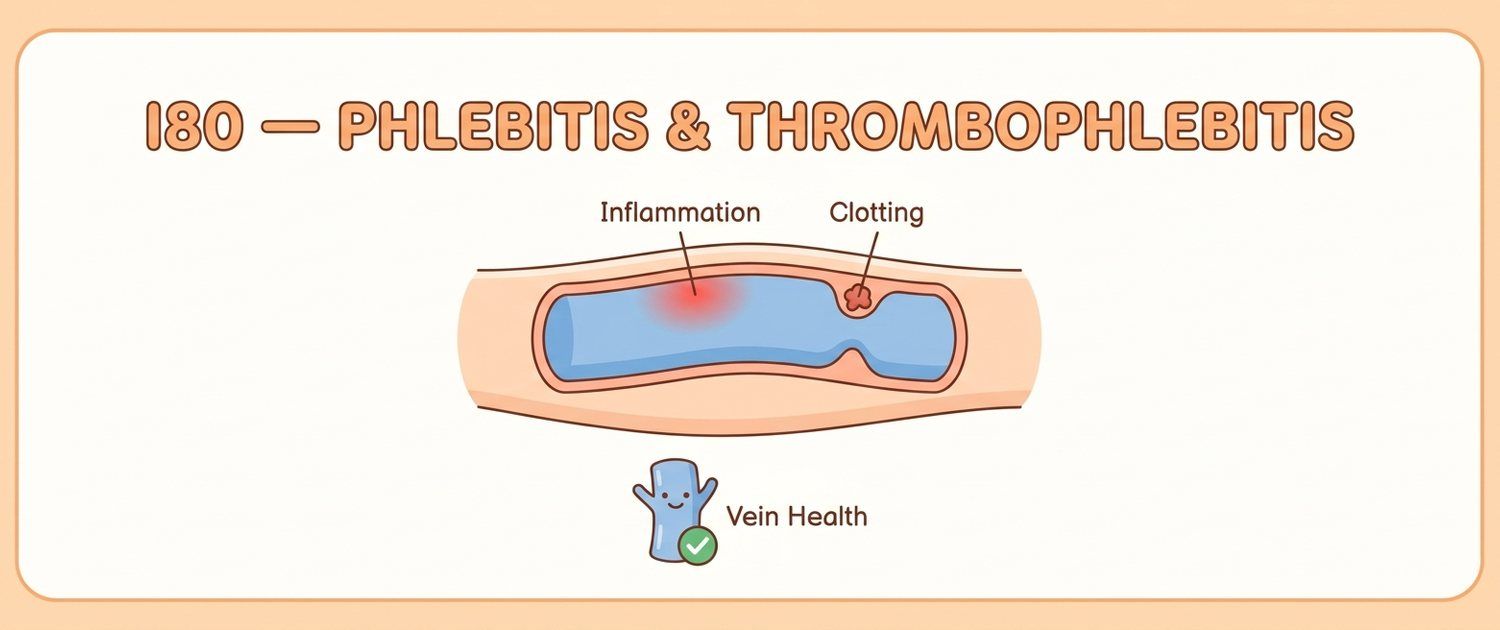
If the «Diagnosis» field of a discharge note, a surgical referral or a venous ultrasound report contains I80, there is a real vascular condition behind it rather than a bookkeeping mark. Yet the code on its own only names the type of problem — an inflamed vein — and says nothing about which vein is involved, how far the clot extends or what the risks are. Below we take the code apart, look at the subcategories that actually change the picture, compare it with neighbouring codes and set out what is sensible to do next.
What ICD-10 code I80 means: phlebitis and thrombophlebitis
The official wording of I80 is «Phlebitis and thrombophlebitis». Element by element:
- I — the letter of ICD-10 Class IX: «Diseases of the circulatory system» (categories I00–I99). Unlike the administrative Class Z, this class codes actual diseases.
- I80–I89 — the block «Diseases of veins, lymphatic vessels and lymph nodes, not elsewhere classified». The key word is veins: arteries belong to other blocks.
- I80 — the category «Phlebitis and thrombophlebitis». Phlebitis is inflammation of the vein wall; thrombophlebitis is the same inflammation with a clot in the lumen. In real documents the second is almost always what is meant.
Everything else depends on the digit after the dot, which states which vein is affected:
| Code | Wording | What it means in practice |
|---|---|---|
| I80.0 | Phlebitis and thrombophlebitis of superficial vessels of lower extremities | Subcutaneous veins of the calf or thigh, often on top of varicose veins; the vein is visible and tender |
| I80.1 | Phlebitis and thrombophlebitis of femoral vein | A large deep vein of the thigh, given its own subcategory because the site matters |
| I80.2 | Phlebitis and thrombophlebitis of other deep vessels of lower extremities | Deep calf veins, the popliteal and the iliac veins — what is usually called deep vein thrombosis |
| I80.3 | Phlebitis and thrombophlebitis of lower extremities, unspecified | The leg is named but the level is not specified in the document |
| I80.8 | Phlebitis and thrombophlebitis of other sites | Arm veins, chest wall and other areas, including after a catheter or injections |
| I80.9 | Phlebitis and thrombophlebitis of unspecified site | Neither the site nor the level is stated |
If there is no digit after the dot, the document simply names the category. On referrals and visit records this is routine: the subcategory is added once the vein has been seen on ultrasound.
Where you may have seen this code
I80 normally appears after an examination or a venous ultrasound:
| Document | Why I80 is there |
|---|---|
| Duplex ultrasound report | The clot and the inflamed vein are visible, and the finding is coded |
| Referral to a surgeon or vascular specialist | The code states the reason for the consultation — a suspected or known venous problem |
| Hospital discharge note | The final diagnosis after observation and investigation |
| Outpatient visit record | The administrative record of a visit with a previously established diagnosis |
| Insurance claim | The clinic reports the service delivered; the code justifies payment |
| Certificate of incapacity for work | I80 will not appear there: sick notes carry no diagnosis at all |
Two details are worth keeping in mind. First, the code may have been entered once — after thrombophlebitis around an intravenous line — and stayed in the file for years, so the date of the document matters as much as the code. Second, on a referral the code reflects the doctor's suspicion before imaging, while in a discharge note it is the conclusion after it; those records carry very different weight.
How serious is it — what the code says about your condition
Plainly: one code, I80, covers two scenarios with very different risks, and the subcategory decides which one you have.
Superficial thrombophlebitis (I80.0) is inflammation of a subcutaneous vein. It is usually a local and clearly visible problem: a painful firm cord under the skin, redness, local swelling. On its own it rarely threatens life. But it has one important property: the clot can extend upwards along the vein and pass into the deep system where the two connect. That is why a doctor assessing superficial thrombophlebitis looks not only at the visible segment but at its upper limit on ultrasound.
Deep vein thrombophlebitis (I80.1, I80.2) is a more serious situation, and there is no reason to soften that. The principal risk is a fragment of the clot travelling to the pulmonary artery (pulmonary embolism, code I26). This does not mean the complication is inevitable: the risk is assessed individually from the location and character of the clot, and medical follow-up reduces it substantially. The condition itself is covered in detail in the article on deep vein thrombosis.
What the code does not tell you:
- how far the clot extends and where its upper limit lies — only ultrasound shows that;
- how fresh and how mobile the clot is — again an ultrasound question, not a coding one;
- the cause — injury, surgery, a long flight, hormonal medication, an inherited clotting trait;
- whether the diagnosis is still current — the code may date back to an old episode.
Separately, and without alarmism, the signs that mean calling emergency services rather than waiting for a scheduled visit: sudden breathlessness, chest pain on inspiration, coughing up blood, sudden weakness or fainting, and rapidly increasing swelling of the whole leg with bluish discolouration and severe pain.
Neighbouring codes: I80 versus I82, I83 and I74
Vascular conditions are coded in different categories depending on which vessel is involved and whether inflammation is present:
| Code | Meaning | How it differs from I80 |
|---|---|---|
| I80 | Phlebitis and thrombophlebitis | Inflammation of the vein wall, as a rule with a clot in the lumen |
| I82 | Other venous embolism and thrombosis | A clot in a vein without the emphasis on inflammation; I82.4 is acute deep vein thrombosis of the leg |
| I83 | Varicose veins of lower extremities | Dilated tortuous veins without a clot; a common background for I80.0 but not the same thing |
| I81 | Portal vein thrombosis | A different site — the venous system of the liver |
| I26 | Pulmonary embolism | Already a complication: the clot has reached the pulmonary artery |
| I87.0 | Postphlebitic syndrome | The aftermath of a past thrombosis: swelling and skin changes months or years later |
| I74 | Arterial embolism and thrombosis | An artery, not a vein — a fundamentally different mechanism and clinical picture |
The commonest confusion is between I80.2 and I82.4. Both can be used for deep vein thrombosis of the leg: the first stresses the inflammatory component, the second the fact of thrombosis and embolism. The choice often depends on local coding practice rather than on severity, so comparing your discharge note with someone else's by the code alone is meaningless.
It also matters not to mix venous and arterial thrombosis: they differ in causes, investigations and codes. Arteries occlude against a background of atherosclerotic change — that is category I70 — and occlusion of a cerebral artery is coded as I63. Neither has anything to do with a vein.
Which investigations are usually ordered with this code
The purpose of the work-up is not to confirm the code but to describe the actual picture: which vein, over what length, how fresh the clot is and why it formed. A typical set:
- duplex ultrasound of the limb veins — the key study: it shows the vein itself, the clot, its limits and whether the vessel is patent;
- D-dimer — a laboratory marker of fibrin breakdown; it helps estimate the probability of thrombosis but does not replace ultrasound;
- coagulation panel — a baseline assessment of the clotting system;
- full blood count and C-reactive protein — assessment of the inflammatory component;
- thrombophilia testing — for recurrent, unexplained or early-onset thrombosis, at the doctor's discretion.
Before imaging, doctors often estimate the clinical probability of thrombosis with a formal score — it is available as the Wells score calculator and makes the logic of the orders easier to follow. Once the forms are in your hands, D-dimer is usually the most puzzling line: what its values mean and why it is frequently raised without any clot is explained in the guide to the D-dimer test. A completed report can also be gone through line by line with the lab-decoding service — which does not replace a doctor but helps you arrive with prepared questions.
What to do next
- Look at the digit after the dot. I80.0 and I80.2 carry very different risks; if the subcategory is missing, ask your doctor for it.
- Find the ultrasound report. The substance is there: which vein, where the upper limit of the clot lies, whether the vessel is patent. The code in the header conveys none of that.
- Check the date of the document. A recent entry and an episode from years ago mean entirely different things.
- Go through the blood tests you had. What each line of the clotting profile shows is explained in the guide to reading a coagulation panel.
- Do not choose treatment yourself. Management of thrombophlebitis is the doctor's work: it depends on the site, the extent of the clot and other conditions.
- If a sick note was issued, do not look for a diagnosis in it. It carries only a two-digit reason code; how those codes work is explained in the guide to sick note codes.
- Seek emergency care for warning signs — sudden breathlessness, chest pain on inspiration, coughing up blood, fainting or a rapidly swelling leg.
The short version
I80 is the code «phlebitis and thrombophlebitis» from the class of circulatory diseases: inflammation of a vein, usually with a clot inside it. It is a genuine diagnosis rather than an administrative mark, and its weight is set entirely by the subcategory — superficial veins (I80.0) and deep veins (I80.1, I80.2) are different scenarios. The code itself describes neither the extent of the clot nor its age nor the outlook: the substance lies in the ultrasound report, the blood tests and the vascular specialist who reads them.
For informational purposes only
This article is for informational purposes only and does not constitute medical advice, diagnosis, or treatment. Please consult a healthcare professional for medical guidance.