I70 — What This ICD-10 Code for Atherosclerosis Means
Reviewed by the LabReadAI medical team
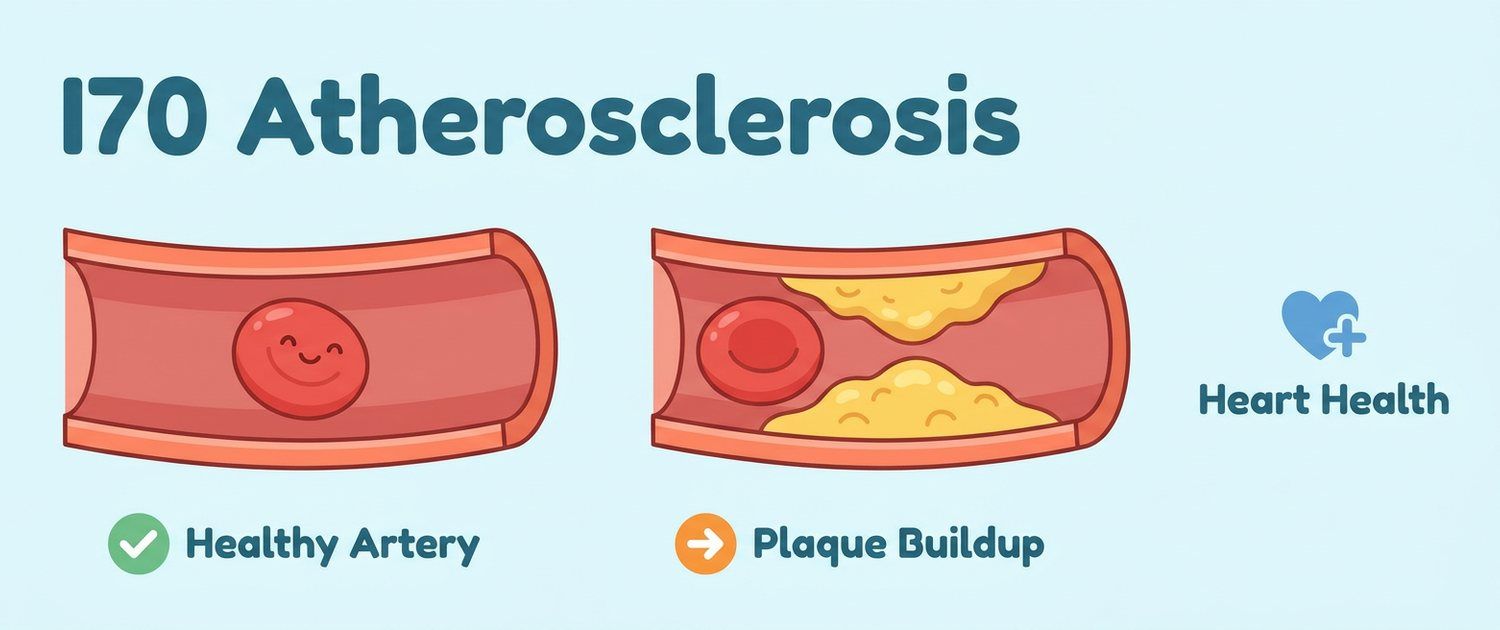
If the «Diagnosis» field of your chart, referral or discharge note contains I70, that is not an alarm bell and not a verdict — it is a record of a chronic process a doctor saw and chose to write down. Let us take the code apart: what it literally means, where it may have appeared in your documents, what it says and — more importantly — what it does not say about your condition, how it differs from neighbouring codes, and which investigations usually follow.
What ICD-10 code I70 means: atherosclerosis
The official wording of I70 is «Atherosclerosis». Element by element:
- I — the letter of ICD-10 Class IX: «Diseases of the circulatory system» (categories I00–I99). This is a class of real diseases rather than administrative markers such as Class Z: the code denotes a condition, not a reason for a visit.
- 70 — the category number. The classification lists its synonyms right beside it: atheroma, arteriosclerosis, arteriosclerotic vascular disease, senile endarteritis. They all describe the same thing — an arterial wall remodelled by plaque.
- The digit after the dot — the vascular territory, and this is where the real information sits: I70.0 aorta, I70.1 renal artery, I70.2 arteries of the extremities, I70.8 other arteries, I70.9 generalised and unspecified atherosclerosis.
What it means in substance: lipids accumulate in the arterial wall over years, a plaque forms, the wall loses elasticity and the lumen narrows. The mechanism, risk factors and symptoms are covered in detail in the explainer on atherosclerosis.
One detail surprises many people: category I70 does not cover the heart or the brain. ICD-10 gives it explicit exclusions — coronary atherosclerosis is coded I25.1, cerebral I67.2, mesenteric K55.1, pulmonary artery I27.0. So I70 in your chart usually refers to the aorta, the renal arteries or the vessels of the legs, not to the heart.
Where you may have seen this code
I70 is a routine entry in outpatient and hospital paperwork for patients over roughly 45–50:
| Document | Why I70 is there |
|---|---|
| Medical chart, list of confirmed diagnoses | A chronic diagnosis entered once and carried forward from visit to visit |
| Vascular ultrasound (duplex scan) report | The sonographer described plaque in the carotids, aorta or leg arteries and the finding was coded |
| Referral to a vascular surgeon or cardiologist | Referrals are issued against an already known diagnosis |
| Hospital discharge summary | Listed as a comorbidity next to the main reason for admission |
| Insurance claim | The clinic reports the service delivered, with the diagnosis code as its basis |
| Certificate for work, sport or a spa stay | The code is carried over from the chart as a chronic condition |
The practical conclusion: the code may have been assigned years ago — after a single ultrasound — and simply copied forward ever since. The date of the original entry and the current state of your arteries are different things, and worth clarifying with the doctor who follows you.
Is it dangerous: what code I70 does and does not say
Plainly, without alarm and without softening. Atherosclerosis is not a harmless quirk of ageing: it underlies heart attacks, ischaemic strokes and critical limb ischaemia, which is exactly why it gets recorded. At the same time it is a slow process that unfolds over decades and responds to understandable factors — blood lipids, blood pressure, smoking, blood sugar, weight and activity. Between «a code in the chart» and «a catastrophe» lie many years, and they are not predetermined.
What matters about the code itself:
- I70 carries no degree of stenosis. You cannot tell from it whether the lumen is 20 % or 70 % narrowed — that figure is in the ultrasound report.
- I70 carries no symptoms. An incidental asymptomatic aortic plaque and disabling calf pain on walking can end up with the same code.
- I70.9 is the most common and least informative variant. «Generalised and unspecified» is used when several territories are involved or when the site was simply not specified. That reflects coding practice, not severity.
So the appearance of I70 in a chart is closer to neutral news than to bad news: the process has been named, which means it has been seen and will be followed. The danger comes from atherosclerosis nobody is watching, not from the entry itself.
Neighbouring codes and how they differ
The codes around I70 differ mainly on two things: which vascular territory is affected, and whether an event has already happened — that is, whether the process has turned from chronic into acute.
| Code | Meaning | How it differs from I70 |
|---|---|---|
| I70 | Atherosclerosis | Aorta, renal arteries, arteries of the extremities; a chronic process |
| I70.2 | Atherosclerosis of arteries of extremities | A subcategory of I70 itself — what «atherosclerosis of the leg arteries» means |
| I25.1 | Atherosclerotic heart disease | The same process in the coronary arteries, coded separately from I70 |
| I67.2 | Cerebral atherosclerosis | The same process in the arteries of the brain, also outside I70 |
| I20 | Angina pectoris | The clinical expression of coronary atherosclerosis: chest pain on exertion |
| I63 | Cerebral infarction | An event that has already happened, not a chronic background |
| E78.0 | Pure hypercholesterolaemia | Cholesterol is raised, but no plaque has been documented |
| I73.9 | Peripheral vascular disease, unspecified | Impaired limb circulation without atherosclerosis named as the cause |
Two pairs cause most of the confusion. I70 and E78.0: the first is about a changed vessel wall, the second only about numbers on a lab form — high cholesterol without documented plaque is not yet I70. I70 and I25.1: if a cardiologist's summary says I25.1, the subject is the heart, and category I70 does not apply there at all, even when plaque exists in both places.
Which investigations usually follow this code
The point of testing in I70 is not to prove that plaque exists — an ultrasound usually did that already — but to answer three questions: how active the process is, which territories are involved and what is actually modifiable. A typical set looks like this:
- Lipid profile — total cholesterol, LDL, HDL, triglycerides. This is the main monitoring tool: LDL is what tells a doctor whether things are moving in the right direction. What the extended version includes and what each line means is set out in the guide to the extended lipid panel, and age-based reference points are laid out in the cholesterol norms calculator.
- Glucose and HbA1c — diabetes accelerates atherosclerosis sharply, so it is looked for even without symptoms.
- Creatinine with estimated kidney function — particularly where I70.1, renal artery atherosclerosis, is suspected.
- Duplex ultrasound of the arteries — carotids, aorta, lower limb arteries: it shows the plaques, their size and the percentage of stenosis.
- Ankle-brachial index — a simple test of leg perfusion, usually done when walking causes calf pain.
- ECG, and where indicated stress testing or CT angiography — if cardiac involvement is suspected.
The added difficulty is that both the lipid form and the ultrasound report are written in professional language: «LDL above target», «intima-media thickness 1.1 mm», «heterogeneous plaque with 35 % stenosis». Working out what your report actually says — before the appointment and without guesswork — is what the LabReadAI test review is for: it explains each value in plain words and suggests what to ask. Treatment decisions and target levels always stay with your doctor.
What to do next
- Find out what the code refers to. Ask at the appointment or check the summary: which vessel, which plaque, what percentage of narrowing. That is the substantive part of the diagnosis, unlike four characters in a form field.
- Locate the source document. Usually it is the duplex scan report — that is where what was seen, and where, is actually written down.
- Get a current lipid profile if the last one is old. Without fresh numbers a conversation about risk has nothing to stand on; what a raised result means and when medication is discussed is covered in the guide on high cholesterol.
- Assess overall cardiovascular risk. It is built from age, sex, blood pressure, smoking and cholesterol together rather than from one number; you can sketch your own picture with the SCORE2 calculator and then discuss it with your doctor.
- Check your blood pressure. Hypertension and atherosclerosis reinforce each other and often sit side by side in a chart; the neighbouring code is explained in the piece on I10.
- Agree monitoring and treatment with your doctor. How often to repeat the ultrasound, what LDL target to aim for and whether treatment is needed are theirs to decide — all the more so because the process is silent and gives you no feedback through how you feel.
The short version
I70 is the code for atherosclerosis: cholesterol plaque in the wall of the aorta, the renal arteries or the arteries of the limbs. It is a genuine diagnosis rather than an administrative marker, yet the code itself holds no degree of stenosis, no symptoms and no prognosis — those live in the imaging report and in what your doctor says. The heart and brain are coded separately (I25.1 and I67.2), so I70 usually is not about them. The process is chronic and slow, which is precisely what makes it manageable: meaning lies in the lipid profile, the vascular imaging and a calm conversation with your doctor.
For informational purposes only
This article is for informational purposes only and does not constitute medical advice, diagnosis, or treatment. Please consult a healthcare professional for medical guidance.