I10 — What This ICD-10 Code for High Blood Pressure Means
Reviewed by the LabReadAI medical team
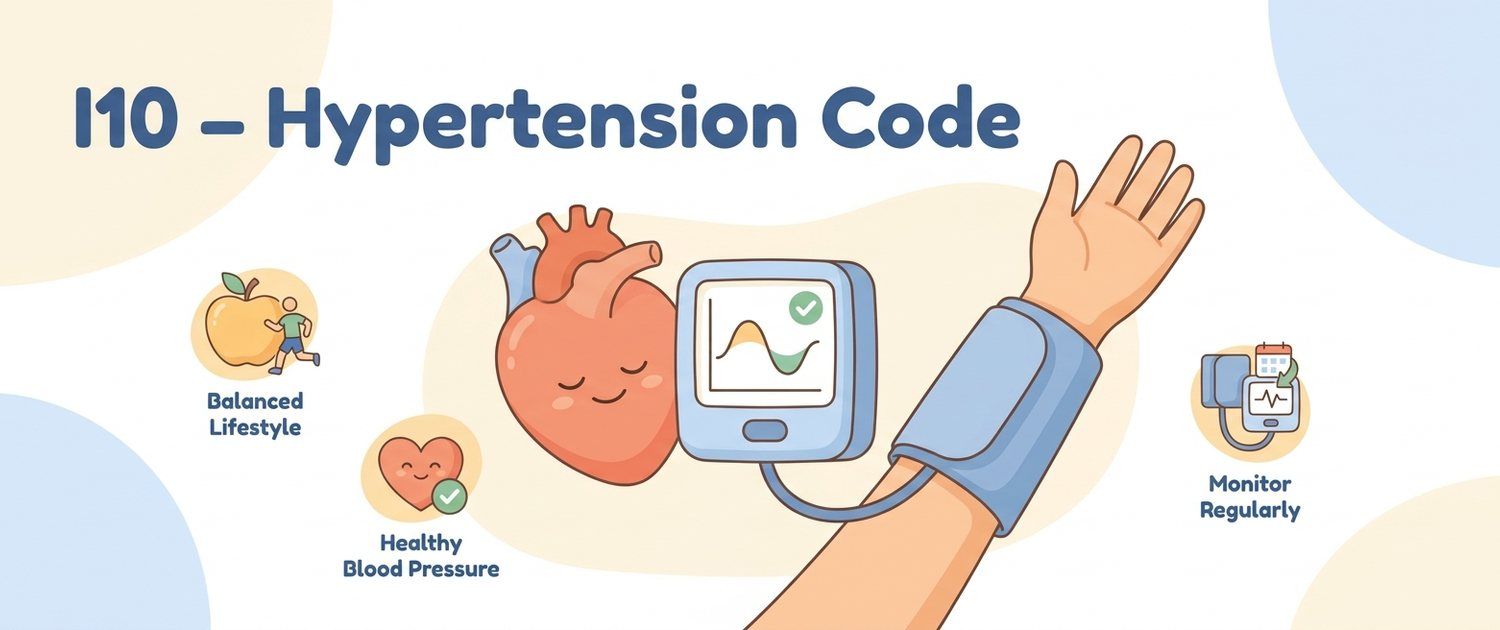
If the «Diagnosis» field of your chart, referral or discharge note contains I10, that short entry stands for one of the most common conditions on the planet. Let us take it apart: what it literally means, where it may have appeared in your documents, what it says — and, more importantly, what it does not say — about your condition, how it differs from neighbouring codes, and which investigations usually follow.
What ICD-10 code I10 means: essential (primary) hypertension
The official wording of I10 is «Essential (primary) hypertension». Element by element:
- I — the letter of ICD-10 Class IX: «Diseases of the circulatory system» (categories I00–I99). Unlike administrative classes such as Z, this class covers real diseases: the code does denote a condition, not a reason for a visit.
- I10 — the category itself. It is three-character and has no subcategories: hypertension without specified organ involvement has exactly one code.
- «Essential» — the word that frightens people most often. It does not mean «severe» or «incurable»; it means «standalone»: the blood pressure is raised in its own right, not as a consequence of another disease. The wording itself gives the synonym — «primary».
- «Hypertension» — persistently raised arterial pressure. European and Russian practice uses a threshold of 140/90 mmHg on repeated office measurements; United States guidance sets a lower bar of 130/80.
Put together: I10 records «this person has persistently raised blood pressure and no separate causative disease has been found». Primary hypertension accounts for the vast majority of all raised-pressure cases; the mechanisms and risk factors behind it are covered in the explainer on hypertension.
Note one detail: the diagnosis is never made from a single reading. It requires repeated measurements at different visits and often a home diary or 24-hour ambulatory monitoring. One high number on a monitor does not by itself become code I10.
Where you may have seen this code
I10 is a workhorse of outpatient paperwork, so it turns up almost everywhere:
| Document | Why I10 is there |
|---|---|
| Medical chart, list of confirmed diagnoses | The standing record of a chronic condition, carried from visit to visit |
| Referral for tests or to a specialist | Referrals are issued against a known diagnosis — for an ECG, a heart ultrasound, a cardiology appointment |
| Outpatient visit record | The administrative record of the visit: the reason is follow-up for hypertension |
| Certificate or discharge note | The final diagnosis of the visit; stage and risk are usually spelled out next to it in words |
| Insurance claim | The clinic reports the service delivered, with the diagnosis code as its basis |
| Certificate for work, sport or a sanatorium | The code is carried over from the chart as a chronic condition affecting clearance |
The practical conclusion: the code may have been assigned long ago and simply copied forward. The date of the original entry and your current readings are different things — worth clarifying with the doctor who follows you.
Is it dangerous: what the code says about high blood pressure
Plainly, and without either extreme. Hypertension is not a trifle: pressure that stays high gradually loads the heart, the vessels, the kidneys and the eyes, which is exactly why it is treated and monitored. At the same time it is one of the best-studied and best-controlled chronic conditions: with pressure under control, people live ordinary full lives for decades.
What matters about the code itself:
- I10 carries no numbers. You cannot tell from it whether the reading was 145/90 or 180/110 — that information sits in the text of the document, not in the cipher.
- I10 carries no stage or risk. The stage (by organ involvement) and cardiovascular risk are written out separately in words.
- I10 means «without specified organ involvement». Had the work-up shown that the heart or kidneys were already affected, the doctor would have used a different code — I11 or I12.
So the presence of I10 in a chart is closer to neutral news than to bad news: the condition has been named, which means it has been seen and will be followed. The danger comes not from the entry in the record but from uncontrolled pressure that nobody knows about.
Neighbouring codes and how they differ
The codes around I10 differ on two questions: whether organ damage is already documented, and whether a cause has been identified.
| Code | Meaning | How it differs from I10 |
|---|---|---|
| I10 | Essential (primary) hypertension | No cause identified, no organ involvement specified |
| I11 | Hypertensive heart disease | The pressure has already affected the heart, typically as left ventricular thickening |
| I12 | Hypertensive renal disease | Impaired kidney function has been documented alongside the raised pressure |
| I15 | Secondary hypertension | A cause has been found: kidney, adrenal or vascular disease, or a medication |
| R03.0 | Elevated blood pressure reading without diagnosis of hypertension | A high reading is on record, but the diagnosis has not been made yet |
Two pairs are confused most often. I10 and R03.0: the latter is «a high reading so far», an interim entry before confirmation. I10 and I11: moving between them does not mean things suddenly got worse — it means an investigation documented changes in the heart that were not on record before. A changed code is a good reason to calmly ask what exactly was found.
Which investigations usually follow this code
The point of testing in I10 is not to reconfirm that the pressure is high — measurements already did that — but to answer two questions: is the hypertension secondary, and have the target organs been affected. A typical set looks like this:
- Repeated measurements and a home diary — the backbone of the diagnosis; what counts as normal varies with age, and a doctor reads a series of readings rather than a single number.
- 24-hour ambulatory monitoring — shows how pressure behaves at night and through the day, and separates white-coat hypertension from the real thing.
- ECG — the baseline cardiac test in hypertension, looking for strain patterns and rhythm disturbances.
- Echocardiography (heart ultrasound) — assesses wall thickness and heart muscle function; its result often decides whether the code stays I10 or becomes I11.
- Blood and urine tests — creatinine with estimated kidney function, lipid profile, glucose, potassium, urinalysis.
- Kidney and renal artery ultrasound, fundoscopy — where indicated, to look for a cause and assess target organs.
The added difficulty is that ECG and ultrasound reports are written in professional language: «LV hypertrophy», «diastolic dysfunction», «sinus rhythm with strain pattern». Working out what your particular report and images actually say — before the appointment and without guesswork — is what the LabReadAI study review is for: it explains the wording in plain language and suggests what to ask. Treatment decisions always stay with your doctor.
What to do next
- Find out what the code refers to. Ask at the appointment or check the discharge note: which readings were recorded, and what stage and risk are stated in words. That is the substantive part of the diagnosis.
- Start a blood pressure diary. Calm readings at home, morning and evening, tell a doctor far more than one measurement in a consulting room; reference ranges for your age are in the blood pressure norms guide.
- Complete the investigations ordered. ECG, heart ultrasound, blood and urine tests answer the question of target-organ involvement, and that is what shapes further management.
- Make sense of the reports you receive. Understand what the form and the images say before drawing conclusions; raised pressure often prompts a look at heart rhythm too — see the explainer on atrial fibrillation.
- Discuss treatment and follow-up with your doctor. Medication choices and monitoring intervals are theirs to set: self-adjusting or stopping treatment in hypertension is dangerous.
- If you are pregnant, say so immediately. Raised pressure in pregnancy is managed under separate rules and coded differently.
The short version
I10 is the code for essential (primary) hypertension: persistently raised blood pressure with no separate causative disease found. It is a genuine diagnosis rather than an administrative marker, yet the code itself holds no figures, no stage and no risk — the doctor writes those out alongside it. The condition is serious exactly to the extent that it goes unwatched: measured and monitored pressure is a manageable story. The meaning lies in the results and the conversation with your doctor, not in four characters in a form field.
For informational purposes only
This article is for informational purposes only and does not constitute medical advice, diagnosis, or treatment. Please consult a healthcare professional for medical guidance.