N40 — Hyperplasia of Prostate: What This ICD-10 Code Means
Reviewed by the LabReadAI medical team
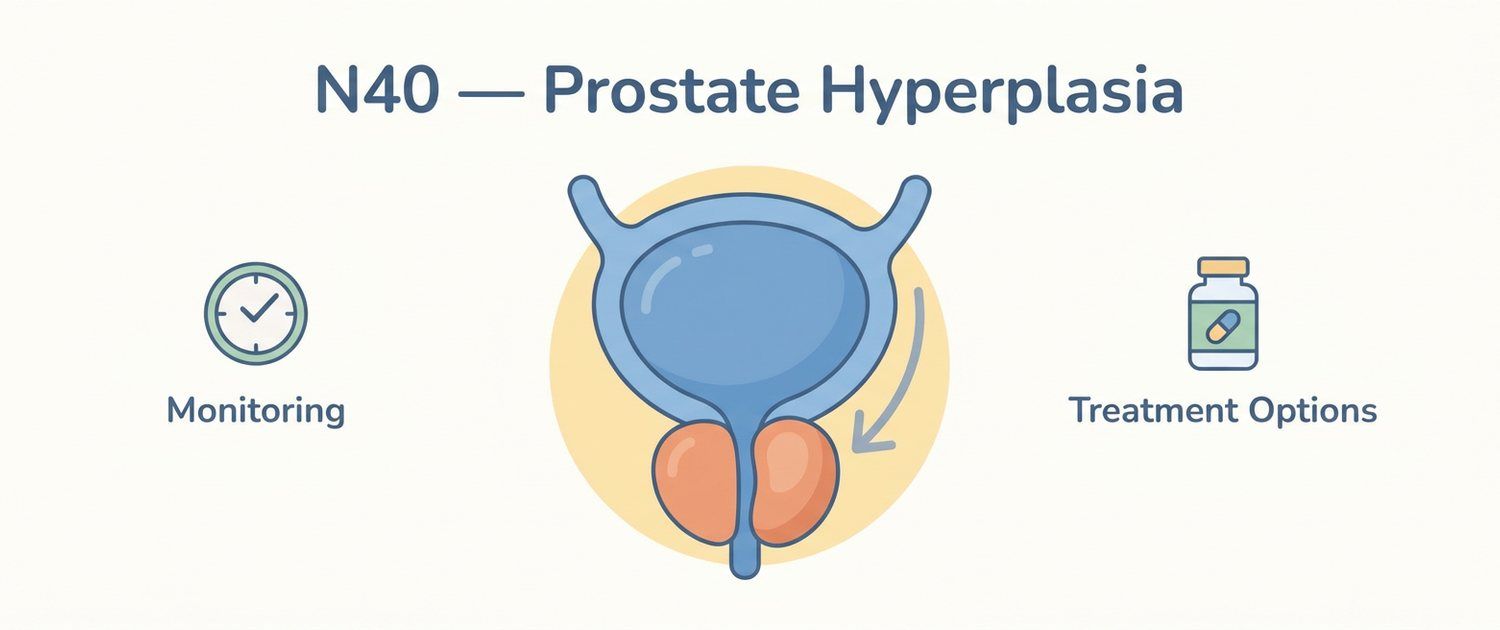
If the «Diagnosis» field of a referral, discharge note or visit record contains only N40, the first impulse is usually to search the internet for «cancer». So, straight to the point: N40 is the code for benign enlargement of the prostate gland, the condition usually called prostate adenoma. Malignant prostate disease carries a different code entirely. Below we take the code apart, look at where it appears, what it does and does not say about your condition, and what makes sense to do next.
What ICD-10 code N40 means: hyperplasia of prostate, element by element
The official wording of N40 is «Hyperplasia of prostate»; the Russian adaptation of ICD-10 adds the clarification «prostate adenoma». Element by element:
- N — the letter of ICD-10 Class XIV: «Diseases of the genitourinary system» (categories N00–N99). It covers the kidneys, bladder, urethra and the male and female genital organs.
- N40 — the category assigned to hyperplasia of the prostate. It is a three-character category and in the base version of ICD-10 has no subdivisions, so there may be no digits after a decimal point at all.
- Hyperplasia — a medical term for enlargement of an organ caused by an increase in the number of its own cells. That is the key word: the tissue grows, but it remains the gland's own, benign tissue.
Clinical guidelines call the same condition BPH — benign prostatic hyperplasia. «Prostate adenoma», «BPH» and «hyperplasia of prostate» all describe one and the same thing and are coded as N40. How the condition actually presents is covered in the guide to prostate adenoma symptoms.
Where you may have seen this code
N40 codes an established condition, so it appears both before and after an examination:
| Document | Why N40 is there |
|---|---|
| Referral to a urologist or for ultrasound | The doctor suspects or already knows about the enlargement and wants the gland volume measured |
| Outpatient visit record | The administrative record of the visit: the condition the appointment was about |
| Urologist's discharge note or report | The final diagnosis after examination, ultrasound and lab tests |
| Medical certificate | A note of a chronic condition that requires follow-up |
| Insurance claim | The basis for paying for the appointment and investigations |
One practical nuance: a code on a referral may be provisional — the doctor writes the most likely category simply to issue the document. A code in a urologist's report after an examination is a conclusion. The text next to it tells them apart: if there is an ultrasound description, a gland volume in cubic centimetres and a conclusion, you are looking at a result, not an assumption.
Is it dangerous, and what the code actually says
Honestly, without either extreme.
What N40 does not mean. It is not cancer and not a precancerous state. Hyperplasia and prostate cancer are different processes, arise in different zones of the gland and are coded differently (cancer is C61). Having N40 on record does not by itself raise cancer risk. The two can, however, coexist in the same man, which is why a urologist checks for both.
What N40 does mean. The prostate is enlarged. It surrounds the first part of the urethra, so growing tissue narrows that channel — hence the typical complaints: a weak stream, straining, a feeling of incomplete emptying, frequent urination and night-time trips to the toilet.
How common it is. Age-related enlargement is close to universal: histological signs of hyperplasia are found in most men over 60. Symptoms, though, develop in only a share of them, so the code on your record does not mean trouble is guaranteed.
What genuinely deserves attention. The condition is benign but not harmless if neglected: long-standing obstruction to urine flow can lead to acute retention, urinary tract infections, bladder stones and strain on the kidneys. That is why it is monitored rather than ignored.
What the code cannot tell you. Neither the degree of enlargement, nor how troublesome the symptoms are, nor whether surgery is needed. Category N40 is identical for a man with an incidental ultrasound finding and for a severe case. Severity is defined by symptoms (scored with the IPSS questionnaire), gland volume, residual urine and kidney function — not by the code.
Neighbouring codes and how they differ
The codes most often seen alongside N40 in male urology are:
| Code | Meaning | How it differs from N40 |
|---|---|---|
| N40 | Hyperplasia of prostate (prostate adenoma) | Benign growth of the gland's own tissue |
| N41 | Inflammatory diseases of prostate (prostatitis, abscess) | Inflammation rather than growth; often pain, fever, acute onset |
| N42 | Other disorders of prostate (stones, atrophy, cysts) | «Other» prostate conditions that fit neither N40 nor N41 |
| C61 | Malignant neoplasm of prostate | Prostate cancer — a malignant process in an entirely different class (Class II) |
| R39.1 | Other difficulties with micturition | A symptom code, not a disease: the complaint is recorded, the cause is not yet established |
R39.1 deserves a note: it often appears on a first referral while the cause of difficult urination is still unknown, and is usually replaced later by the code of the actual condition — N40, for instance. The same logic applies to Class Z contact codes, explained on the Z01 page.
Which investigations are ordered for benign prostatic hyperplasia (BPH)
The work-up for prostatic hyperplasia is standard and serves three goals: measure the gland, assess how far urine flow is obstructed, and rule out other causes of the symptoms. Typically:
- Serum PSA (prostate-specific antigen) — a marker that rises with gland volume, with inflammation and with malignancy. It does not make a diagnosis on its own; it decides whether further work-up is needed. How to read the value and what distorts it is covered in the PSA test guide.
- Prostate ultrasound, often transrectal (TRUS) — gives the gland volume in cubic centimetres, the tissue structure and the post-void residual volume. What the procedure involves is described in the guide to prostate ultrasound and TRUS.
- Urinalysis — rules out infection or blood in the urine as the cause of symptoms.
- Serum creatinine and urea — kidney function, relevant if obstruction has lasted a long time.
- IPSS questionnaire and a voiding diary — a formal measure of how much the symptoms interfere with daily life.
Once the report is in your hands, the useful step is understanding what each value means and which deviations matter — this is exactly where it is easy to get lost between a laboratory's reference range and your own number.
What to do next
A sensible sequence after seeing N40 in a document:
- Do not read cancer into this code. N40 denotes a benign condition; malignant prostate disease is coded C61, and it is not what your document says.
- Work out where the code came from. On a referral it is provisional. In a urologist's report with an ultrasound description it is an established diagnosis.
- Assess your symptoms honestly. Stream, night-time trips, incomplete emptying — these, not the code, decide whether active treatment is needed; see the guide to prostate adenoma symptoms.
- Complete the ordered tests. At minimum PSA and an ultrasound: the PSA test and TRUS together give the urologist enough to decide.
- Bring the results and your questions to the urologist. The choice between watchful waiting, medication and surgery belongs to the doctor and rests on numbers and symptoms, not on a code.
- Keep up follow-up even if nothing bothers you. Hyperplasia is chronic; an annual urology review with PSA and ultrasound is routine for men with this diagnosis.
The same logic applies to other benign growths of glandular tissue: in the breast that is code N60, and when the nature of a lesion has not yet been determined, category D48 is used.
The short version
N40 in a medical document means hyperplasia of the prostate — benign enlargement of the gland, extremely common with age. It is neither cancer nor a verdict, but it is not something to forget about either: prolonged obstruction of urine flow harms the bladder and kidneys. The code itself conveys neither severity nor stage — those come from symptoms, PSA, gland volume on ultrasound and residual urine. Those are the data to bring to a urologist.
For informational purposes only
This article is for informational purposes only and does not constitute medical advice, diagnosis, or treatment. Please consult a healthcare professional for medical guidance.