Formula · 8.4
Brand · 8.1
The Ordinary · azelaic acid 10% · Canada
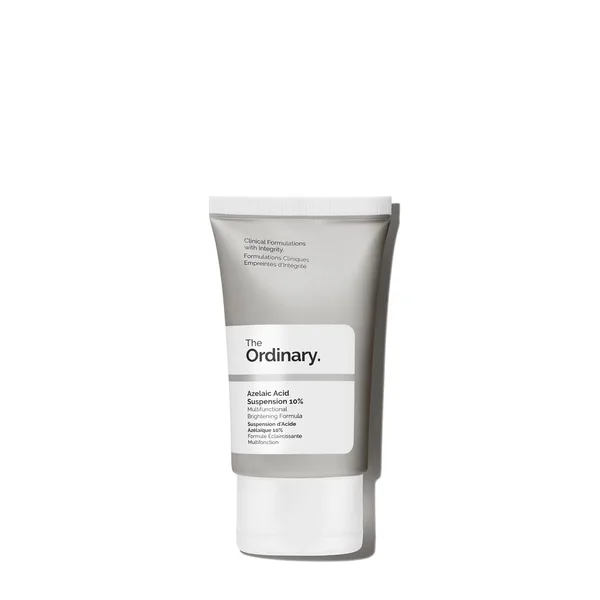
The Ordinary Azelaic Acid Suspension 10%
LabReadAI label score
How the score is calculated- Actives and evidence1.0Effect supported by studies
- Active concentration1.0Concentration within the working range
- Completeness for the purpose0.6For “dark spots and uneven tone” — 57 %; retinoid; glycolic acid; could be added without conflict: retinoid, glycolic acid; a formula with one main purpose
- Tolerance1.0No ingredients from irritant or allergen lists
- adults
- pregnancyallowed per the leaflet
- sensitive skinstinging for the first 1–2 weeks
Ingredients — 16 components, 1 of them active
The rest is the formula base: it holds texture, shelf life and application, and is not meant to act.
What works: 1 of 16 ingredients: azelaic acid. Against dark spots you need two fronts: actives that slow pigment production (azelaic and tranexamic acids, niacinamide, vitamin C, arbutin, thiamidol) and those that speed up skin renewal (a retinoid, acids). One active per front is enough; better both fronts and SPF in the daytime.
Strengths: actives and evidence, active concentration, tolerance
What lowers the score: completeness for the purpose: for “dark spots and uneven tone” — 57 %
Questions: no debatable ingredients in the formula
- Aqua (Water base: coating, fillers · water — the solvent and base; listed first because there is more of it than anything else; in supplements — part of the capsule shell
- Isodecyl Neopentanoate base: coating, fillers · fills the gaps between skin flakes, so the surface feels smooth
- Dimethicone base: coating, fillers · form a smooth film and shine; inert and not absorbed — a preference question, not a safety one
- Azelaic Acid works · the active ingredient — what the product is for; form: azelaic acid
- Dimethicone/Bis-Isobutyl PPG-20 Crosspolymer base: coating, fillers · form a smooth film and shine; inert and not absorbed — a preference question, not a safety one
- Dimethyl Isosorbide base: coating, fillers · soften, condition and carry the actives; the backbone of the texture
- Hydroxyethyl Acrylate/Sodium Acryloyldimethyl Taurate Copolymer base: coating, fillers · hold the texture: gels, creams and foam do not separate
- Polysilicone-11 base: coating, fillers · leaves a thin film on skin or hair
- Isohexadecane base: coating, fillers · soften, condition and carry the actives; the backbone of the texture
- Tocopherol base: coating, fillers · vitamin E at hundredths of a percent: keeps the oils of the formula (a cream or a capsule fill) from going rancid; at that share it protects the product, it is not vitamin E as an active
- Trisodium Ethylenediamine Disuccinate base: coating, fillers · bind hard-water metals so the formula stays stable and the foam works
- Isoceteth-20 base: coating, fillers · cleanse and bind water with oils; milder than the sulfate ones
- Polysorbate 60 base: coating, fillers · cleanse and bind water with oils; milder than the sulfate ones
- Triethanolamine base: coating, fillers · a pH adjuster and thickener neutraliser; rarely clogs pores in leave-on face products
- Ethoxydiglycol base: coating, fillers · humectants and solvents — hold water and help actives dissolve
- Phenoxyethanol base: coating, fillers · the most widespread cosmetic preservative: it keeps the product sterile. Permitted in the EU up to 1 %, recognised as safe at that level.
- Chlorphenesin base: coating, fillers · a preservative, usually paired with phenoxyethanol. Permitted in the EU up to 0.3 %.
The Ordinary Azelaic Acid Suspension 10% is a product whose active ingredient is azelaic acid at a declared 10 %. The effect is supported by studies: 10–20 %: acne, rosacea and dark spots — several RCTs, a meta-analysis against hydroquinone in melasma. The formula has 16 ingredients, 1 of which does the work; the rest is the formula base. Against dark spots you need two fronts: actives that slow pigment production (azelaic and tranexamic acids, niacinamide, vitamin C, arbutin, thiamidol) and those that speed up skin renewal (a retinoid, acids). One active per front is enough; better both fronts and SPF in the daytime. By the list, no alcohol (alcohol denat), sulfates (SLS/SLES), formaldehyde releasers, isothiazolinones (MIT/MCI), parabens, mineral oils and petrolatum, soap, fragrance, gelatin in the coating, toning dyes, tar. Suitable for: adults, pregnancy. sensitive skin — ask a doctor. Use: morning and evening, fine with SPF. When to expect an effect: acne — 4–8 weeks, spots — 8–12. Label score — 8.4 out of 10 (for “dark spots and uneven tone” — 57 %; retinoid; glycolic acid; could be added without conflict: retinoid, glycolic acid; a formula with one main purpose).
Who it does not suit
When to stop: persistent burning — stop
Is this product right for your skin?
The score describes the formula, not your skin: the same product dries one person and saves another. Describe your skin type, reactions and goals, attach a photo of the ingredient list or the product — we will go through every ingredient and say whether it suits you, what to pair it with and what to avoid.
Similar products
Same nutrient and the same purpose — closest by form and dose. Each has its own score by the same method, so you can see whether there is an option nearby that is more honest or simpler in composition.