Formula · 5.3
Brand · 5.3
Weleda · calendula, chamomile and pansy extracts · Switzerland
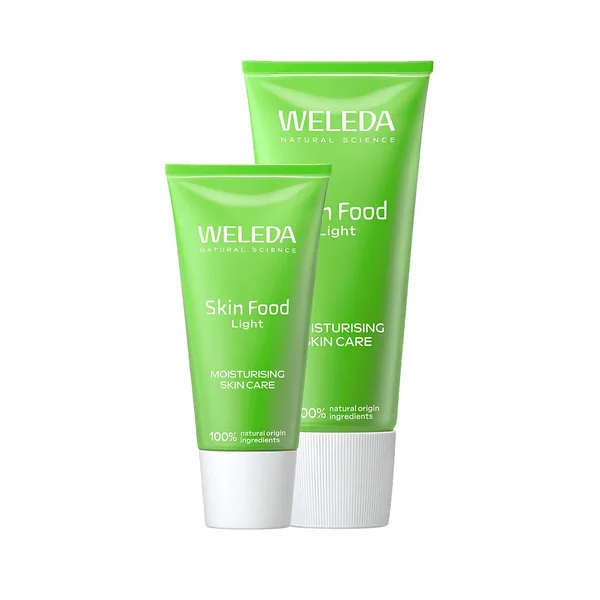
Weleda Skin Food Light
LabReadAI label score
How the score is calculated- Actives and evidence0.4Little evidence of effect
- Completeness for the purpose0.6For “dryness and a damaged barrier” — 58 %; without ceramides — the bricks of the barrier; could be added without conflict: ceramides; a broad formula across 3 purposes
- Tolerance0.6Debatable ingredient groups: denatured alcohol, fragrance and its allergens (skin test positive in 13 of 100 tested); comedogenic ingredients at a notable share (may clog pores): cocoa butter
- adults
- pregnancyallowed per the leaflet
- children
- sensitive skinirritation possible
- dry skinmay dry
- acne-pronemay clog pores in leave-on face products
- atopic skinfragrance is a common trigger
Ingredients — 21 component · 1 works
What works: 1 of 21 ingredients: calendula extract. Dry skin needs three things at once: draw water in (glycerin, hyaluronate), rebuild the barrier (ceramides with cholesterol, panthenol) and seal moisture with a film (petrolatum, oils). One of the three is half the job.
What lowers the score: actives and evidence: little evidence of effect; completeness for the purpose: for “dryness and a damaged barrier” — 58 %; tolerance: debatable ingredient groups: denatured alcohol, fragrance and its allergens
Questions: denatured alcohol: alcohol — evaporates fast and degreases; frequent contact can dry the skin — a tolerance question, not a regulatory one; does not clog pores; fragrance and its allergens: limonene, fragrance, linalool, geraniol, citral — the fragrance and its aromatic components; the EU requires 26 of them to be listed separately — matters to people allergic to fragrance, does not affect how the product works; carrageenan
- Water (Aqua base: coating, fillers · water — the solvent and base; listed first because there is more of it than anything else; in supplements — part of the capsule shell
- Helianthus Annuus (Sunflower) Seed Oil base: coating, fillers · a light emollient oil rich in linoleic acid (in tablets — a coating component); does not clog pores
- Glycerin base: coating, fillers · a humectant: coats the tablet, holds moisture in creams and shampoos; does not clog pores
- Alcohol questions · evaporates fast and degreases; frequent contact can dry the skin — a tolerance question, not a regulatory one; does not clog pores
- Glyceryl Stearate Citrate base: coating, fillers · the basic cream emulsifier (neutral NSE form); the self-emulsifying SE form with added potassium stearate is a separate entry, 3 of 5; does not clog pores
- Beeswax (Cera Alba base: coating, fillers · a thickening wax for balms and creams; rarely clogs pores in leave-on face products
- Theobroma Cacao (Cocoa) Seed Butter base: coating, fillers · emollient/base; may clog pores in leave-on face products
- Cetearyl Alcohol base: coating, fillers · a fatty-alcohol blend (C16–C18), an emulsifier and thickener, does not dry the skin; paired with ceteareth-20 — 4 of 5; rarely clogs pores in leave-on face products
- Butyrospermum Parkii (Shea) Butter base: coating, fillers · the plant base: emollient oils, waxes and care extracts
- Limonene questions · the fragrance and its aromatic components; the EU requires 26 of them to be listed separately — matters to people allergic to fragrance, does not affect how the product works
- Viola Tricolor Extract base: coating, fillers · the plant base: emollient oils, waxes and care extracts
- Chamomilla Recutita (Matricaria) Flower Extract base: coating, fillers · the plant base: emollient oils, waxes and care extracts
- Calendula Officinalis Flower Extract works · the active ingredient — what the product is for; form: flower extract
- Lanolin base: coating, fillers · sheep-wool wax, a rich softening and protective ingredient; does not clog pores
- Carrageenan questions · a thickener from red seaweed. It is permitted but debated: in animal studies the degraded form irritated the gut, so people with inflammatory bowel disease are sometimes advised to avoid it. For food-grade carrageenan there is no such proof.
- Xanthan Gum base: coating, fillers · hold the texture: gels, creams and foam do not separate
- Lactic Acid base: coating, fillers · tune the acidity and texture; salt is a common shampoo thickener
- Glyceryl Caprylate base: coating, fillers · a glycerin–caprylic acid ester: an emollient and co-emulsifier that also curbs microbial growth — boosts the preservative and lets the maker skip “heavy” ones
- Fragrance (Parfum questions · the fragrance and its aromatic components; the EU requires 26 of them to be listed separately — matters to people allergic to fragrance, does not affect how the product works
- Linalool questions · the fragrance and its aromatic components; the EU requires 26 of them to be listed separately — matters to people allergic to fragrance, does not affect how the product works
- Geraniol questions · the fragrance and its aromatic components; the EU requires 26 of them to be listed separately — matters to people allergic to fragrance, does not affect how the product works
- Citral questions · the fragrance and its aromatic components; the EU requires 26 of them to be listed separately — matters to people allergic to fragrance, does not affect how the product works
Weleda Skin Food Light is a product whose active ingredient is calendula extract. The concentration is not declared; the active sits after the 1 % line, but works at small shares. There is little evidence of effect: soothes and aids healing in small studies; few rigorous RCTs. The formula has 21 ingredients, 1 of which does the work; the rest is the formula base. Worth noting: Alcohol (evaporates fast and degreases; frequent contact can dry the skin — a tolerance question, not a regulatory one; does not clog pores); Limonene, Fragrance (Parfum), Linalool, Geraniol, Citral (the fragrance and its aromatic components; the EU requires 26 of them to be listed separately — matters to people allergic to fragrance, does not affect how the product works); Carrageenan. Dry skin needs three things at once: draw water in (glycerin, hyaluronate), rebuild the barrier (ceramides with cholesterol, panthenol) and seal moisture with a film (petrolatum, oils). One of the three is half the job. By the list, no sulfates (SLS/SLES), formaldehyde releasers, isothiazolinones (MIT/MCI), parabens, mineral oils and petrolatum, soap, silicones, gelatin in the coating, toning dyes, tar. Suitable for: adults, pregnancy, children. sensitive skin, dry skin, acne-prone, atopic skin — ask a doctor. Asteraceae allergy, fragrance allergy — not without a doctor. Use: morning and evening. When to expect an effect: soothing — days; no notable healing to expect. Label score — 5.3 out of 10 (little evidence of effect; for “dryness and a damaged barrier” — 58 %; without ceramides — the bricks of the barrier; could be added without conflict: ceramides; a broad formula across 3 purposes; debatable ingredient groups: denatured alcohol, fragrance and its allergens (skin test positive in 13 of 100 tested); comedogenic ingredients at a notable share (may clog pores): cocoa butter).
Who it does not suit
- Asteraceae allergychamomile, ragweed, calendula
- fragrance allergyrisk of reaction
When to stop: itching or rash with Asteraceae allergy — stop
Is this product right for your skin?
The score describes the formula, not your skin: the same product dries one person and saves another. Describe your skin type, reactions and goals, attach a photo of the ingredient list or the product — we will go through every ingredient and say whether it suits you, what to pair it with and what to avoid.
Similar products
Same nutrient and the same purpose — closest by form and dose. Each has its own score by the same method, so you can see whether there is an option nearby that is more honest or simpler in composition.