L40 — What This ICD-10 Psoriasis Code Means on Your Records
Reviewed by the LabReadAI medical team
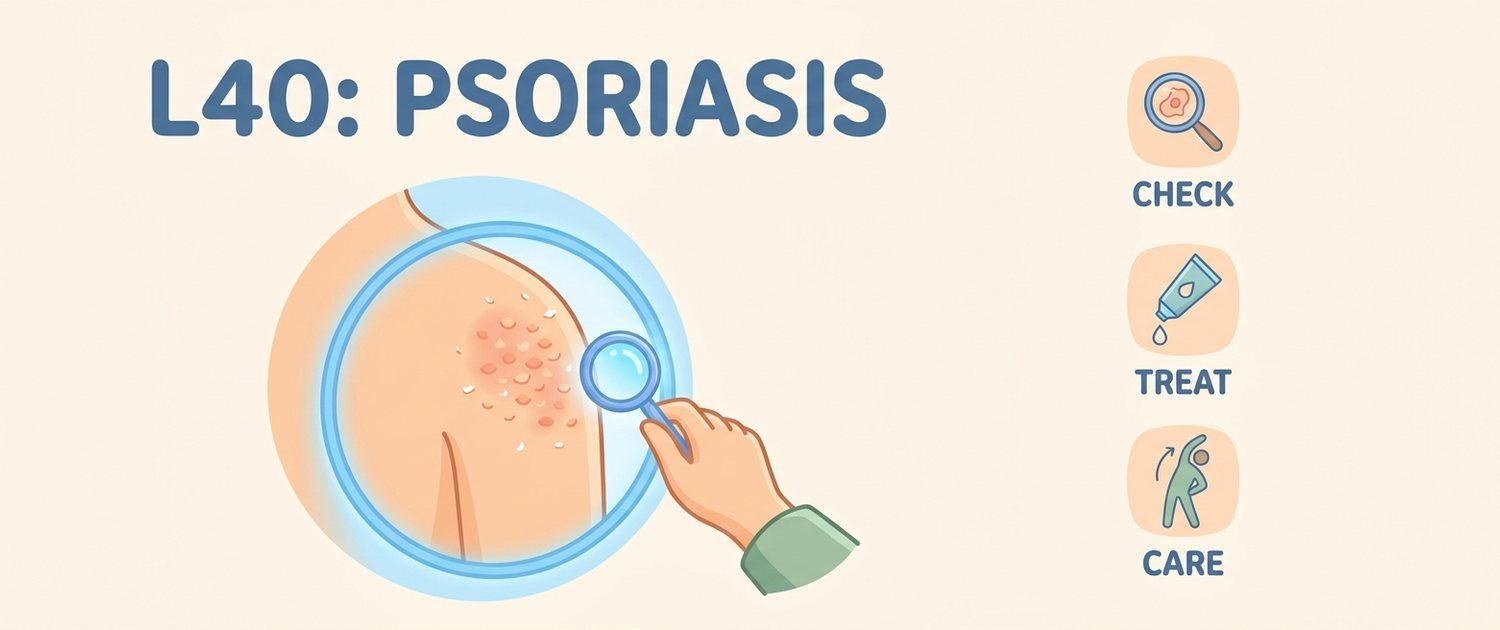
If the «Diagnosis» field of your referral, discharge note or certificate contains L40, that is the code for psoriasis. It looks dry and opaque, yet it stands for a specific and well-studied skin disease. Below we take the code apart: what it literally means, why it appeared in your document, what it does and does not say about your condition, how it differs from neighbouring skin codes and which steps make sense next.
What the ICD-10 psoriasis code L40 means
The official wording of category L40 is «Psoriasis». Element by element:
- L — the letter of ICD-10 Class XII: «Diseases of the skin and subcutaneous tissue» (block L00–L99). This is a class of actual diseases: unlike Class Z, an L code means an established diagnosis.
- L40 — the three-character category covering all forms of psoriasis. It opens the block L40–L45, «Papulosquamous disorders» — conditions with characteristic papules and scaling.
- The digit after the dot — the subcategory specifying the form. If the document says just
L40, the form was either not specified when the record was filled in, or is written out in the text of the conclusion.
The main subcategories are:
| Code | Form |
|---|---|
| L40.0 | Psoriasis vulgaris (plaque psoriasis) — the most common form |
| L40.1 | Generalized pustular psoriasis |
| L40.2 | Acrodermatitis continua |
| L40.3 | Pustulosis palmaris et plantaris |
| L40.4 | Guttate psoriasis |
| L40.5 | Arthropathic psoriasis (with joint involvement) |
| L40.8 | Other psoriasis |
| L40.9 | Psoriasis, unspecified |
In essence psoriasis is chronic immune-mediated inflammation in which skin cells renew several times faster than normal. Hence the typical picture: raised reddish plaques covered with silvery-white scales, most often on the elbows, knees, scalp and lower back. It affects roughly 2 % of people and is not an infection — you cannot catch it and cannot pass it on.
Where you may have seen this code
Unlike administrative codes, L40 appears in documents issued after a doctor has examined the skin and reached a conclusion:
| Document | Why L40 is there |
|---|---|
| Referral to a dermatologist or for procedures | The diagnosis already exists; the referral is issued under it |
| Outpatient visit record | The administrative record of the visit: the reason is an established skin disease |
| Dermatologist's report or discharge note | The final diagnosis of the visit, often with the form and affected area specified |
| Certificate (pool, sanatorium, school) | Confirmation that the rash is non-infectious and harmless to others |
| Insurance claim | The clinic reports the service delivered; the code justifies payment for the visit |
The practical conclusion: L40 records the diagnosis but says nothing about severity. The affected area, the activity of the process and any joint involvement stay in the text of the report, not in the code.
Is L40 serious or not
Plainly, without softening and without alarm. Psoriasis is a chronic disease that does not resolve on its own and is not cured permanently, yet it is not life-threatening. It runs in waves: flares alternate with remissions that can last for years.
What genuinely matters:
- It is not contagious. Not by a handshake, not in a pool, not through shared dishes. The restrictions people with psoriasis sometimes meet rest on a misconception, not on medicine.
- It is not an allergy and not a matter of hygiene. The mechanism is a failure of immune regulation with an inherited predisposition; flares can be triggered by stress, infections, skin injury, smoking or certain medicines.
- Some people develop joint involvement. Psoriatic arthritis (L40.5) occurs in a sizeable minority of people with skin psoriasis. Persistent pain, morning stiffness lasting over 30 minutes, swollen fingers — all worth telling your dermatologist about, because joint changes are best noticed early.
- There are systemic companions. Excess weight, disturbances of glucose and lipid metabolism, raised blood pressure and depressive states are more common in psoriasis, largely because of chronic inflammation and the burden of a visible skin disease. That is why a doctor may order tests that seem unrelated to skin.
- Severity varies enormously. For some it is a couple of plaques on the elbows for years; for others, extensive involvement affecting sleep, work and self-image. The code L40 is identical in both cases.
Psoriasis responds well to modern care. The scope and type of that care is decided only by a dermatologist, in person, taking the form, affected area and coexisting conditions into account.
Neighbouring codes and how they differ
Psoriasis resembles several other skin conditions, and neighbouring codes often show up in records — before the diagnosis is refined, or as accompanying entries:
| Code | Meaning | How it differs from L40 |
|---|---|---|
| L20.8 | Other atopic dermatitis | Dominated by intense itch and dryness on an allergic background; the scales are not silvery |
| L21 | Seborrhoeic dermatitis | Greasy yellowish scales in sebaceous zones (scalp, sides of the nose, eyebrows); often confused with scalp psoriasis |
| L30.9 | Dermatitis, unspecified | A working code for skin inflammation of undetermined nature; frequently precedes a refined diagnosis |
| L40 | Psoriasis | Well-defined plaques with silvery-white scaling, chronic course, possible nail and joint involvement |
| L43 | Lichen planus | Flat violet-pink papules, often on the wrists and oral mucosa; a different mechanism and course |
If different documents carry different codes — L30.9 first, then L40 — that is usually not an error but the normal path of refining a diagnosis. These conditions cannot be told apart from an internet photo: the dermatoscopic picture and the evolution of the rash decide a great deal.
Which tests are usually ordered with this code
Psoriasis is diagnosed primarily clinically, from the appearance and distribution of the lesions. Even so, the code L40 usually travels with the following:
- Dermatological examination with dermatoscopy. The core method: assessing the lesions, the character of scaling, nail changes and scalp involvement.
- Area and severity scoring (BSA, PASI). Formal scales the doctor uses to describe how widespread the process is and to track change over time.
- Skin biopsy — rarely, only in unclear cases where the picture is atypical and psoriasis must be distinguished from other papulosquamous conditions.
- Joint review — questions about pain and stiffness, and referral to a rheumatologist if there are complaints.
- Screening for the companions — weight and waist circumference, glucose, lipid profile, blood pressure. These are ordered not because something is wrong with the skin, but because chronic inflammation touches metabolism.
If you already have photographs of the lesions and a dermatologist's report, it helps to go through them calmly before the next appointment: which form is described, what the terms mean and what to ask about. The LabReadAI skin review explains, in plain language, what is visible in the image and written in the report — with no prescriptions and no substitute for an in-person visit. It is also worth reading about the causes of skin itching: itch in psoriasis varies widely, and that detail matters to the doctor.
What to do next
A practical sequence once you have seen L40 in your documents:
- Read the text of the report, not only the code. The form, the affected area, nail and joint involvement — all of it is written in words; the code reflects none of it.
- Ask the doctor which form it is. The subcategory (L40.0, L40.4, L40.5 and others) noticeably changes how you are followed up, so the question is a useful one.
- Mention your joints. Morning stiffness beyond half an hour, low back pain, swollen fingers — you may need to raise these yourself; a dermatologist does not always ask first.
- Do not start anything on your own. Ointments, supplements and folk regimens taken without medical advice can provoke a flare. Any management plan comes from a dermatologist in person.
- Discuss the coexisting conditions. Weight, blood pressure, glucose and mood are part of the picture in psoriasis, not a separate topic; if low mood persists, it helps to know what a depressive episode looks like and to say so at the appointment.
- Come prepared. Write down your questions and note when the rash started and what preceded the flare; the overview of causes of skin rash helps put it in context.
The short version
L40 is the ICD-10 code for psoriasis: a chronic, non-contagious, immune-mediated skin disease. The code confirms an established diagnosis but says nothing about form or severity — those stay in the text of the report. Psoriasis is not cured permanently, but it is well controlled; the key steps are to clarify the form with a dermatologist, watch the joints and discuss coexisting conditions. Management decisions belong to the doctor, in person.
For informational purposes only
This article is for informational purposes only and does not constitute medical advice, diagnosis, or treatment. Please consult a healthcare professional for medical guidance.