R51 — What the ICD-10 Headache Code Means on Your Documents
Reviewed by the LabReadAI medical team
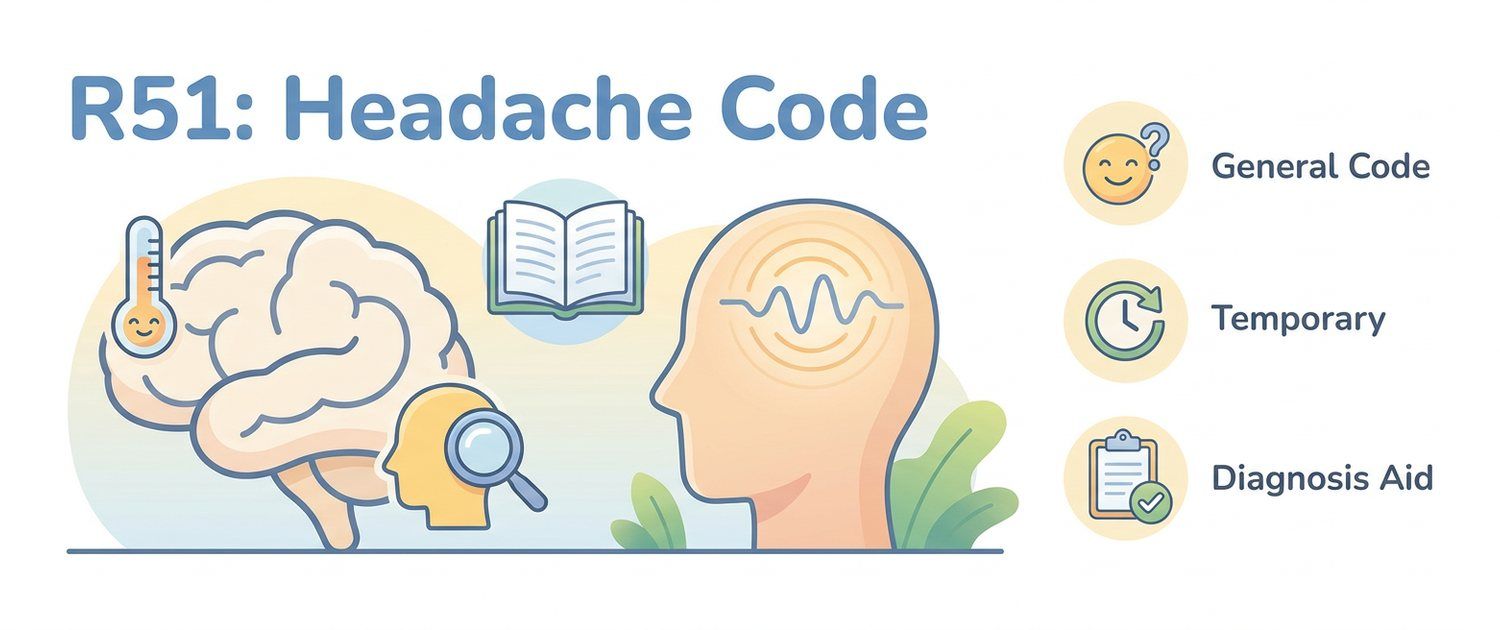
If the «Diagnosis» field on your visit record, referral or discharge note contains only R51, the code can look cryptic and therefore alarming. Let us take it apart calmly. R51 is the symptom code for «headache», not the name of a disease: it records the complaint a person came with, before its cause has been established. Below: what each element of the code means, where it appears, what it does and does not tell you, how it differs from neighbouring codes, and which next steps make sense.
What the ICD-10 headache code R51 actually means
The official wording of R51 is «Headache». Element by element:
- R — the letter of ICD-10 Class XVIII: «Symptoms, signs and abnormal clinical and laboratory findings, not elsewhere classified». The key words are symptoms and not elsewhere classified. The whole class covers manifestations for which no specific diagnosis has yet been assigned.
- R50–R69 — the block «General symptoms and signs»: fever, headache, malaise, fainting and similar complaints that do not by themselves point to one particular disease.
- R51 — the category «Headache». In the classic edition of ICD-10 it is a whole three-character category; facial pain of unspecified cause is classified here as well.
- .0 / .9 — updated editions of the classification split the category further: R51.0 for headache with orthostatic component (worse when upright), R51.9 for headache, unspecified. Many national documents still use plain
R51.
Put together: R51 in a document states «a complaint of headache has been recorded; this entry does not name its cause». It is the starting point of a work-up, not its conclusion.
Where you may have seen this code
R51 is normally assigned at the entry point — at the first contact, before the pain has been attributed to a specific type:
| Document | Why R51 is there |
|---|---|
| Outpatient visit record | The administrative record of the visit; the reason for contact is headache |
| Referral to a neurologist or for imaging | A referral needs a code, and the cause of the pain is not yet known |
| Certificate or discharge note | The doctor examined you, ordered a work-up, and named no specific disease yet |
| Insurance claim | The clinic reports the consultation; the symptom code justifies payment for the visit |
| Ambulance call sheet | The initial record of the complaint before its cause is clarified |
The practical conclusion: a code on a referral describes the reason for the visit, not an established diagnosis. It was assigned before the examination and test results were known.
Is R51 dangerous or not
The honest answer: the code itself indicates nothing either way. R51 is neutral — it states only that the complaint has been recorded.
What is worth knowing plainly: the overwhelming majority of headaches are primary, meaning the pain is the disorder itself rather than a sign of damage to the brain. Migraine and tension-type headache belong here; they are debilitating but not life-threatening. Secondary headaches — caused by another condition — are considerably rarer, and it is precisely to rule them out that a doctor asks detailed questions.
There is a set of features that should not wait. This is not a reason to panic, but the list clinicians check first:
- the pain started abruptly and peaked within seconds (a «thunderclap» onset);
- headache with high fever, neck stiffness or a rash;
- weakness or numbness in the limbs, speech, vision or consciousness disturbance;
- a first-ever headache after the age of 50, or an abrupt change in a familiar pattern;
- pain worse in the morning, on bending or straining, with vomiting;
- headache following a head injury;
- headache in a person with cancer, HIV or on immunity-suppressing medication.
Any of these calls for a doctor in person, promptly. Otherwise the code creates no urgency — but a recurring headache still deserves a proper look, because it almost always has an explainable cause.
Neighbouring codes and how they differ
Headache is coded differently depending on how clear its nature is:
| Code | Meaning | When it is used |
|---|---|---|
| R51 | Headache | The complaint is recorded; type and cause are not specified |
| R51.0 | Headache with orthostatic component | The pain is clearly worse upright and eases lying down |
| G43 | Migraine | Migraine has been diagnosed — attacks with a characteristic pattern, often with aura |
| G44.2 | Tension-type headache | The type is established — bilateral, pressing, without nausea or photophobia |
| R42 | Dizziness and giddiness | The leading complaint is dizziness and unsteadiness rather than pain |
The main distinction is between R51 and the Class G codes. Class G (diseases of the nervous system) applies once the doctor has attributed the pain to a specific entity: migraine is coded G43, tension-type headache G44.2. R51 stays in the paperwork while that certainty is missing. So replacing R51 with G43 in a later note is not a deterioration — it means the diagnosis has become more precise.
Which tests are usually ordered with this code
The key diagnostic instrument for headache is not a scanner but a detailed conversation. Migraine and tension-type headache are diagnosed clinically, from the character, duration and frequency of attacks and the symptoms that come with them. A doctor will typically ask where exactly it hurts, how the pain feels (pressing, throbbing, stabbing), how long an attack lasts, what triggers and what relieves it, whether light and sound are intolerable, whether nausea occurs, and how many days a month you take painkillers.
Depending on the answers, blood pressure may be measured, the fundus examined, and blood tests ordered — full blood count, ESR, ferritin, TSH, glucose — to exclude anaemia, inflammation or thyroid dysfunction. Neuroimaging (MRI or CT of the brain) is not for everyone: it is ordered selectively, for the red flags listed above, for a changed pattern of pain, or for neurological signs. In long-standing typical migraine without warning features a scan usually adds nothing.
The most useful preparation is a headache diary kept for two to four weeks: dates, duration, intensity on a ten-point scale, what preceded the attack, which medication was taken. Such a diary tells a doctor more than most single investigations. Organising your own symptoms before the appointment is real work, and it directly affects how precise the assessment can be.
What to do next
A sensible sequence:
- Do not look for a hidden diagnosis behind the code. R51 carries no information about the cause; that is established at the consultation, not in the code field.
- Check yourself against the red-flag list above. If nothing matches, arrange a routine appointment with a physician or neurologist.
- Start a headache diary. Two or three weeks of notes turn a vague «my head often hurts» into a concrete picture.
- Note accompanying symptoms. Dizziness alongside the pain shifts the direction of the search — what may lie behind it is covered in the guide to causes of dizziness. If the pain comes with anxiety attacks, palpitations and shortness of breath, see the overview of panic attacks and related tests.
- Count your painkillers. Taking analgesics on more than 10–15 days a month can sustain a chronic headache on its own — tell your doctor about it.
- Mention persistent tiredness if you have it: constant fatigue is coded separately as R53, malaise and fatigue, and together the two complaints read differently than each alone.
If the consultation attributes the pain to a specific type, a different code will appear in later documents — G43 or G44.2, for example — together with the name of the diagnosis. That is when the conversation becomes concrete.
The short version
R51 is the symptom code «headache» from ICD-10 Class XVIII. It records a complaint rather than establishing a disease, and it signals neither danger nor safety. Meaning lies in the pattern of the pain, its frequency, accompanying symptoms and the clinical examination. Thunderclap onset, fever with neck stiffness, neurological deficits or pain after a head injury mean seeing a doctor urgently. Otherwise an unhurried but not indefinitely postponed appointment, with a headache diary in hand, is what helps most.
For informational purposes only
This article is for informational purposes only and does not constitute medical advice, diagnosis, or treatment. Please consult a healthcare professional for medical guidance.