How to Choose an Occupation: A Method, Not a List
Reviewed by the LabReadAI medical team
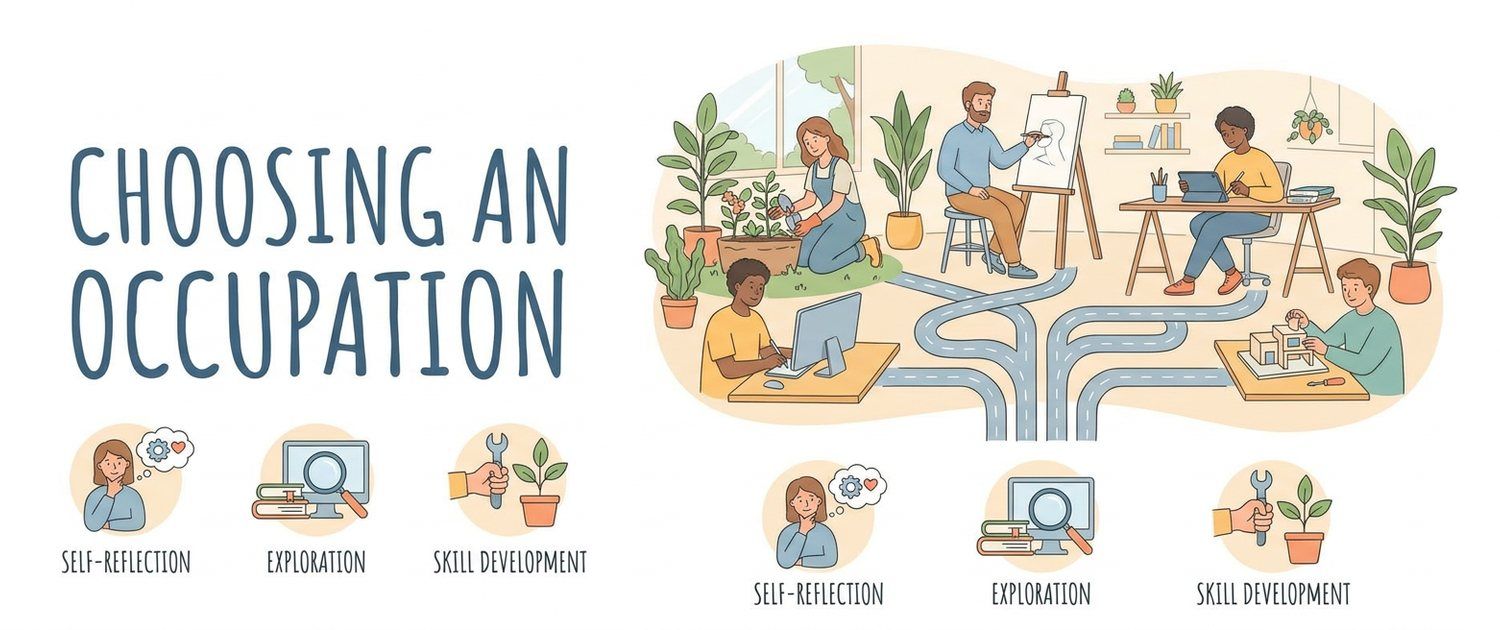
The question «how do I choose an occupation» is almost always asked as though names were missing. Usually they are not: people know about analysts, designers, welders, accountants and logistics coordinators. Something else is missing — and that something comes in six different kinds.
Working out which of the six is yours matters more than any list of options, because what makes sense to do next depends entirely on it.
The six places where a choice actually gets stuck
A published taxonomy of career decision difficulties sorts them into three groups: lack of readiness, lack of information, and inconsistent information. Inside them sit six things that look identical from outside («I cannot choose») and need completely different responses.
| What is stuck | How it sounds from inside | What helps |
|---|---|---|
| Not knowing myself | «I do not understand what I even enjoy» | Short trials that reveal what was done with pleasure |
| Not knowing occupations | «I have no idea what they do all day» | One conversation with an insider — about an ordinary Tuesday |
| Not wanting to deal with it | «I have no room for this right now» | First work out why: tiredness, or the wrong person asked |
| Finding decisions hard | «I stand twenty minutes in a shop too» | Shrink the stake, do not widen the analysis |
| Believing in one right one | «What if this is not The One» | Take the belief apart — see below |
| No backing at home | «I know what I want but they will not let me» | Wording for specific objections, not more resolve |
Note that only one row out of six is answered by a test. The other five are answered by actions, and all of them are small.
Why «think it over some more» is the one always-wrong answer
If what is missing is information about the world of work, no amount of thinking will supply it: you can only think about what you already know. Exactly three things help, and all of them take under a week.
A conversation with an insider. Not about the profession but about an ordinary Tuesday: how the day starts, what takes the most hours, what is infuriating, why people leave. One such conversation eliminates more options than a month of reading job ads.
A trial task. Small, real, carried through to the end. Not a course — a course shows whether you like studying, not whether you like the work.
A day of watching. If you can, simply sit alongside. What decides is not the impression but the tiredness by evening: the pleasant kind or the empty kind.
The belief that gets in the way more than circumstances
There is an idea almost everyone treats as harmless: somewhere there is one occupation that suits me, and the task is to guess it. It is the most expensive of career beliefs, and here is why.
Research on implicit theories of interest shows that people who treat interest as fixed and findable engage worse with anything outside their current zone, expect limitless motivation from «their» work, and quit at the first difficulty, because difficulty reads as proof of a mistake. People with the opposite belief — that interest develops — hold on.
The practical conclusion is simple: interest grows alongside skill rather than waiting for you somewhere ready-made. So the question «is this The One» is meaningless at the entrance — nothing is The One at the entrance. The meaningful question is whether you will sit through the stretch where you are still bad at it.
How much a «matching» occupation actually decides
Here is a figure this market usually skips. Across more than a hundred studies, the fit between interests and the content of work explains about one part in twenty-five of the differences in how content people are at work. With how well someone performs, the link is noticeably stronger.
This does not mean choosing is pointless. It means the weights belong in the right places: a manager, the workload, the money, the schedule and health decide more than a job title. Someone who moved into «their» field under a bad manager will not have an easier time.
Criteria worth actually checking
It is more useful to check four things in order than to check «do I like it».
- Content. What you will do for most of the hours — not what the title says.
- Values. What you need work for: independence, recognition, the people around, stability, growth. People leave work that interests them by content over this more often than over the tasks.
- The price of entry. How many months without the previous income, how much study, whether a diploma is required or a route without one exists.
- Your constraints. Whether you have a cushion, whether income may fall, whether you have energy to study after the working day, whether the schedule and city can change, whether anyone will back you.
The fourth point is customarily skipped, though it is the one that most often decides. «Quit and study» is useless advice to someone other people depend on for income — and most people are that someone.
When no change is needed
A separate honest option that is rarely said out loud: sometimes the job broadly suits and one part has sagged — the tasks, the relationships or the sense of meaning. Then the answer is not a change of occupation but reshaping the current job. Rebuilding tasks, relationships and meaning inside the same role is linked in research to higher satisfaction and lower burnout — with no resignation at all.
And one more option worth checking first: if there is nothing left in the tank, nothing looks interesting and every list of directions looks equally empty. That is a property of the state, not of the list. Then the burnout reading and a doctor come first, and the choice can wait.
What an algorithm computes here, rather than an eye
Everything above can be checked by hand. But three things do not compute well by hand: the shape of an interest profile, the type of difficulty, and which occupations actually sit on your profile given your constraints.
In the career direction test code does that: six interest types and six work values, two independent axes — how well you understand what you want and how realistic a move is at your circumstances — plus a match of candidates from a 192-occupation directory by profile congruence and by your constraints. The model invents nothing: it explains what was already matched.
Nearby on the same subject
Neighbouring readings in this cluster, if this is not your only question:
For informational purposes only
This article is for informational purposes only and does not constitute medical advice, diagnosis, or treatment. Please consult a healthcare professional for medical guidance.