Why a Four-Letter Type Is a Poor Basis for Choosing Work
Reviewed by the LabReadAI medical team
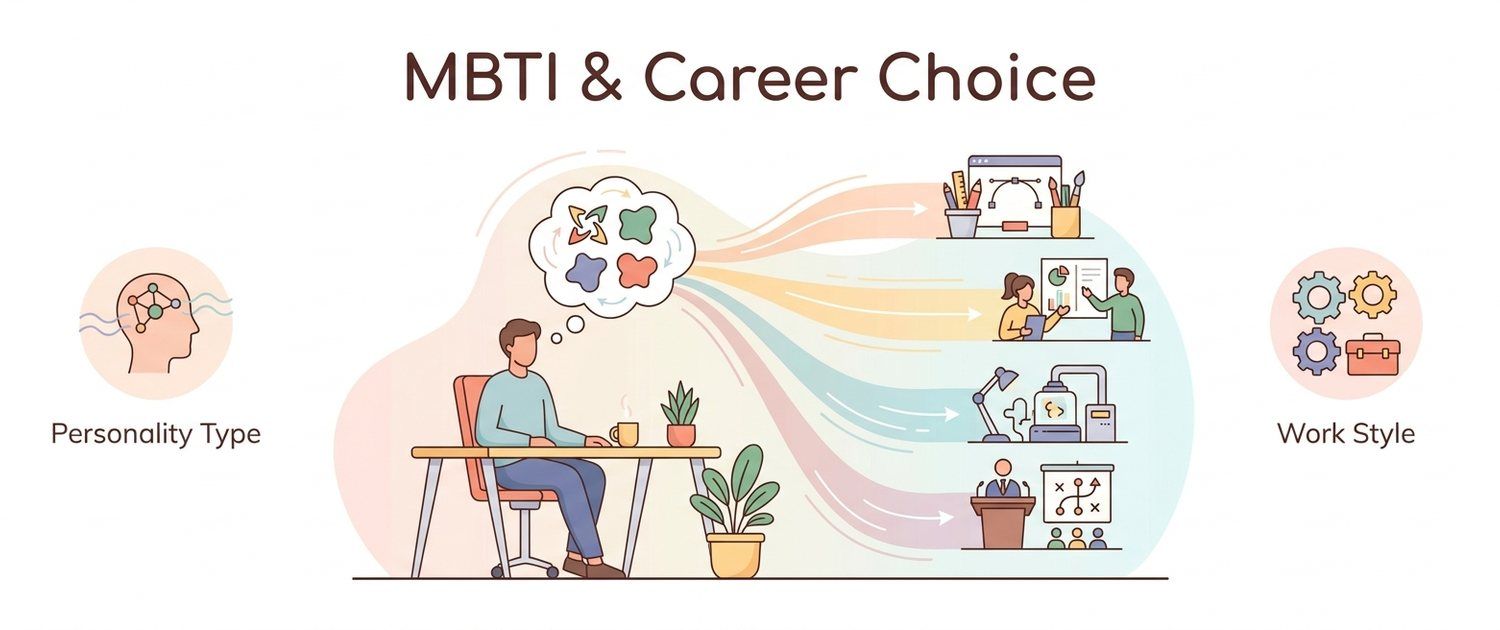
Four-letter types are popular for a reason: they give a coherent, recognisable and broadly kind description of a person, and reading a description of oneself is pleasant. The trouble starts where that description is used to build a decision about changing work.
Below are three objections, each practical rather than ideological.
⚠️ No specific commercial instrument is named here: this is about the mechanics of four-letter typology, not about anyone's trademark.
Objection one: the MBTI type does not reproduce on a retest
The best-known complaint about four-letter typology is the stability of the result on retest. Published reviews put the share of people receiving a different type after just a few weeks in a broad but always substantial range.
For a horoscope that does not matter. For a decision about changing occupation it is critical: the decision then rests on a result that does not repeat itself a month later.
Objection two: the letter comes from cutting a continuous scale
The mechanics are these: a score is computed on each of four scales, then the scale is cut in half and the person receives a letter. An awkward consequence follows: the closer someone is to the middle of a scale, the less stable their letter — and the more their type depends on their mood on the day.
And most people are near the middle. If two separate «kinds of people» existed, the distribution of scores would be bimodal: two groups with a dip between them. In the data the distribution is single-peaked — most people in the middle, the poles rarer. So the boundary between types is drawn exactly where people are densest.
Objection three: MBTI typology gives a continuum, not 16 types
The third follows from the first two. Sixteen types are not sixteen kinds of people but sixteen combinations of four arbitrary cut-offs. Two people with the same four letters may sit at opposite edges of every scale, and two people with different letters may be nearly identical.
In career guidance this matters, because a recommendation of the form «people of your type suit these occupations» rests on a group that does not exist in the data as a group.
What is used instead
Six interest types
The scheme career guidance has run on for half a century: realistic, investigative, artistic, social, enterprising and conventional. The key difference from a four-letter type: this is not a sorting into boxes. A person has a level on each of the six, and a profile is a shape rather than a label. The three leading types make a three-letter code, but even that reads as «where the pull is stronger», not «who you are».
That scheme is taken apart separately in the RIASEC reading.
The five-factor structure of traits
For character, scientific psychology uses five continuous scales instead of types. No cut-offs: a person is described by their position on each scale. Unlike typology, this model has clear reliability and clear links to outside measures.
⚠️ An important caveat made by the authors of the open versions of that model themselves: facet scales are not intended for important decisions about individuals — that is, for hiring and selection. Our personality type test states that limit outright.
Work values
A separate thing typologies say nothing about: what work is for. Achievement, independence, recognition, relationships, fair management, stable conditions. People leave work that interests them by content over a mismatch here more often than over the tasks.
So a type is useless?
As a language for talking about yourself it is quite useful, and there is nothing wrong with that. Four letters give a convenient vocabulary: «open-plan offices are hard for me», «I plan ahead», «I decide by feel». All of that is true and worth knowing.
Only one thing is bad: treating the letters as a fact about yourself and choosing an occupation by them. A type is a description, not a measurement, and a decision about the next ten years is better built on something else.
What an algorithm computes here, rather than a label
The career direction test is deliberately built without typology: six interest types and six work values are scored as continuous scales, work-related traits as a short slice of the five-factor model, and directions are matched from a 192-occupation directory by profile congruence and by your real constraints. There is no four-letter label anywhere in it — and that is not a stylistic choice but a consequence of everything above.
When it is not about the instrument but about your state
A separate check worth doing before any test: if nothing brings joy — including what used to — and rest does not restore, put the question of choice aside. In that state nothing looks interesting, and any typology will return an equally empty answer. That is a property of the state, not of the instrument: start with the burnout reading and a doctor.
Nearby on the same subject
Neighbouring readings in this cluster, if this is not your only question:
For informational purposes only
This article is for informational purposes only and does not constitute medical advice, diagnosis, or treatment. Please consult a healthcare professional for medical guidance.