The Klimov Inventory (DDO): What It Measures and What It Does Not
Reviewed by the LabReadAI medical team
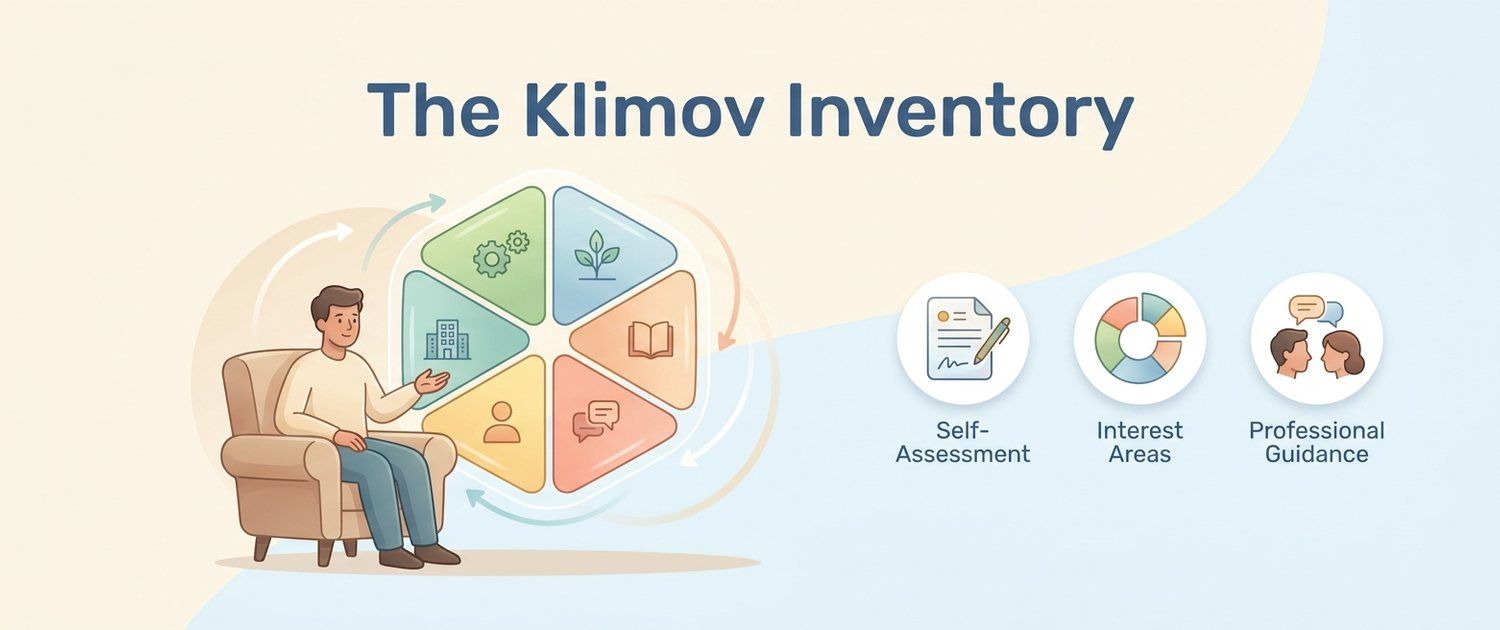
This inventory is one of the most recognisable career-guidance methods in Russian practice: it is used in schools and in employment centres, and its versions circulate freely online. Here is what it gives and what should not be expected of it.
What the Klimov inventory measures: five groups by the object of work
The key idea: occupations are conveniently distinguished by what exactly a person works with.
| Group | Object of work | What happens there |
|---|---|---|
| Person — person | Other people | Teaching, treating, serving, negotiating, accompanying |
| Person — technology | Machines, materials, energy | Assembling, setting up, maintaining, operating |
| Person — sign system | Numbers, texts, diagrams, code | Counting, drafting, reconciling, programming |
| Person — artistic form | Form, sound, word, image | Creating, designing, performing |
| Person — nature | The living: plants, animals, environment | Growing, treating, studying, tending |
Splitting by the object of work is practical because it is visual: people usually grasp easily whether instruments, texts, plants or people are closer to them.
How the Klimov inventory works
The mechanics are simple, and that is their strength: pairs of activities are shown and the person picks the one they would prefer. Each pair pits two groups against each other; the accumulated choices make five sums.
Two properties follow that matter.
The result compares inside you. The inventory does not say how strongly technology pulls you compared with other people. It says technology is closer to you than sign systems. That is fine, but it is not the same as a place among people.
The result is unstable when sums are close. If two groups come out level, the difference is within noise — and a repeat may swap them. Reading such a result as «my type is this one» is wrong.
What it is good for
As a first conversation. Five groups are a very clear language. For a teenager, or for an adult who has never thought about the content of work, it gives a quick foothold: «the living is closer to me», «texts are closer to me».
As a way to rule out what is clearly not yours. If a group sits consistently at the bottom, that is useful information: directions inside it will demand more effort from you than from others.
As a free and fast instrument. It takes minutes, needs no specialist and is widely available.
What the Klimov inventory does not measure
Five groups are a coarse grid. «Person — sign system» holds accountants, programmers and proofreaders alike — jobs with very different demands. For choosing a specific direction the grid is too coarse.
It is not about work values. What you need work for — independence, recognition, stability, people around — is not asked at all. And people leave work that interests them by content over a mismatch there more often than over the tasks.
It is not about constraints. Whether you have runway, whether income may fall, whether you have energy to study after work, whether the schedule can change — none of that is in the method. And that is exactly what decides whether a move is realistic.
It was built for school career guidance. That is not a reproach: an adult has a different task — not «what to become» but «change or reshape, and what will it cost».
It is not about ability. Preference and skill are different things, and the inventory measures the first.
On copyright
The construct of five occupational groups by object of work is an idea, and anyone may use it. But specific item wordings and the keys of derivative versions are covered by copyright: they must not be reproduced verbatim, and the «versions» circulating online often ignore that rule.
So the correct approach in one's own instrument is to take the construct and write one's own items — which is what we do.
How to use the result sensibly
- Look not at one group but at the order of all five, and at whether there is a real gap between the first and the second.
- If there is no gap, read the result as a group of nearby directions, not as a type.
- Overlay work values and your constraints: without them the picture is incomplete.
- Test two directions in real life — a conversation with an insider about an ordinary Tuesday.
What an algorithm computes here
The career direction test is built around a finer grid: six interest types (their profile is shown as a hexagon) plus six work values, work-related traits, the type of decision difficulty and five scales of your real constraints. All wordings are our own. Directions are matched by code from a 192-occupation directory — by profile congruence and by what is genuinely available to you.
When it is not about the instrument but about your state
A separate check worth doing before any test: if nothing brings joy — including what used to — and rest does not restore, put the question of choice aside. In that state nothing looks interesting, and any typology will return an equally empty answer. That is a property of the state, not of the instrument: start with the burnout reading and a doctor.
Nearby on the same subject
Neighbouring readings in this cluster, if this is not your only question:
For informational purposes only
This article is for informational purposes only and does not constitute medical advice, diagnosis, or treatment. Please consult a healthcare professional for medical guidance.