Career Consultants: Who They Are and How to Choose One
Reviewed by the LabReadAI medical team
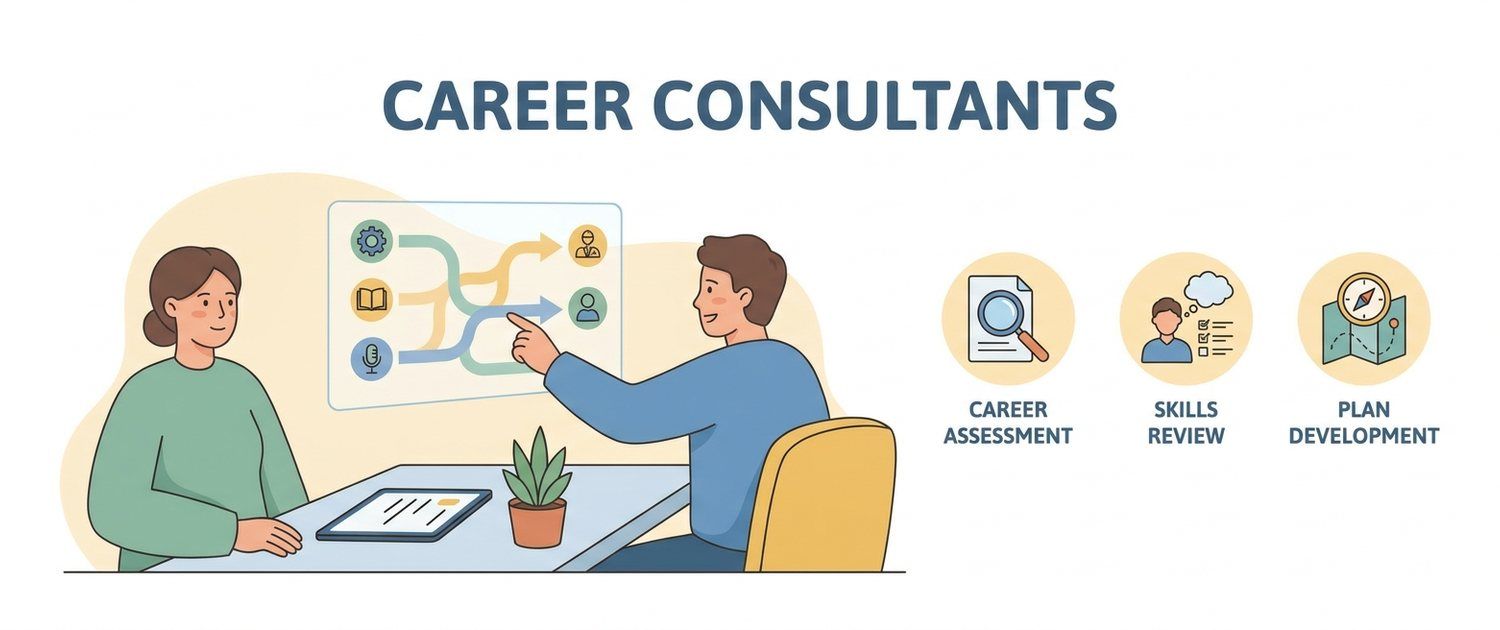
Demand for career consultants is growing while a clear description of the occupation is missing: some call themselves career coaches, others career counsellors, others HR consultants, and the content of their work can differ more than the titles do.
Here is what the service is, when it genuinely helps, and how to judge it.
Who they are and how they differ from neighbours
| Who | What they do | When useful |
|---|---|---|
| Career consultant | Examines your situation whole: profile, constraints, options, a transition plan | When a decision is due and the how is unclear |
| Career counsellor | Closer to assessment: tests, interests, directions | When the direction itself is unclear |
| Career coach | Works with your own search, less content, more process | When you know the decision but are not moving |
| Recruiter | Works for the employer, not for you | When you need a vacancy, not a choice |
| HR consultant | CV, interviews, negotiating terms | When the direction is clear and the tools are weak |
The boundaries are blurred, and what matters more than the title is what a specific person does in a session. That is worth asking about directly.
⚠️ The occupation is unlicensed. Neither a degree nor a certificate is required, and anyone may call themselves a career consultant. That does not mean all of them are poor — it means the vetting falls to the client.
What is known about effectiveness
Here there is a rarity for this field: career interventions have been studied by meta-analyses better than most helping practices, and the result is concrete.
Components work, not instruments. Effectiveness is determined by the presence of five things: a written exercise (the person writes, not merely listens), an individual interpretation of their own result, information about the world of work, a worked model of a similar path, and help building support around the decision. The more of them are present, the stronger the effect — and it grows sharply across the first three.
A live session is stronger than an automated one. This is established, and the explanation is prosaic: it is the dialogue. The ability to ask «how does this look in my case» is exactly what an automatic output lacks.
What shifts most is confidence. The largest effect of career interventions falls not on match accuracy but on career self-efficacy — the ability to decide and to learn. In other words a good session gives you back the decision rather than making it for you.
When a session genuinely helps
- The decision is due but you have been going in circles for months.
- There are several options and it is unclear how to compare them.
- The move runs into constraints, and what is needed is a plan, not a list of occupations.
- You need an outside view from someone who has seen many similar situations.
- There is no backing at home, and you need wording for that conversation.
When it will not help
- If there is nothing left in the tank. In exhaustion nothing looks interesting, and a career conversation gives the wrong answer regardless of the consultant's quality. First the burnout reading and a doctor; weakness and poor sleep are worth checking with tests — ferritin, TSH, vitamin D.
- If you need a vacancy rather than a choice. That is a different service.
- If you expect someone to decide for you. A good consultant will not — and that is a sign of a good one, not a bad one.
How to choose: five questions before paying
- What exactly happens in the session? «We will talk about you» is a poor sign. A clear structure and a clear output is a good one.
- What do I get at the end? A recording, a plan, a document? A spoken conversation with no trace is forgotten in a week.
- Will there be written exercises? This is one of the highest-weight components and the one most often missing.
- Where does the information about occupations come from? If from the consultant's personal experience, it is limited by their biography.
- What do you NOT do? An honest answer to this is the most informative of all. A specialist who does not promise employment, guaranteed income and «finding your calling» is usually better than one who does.
⚠️ Warning signs: a promise of a specific salary, a «guarantee of employment», a recommendation of one particular school or course (especially if the consultant is connected to it), and a result consisting of a single occupation with no explanation.
How to get the most out of a session
An hour is expensive and easy to spend collecting data you could have brought with you. It is useful to arrive:
- with a ready profile — interests, work values, work-related traits;
- with honestly counted constraints: runway, room for income to drop, time to study, mobility, backing;
- with a specific question, not with «help me work things out».
Then the session goes on what it is for: a dialogue about your case.
What an algorithm computes here
The career direction test covers the part it is pointless to do in a live session: code scores six interest types, six work values, the type of decision difficulty and five constraint scales, and matches candidates from a 192-occupation directory. All five proven components are in the reading, including the written steps and the conversation with those close, and the missing dialogue is covered by the chat under the reading — the very component whose absence is why automated tools usually lose to a live session.
This does not replace a consultant in a hard case — it is a way of arriving prepared.
Nearby on the same subject
Neighbouring readings in this cluster, if this is not your only question:
For informational purposes only
This article is for informational purposes only and does not constitute medical advice, diagnosis, or treatment. Please consult a healthcare professional for medical guidance.