Osteochondrosis and Military Service: What Article 66 Requires
Reviewed by the LabReadAI medical team
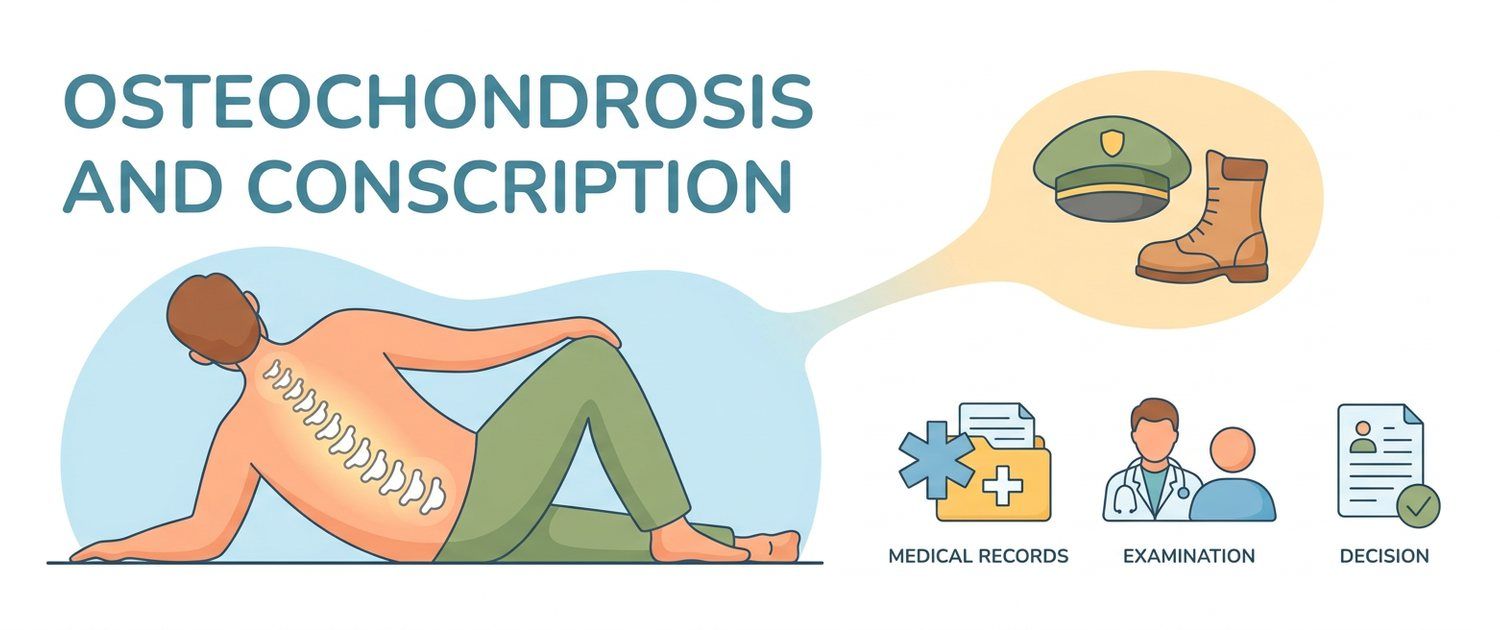
The short answer: osteochondrosis usually does not prevent conscription — it meets the criteria of article 66 less often than people expect. The diagnosis appears in nearly every second chart, but the regulation asks not for an entry: it asks for a combination of a specific number of affected segments, particular radiological signs, and pain confirmed by visits to a doctor.
Which fitness category osteochondrosis yields
| What the records show | Clause | Column I (conscription) |
|---|---|---|
| Osteochondrosis with deep pareses, sphincter dysfunction, severe pain after prolonged treatment without effect | «a» | D — unfit |
| Extensive osteochondrosis with multiple massive beak-shaped outgrowths and persistent pain | «b» | V — limited fitness |
| Limited osteochondrosis (up to 3 discs) with pain on significant exertion and clear anatomical signs | «v» | V — limited fitness |
| Isolated osteochondrosis without functional impairment | «d» | B-3 — fit with restrictions |
Isolated, limited, extensive: counting the segments
The regulation defines these three words numerically, and the clause follows from them:
Extensive spondylosis and osteochondrosis means involvement of 2 or more regions of the spine; limited means involvement of 2–3 vertebral segments of one region; isolated means single lesions.
The regions here are cervical, thoracic and lumbar. So a conclusion reading "osteochondrosis of the cervical and lumbar regions" already describes an extensive process, while "osteochondrosis L4–L5, L5–S1" is a limited one.
Which radiological signs are mandatory
The regulation lists them directly, and these are not generalities:
The radiological symptoms of intervertebral chondrosis are: disturbance of the shape of the spine (impaired static function), reduced height of the intervertebral disc; calcium deposits in the anterior part of the fibrous ring or in the nucleus pulposus; displacement of vertebral bodies (spondylolisthesis)… preservation of clear contours of all surfaces of the vertebral bodies, absence of destructive changes in them.
In intervertebral osteochondrosis the listed signs are joined by marginal bone outgrowths forming in the plane of the disc and continuing the endplates of the vertebral bodies, as well as subchondral osteosclerosis.
As a clinical manifestation of chondrosis the regulation names impaired static function: straightening of the cervical or lumbar lordosis, formation of a kyphosis, a combination of local lordosis and kyphosis instead of an even lordosis.
Why the combination decides, not the diagnosis
The article's key sentence:
Only the combination of the listed clinical and radiological signs of limited deforming spondylosis and intervertebral osteochondrosis provides grounds for applying clause «v».
And separately, on pain:
Pain on physical exertion must be confirmed by repeated requests for medical care recorded in the person's medical documents.
This is why the word "osteochondrosis" without an image showing the signs and without a history of visits remains just a word to the board. And conversely, an asymptomatic MRI finding does not trigger the article — the regulation excludes an asymptomatic isolated process outright.
Functional impairment and instability in numbers
Minor degree: static disturbances after 5–6 hours upright, range of movement restricted by up to 20 %. Moderate: inability to stand for more than 1–2 hours, restriction of 20–50 %, limb muscle weakness. Significant: over 50 % and inability to hold an upright position.
Segmental instability is confirmed by functional radiography: displacement of adjacent vertebral bodies by 3 mm or more in one direction; hypermobility means a combined angular difference on flexion and extension of more than 10 degrees.
What your records must contain
- A radiograph describing the signs: disc height, marginal outgrowths, subchondral osteosclerosis, the state of the lordosis.
- Functional images — without them instability cannot be confirmed.
- A list of affected segments and regions: their number decides limited versus extensive.
- A history of visits for pain across years, with dates.
- Neurological status: reflexes, sensation, muscle strength.
- The chart code is M42.1; it records osteochondrosis but neither the segment count nor function.
What is usually missing
- There is only an MRI, while the board needs a radiograph with functional views; how the two differ in purpose is covered in reading an MRI report.
- The conclusion says "osteochondrosis" without the list of signs from the regulation.
- Segments and regions are not stated.
- There is pain but no visits.
- Osteochondrosis and inflammatory spinal diseases are not separated — different articles and different work-ups; which tests help identify inflammation is collected in the list for joint pain.
Questions for your doctor
- How many segments and which regions of the spine are involved?
- Which radiological signs exactly are described on my image?
- Is there reduced disc height, marginal outgrowths, subchondral osteosclerosis?
- Has instability been confirmed on functional images?
- How many documented visits for pain have I accumulated?
The spine at departmental boards
The above concerns assessment under Government Decree No. 565. The Interior Ministry, National Guard, Federal Security Service and Emergencies Ministry use their own schedules of diseases with their own requirements. A review under article 66 shows how complete your records are but is not their regulation.
The short version
Osteochondrosis is the most common diagnosis in charts and simultaneously one of the weakest arguments at the board when nothing substantiates it. Three things are needed together: the number of affected segments, specific radiological signs, and documented pain under load. Without them the case falls to clause «d» and category B-3. Only the military medical board determines the fitness category.
For informational purposes only
This article is for informational purposes only and does not constitute medical advice, diagnosis, or treatment. Please consult a healthcare professional for medical guidance.