M42.1 — Adult Osteochondrosis of Spine: ICD-10 Code Explained
Reviewed by the LabReadAI medical team
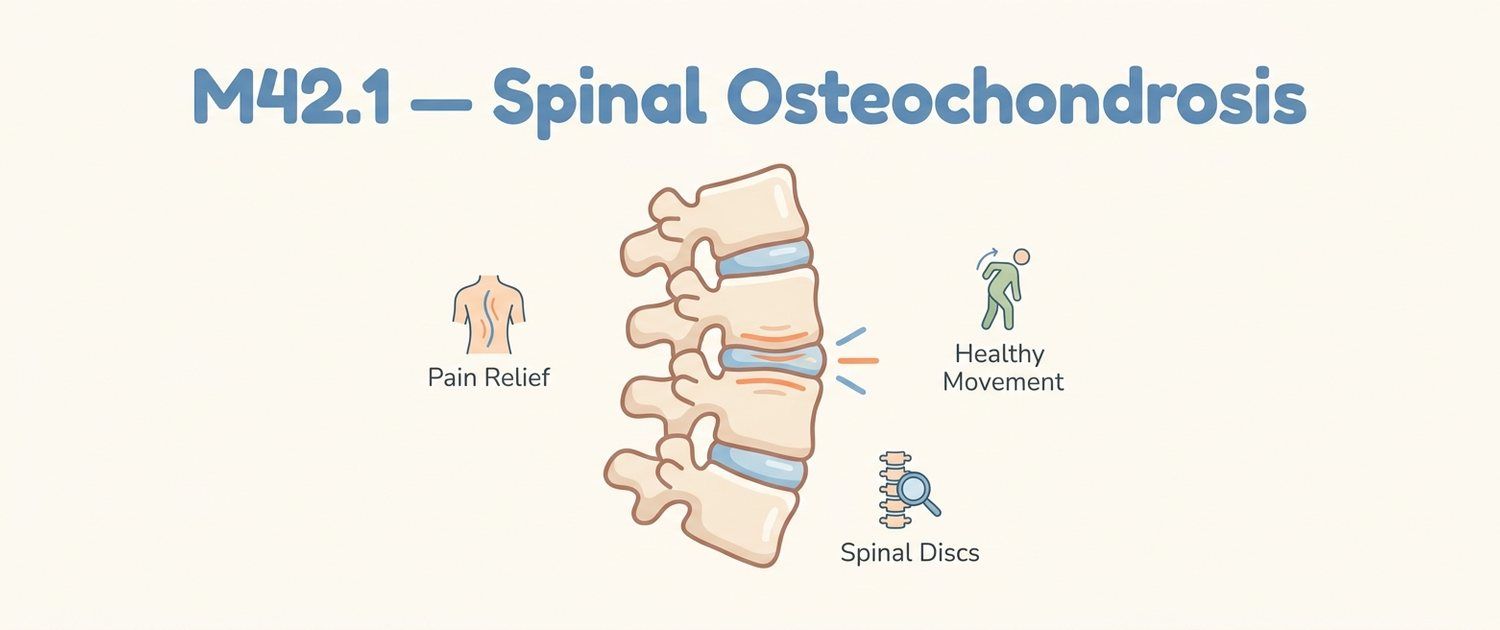
If the «Diagnosis» field of your chart, referral or discharge note contains M42.1, the usual reaction is unease: the code looks opaque. Let us take it apart calmly. M42.1 is the official record of the wording «Adult osteochondrosis of spine». It describes the state of spinal tissue, but says nothing about severity or prognosis. Below: what each element of the code means, where it appears, what actually lies behind it and which steps make sense.
What code M42.1 means in ICD-10
The official wording of M42.1 is «Adult osteochondrosis of spine». Element by element:
- M — the letter of ICD-10 Class XIII: «Diseases of the musculoskeletal system and connective tissue». This class covers joints, bones, muscles and ligaments — support and movement, not internal organs.
- M42 — the category «Spinal osteochondrosis», which groups degenerative change in the intervertebral discs and the adjacent vertebral endplates.
- .1 — the subcategory «in adults». It separates the adult form from the juvenile one (M42.0), which develops while the skeleton is still growing and behaves differently.
About the word itself. «Osteochondrosis» here means change in cartilage and bone within a spinal segment: the disc loses water and height, the vertebral rim thickens, bony outgrowths may form. It is a process of wear and remodelling, not inflammation and not a tumour.
One nuance that helps when reading your papers: in Russian and post-Soviet practice the term is used very broadly — often for any back pain accompanied by age-related findings on imaging. In international literature the closest equivalents are «spondylosis» and «degenerative disc disease». So M42.1 in a chart usually describes the picture rather than answering «why does it hurt».
Where you may have seen this code
M42.1 turns up in documents issued both after a neurologist's appointment and after imaging:
| Document | Why M42.1 is there |
|---|---|
| Referral for MRI, CT or X-ray | A referral needs a code; the doctor records a working diagnosis based on complaints and examination |
| Outpatient visit record | The administrative record of the visit: the reason is back or neck pain |
| Discharge note or neurologist's report | The outcome of the appointment, written both in words and as a code |
| Certificate for work, sport or a sanatorium | The code marks a chronic musculoskeletal condition |
| Insurance claim | The clinic reports the service delivered; the code justifies payment |
A separate note on sick notes: certificates of incapacity for work state no diagnosis at all — neither in words nor as an ICD code — only a two-digit reason code. So if you see M42.1, you are holding a different document.
Is adult osteochondrosis of the spine dangerous or not
Plainly, without softening in either direction.
What M42.1 does not mean. It is not a tumour, not an infection, not inflammation and not a life-threatening state. By itself the code predicts neither disability nor surgery. Degenerative disc change is the commonest form of age-related remodelling: it is found on imaging in most people over 60 who have never had back pain. «Osteochondrosis on MRI», taken without symptoms, means very little.
What M42.1 may mean. That you have a source of chronic or recurring neck, thoracic or lower back pain, restricted movement, morning stiffness. That is a real quality-of-life problem and should not be dismissed with «everyone has it». Back pain responds well to consistent work — but the specific plan is always the doctor's to set.
When a doctor is needed promptly rather than eventually. Red flags that do not belong to M42.1 itself but require quick assessment:
- weakness or numbness in a hand or foot that increases day by day;
- changes in bladder or bowel control, numbness around the groin;
- pain after a fall or accident, or in a person with osteoporosis — risk of a vertebral fracture;
- pain together with fever, chills or unexplained weight loss;
- pain that wakes you at night and does not change with position.
None of these can be read out of a code — they are found on examination. That is precisely why the code in a document does not replace a consultation.
Neighbouring ICD-10 codes for spine degeneration and how they differ
Codes close to M42.1 often appear in the same papers. The difference lies in what is being described: age, structure or symptom.
| Code | Meaning | How it differs from M42.1 |
|---|---|---|
| M42.0 | Juvenile osteochondrosis of spine | Same category, but the growth-period form in adolescents and young adults, with a different course and follow-up |
| M42.1 | Adult osteochondrosis of spine | Degenerative change of discs and vertebrae in adulthood |
| M51.1 | Disc disorders with radiculopathy | States not merely disc change but compression of a nerve root — pain radiating into an arm or leg, numbness |
| M54.5 | Low back pain | A symptom code rather than a structural one: it records the complaint when the cause is not yet established |
| M47 | Spondylosis | Emphasis on the facet joints between vertebrae and bony outgrowths rather than on the discs |
In practice these codes are often used as near-synonyms; the choice depends on what imaging shows and what the examination records. A change of code between two appointments usually means the picture was refined, not that things got worse.
Which investigations are usually ordered with this code
Osteochondrosis is diagnosed primarily from complaints and examination; investigations refine the picture and rule out other causes of pain. The typical set:
- Spinal X-ray — the baseline: disc height, bony outgrowths, segment stability, and with flexion/extension views, excessive mobility.
- MRI — the method of choice when pain radiates into an arm or leg, or there is numbness or weakness: discs, nerve roots and the spinal cord are visible. How to read the wording of such a report — «protrusion», «disc desiccation», «dorsal herniation» — is unpacked in a separate guide on reading an MRI report.
- CT — when bone detail matters: consequences of trauma, assessment before an intervention.
- EMG/nerve conduction study — to establish whether a nerve is affected and how much.
- Blood tests — when an inflammatory or infectious cause of pain is suspected, and as part of a general assessment.
- Bone densitometry — for back pain in older adults, so that reduced bone density is not missed; how that works is covered in the material on osteoporosis.
The hardest part after imaging is rarely the scan itself — it is the report: a page of terminology from which it is unclear what matters. If you have a description of a spinal MRI, CT or X-ray in hand, it can be gone through line by line to see what relates to your symptoms and what is an ordinary age-related finding.
What to do next
A practical sequence:
- Do not read severity out of the code. M42.1 describes the type of change, not its extent or prognosis. Two people with the same code can live very differently.
- Describe your pain in facts. When it began, where it radiates, what makes it worse and better, whether there is numbness or weakness. This tells a doctor more than any image.
- Check the red flags above. If even one is present, do not postpone the visit.
- Work through the imaging report. The phrasing of MRI and X-ray descriptions can be translated into plain language: see reading an MRI report.
- Relate it to co-existing conditions. If back pain comes with frequent headaches, it helps to see how that symptom is coded on its own — code R51. If excess weight is in the picture, spinal load matters too — code E66.
- Agree a plan with your doctor. Activity, movement work, pain control, referral onward — all of that is decided at an appointment, not from a code on a certificate.
The short version
M42.1 records «adult osteochondrosis of spine»: degenerative change of the discs and vertebrae. Such change is extremely common and often painless, so the code alone is neither a measure of severity nor a verdict. What counts is your symptoms, the examination and the content of the report — take those to your doctor.
For informational purposes only
This article is for informational purposes only and does not constitute medical advice, diagnosis, or treatment. Please consult a healthcare professional for medical guidance.