HIV and Military Service: What Article 5 of the Schedule Says
Reviewed by the LabReadAI medical team
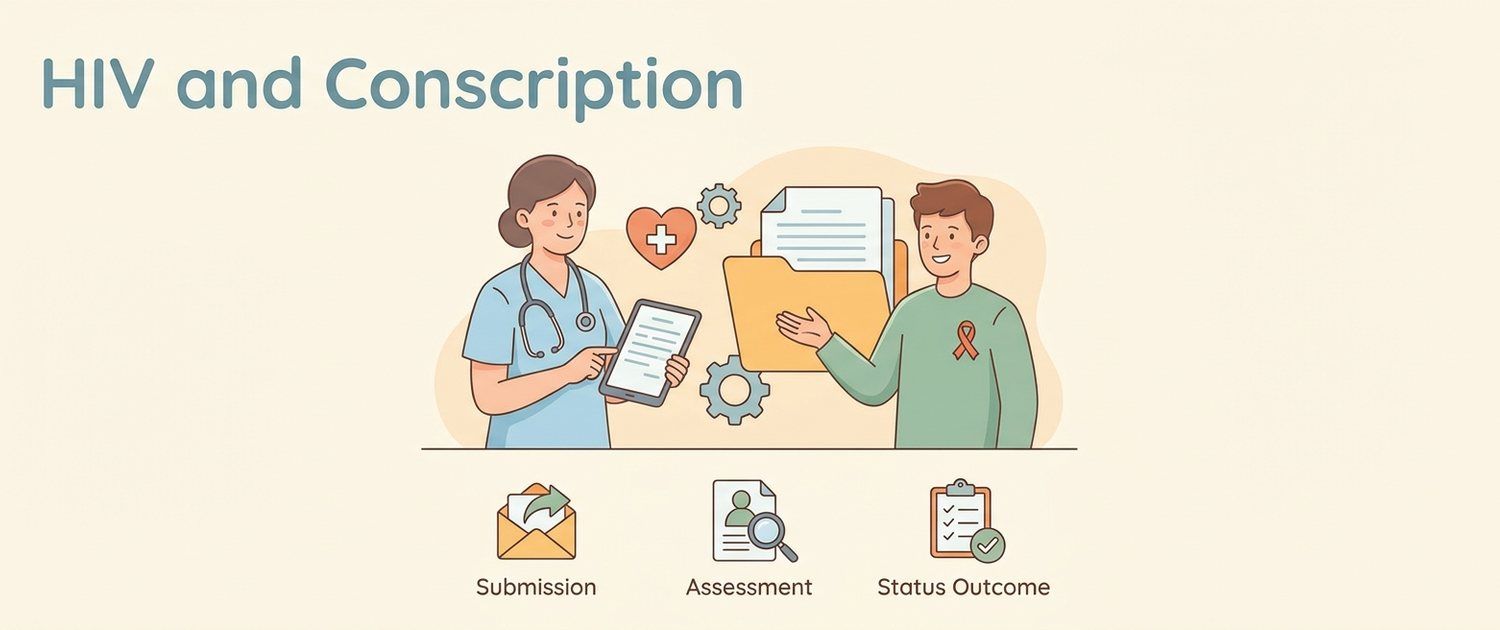
The short answer: HIV infection prevents conscription. Article 5 of the Schedule of Diseases is one of the shortest and least ambiguous in the whole document: it has two clauses, and both give a conscript category D — "unfit for military service". The stage determines the clause but does not change the outcome.
Which fitness category HIV yields
| Stage in the records | Clause | Column I (conscription) | Column III (contract) |
|---|---|---|---|
| Stage of secondary diseases: 2B, 4A–4C, 5 | «a» | D — unfit | D |
| Stage of primary manifestations: 1, 2A, 2B, 3 | «b» | D — unfit | B (V - IND) |
What article 5 says verbatim
The wording is extremely brief:
a) patients with HIV infection at the stage of secondary diseases (stages 2B, 4A–4C, 5)
b) patients with HIV infection at the stage of primary manifestations (stages 1, 2A, 2B, 3)
The article contains no additional conditions — nothing about functional impairment, flare frequency or treatment results. This is a rare case where the confirmed diagnosis alone determines the category.
Contract service and conscription: why the stage differs
In column I — registration and conscription — both clauses lead to category D. The stage matters for the accuracy of the conclusion and for medical care, but it does not affect a conscript's fitness decision: an early stage of primary manifestations and a stage of secondary diseases give the same result.
The difference appears only in column III, for those entering contract service and for officers. There clause «b» gives "B (V - IND)": the decision is individual, taking account of the situation and the post.
AIDS centre: how the diagnosis is confirmed
An HIV diagnosis is not made from a single test. The usual sequence is a screening test, then a confirmatory test, and only then registration with an AIDS prevention and control centre. It is that centre's documents — a certificate of diagnosis stating the stage — that form the basis for the board.
What the tests themselves show, when they become informative and why one positive screen is not yet a diagnosis is covered in the piece on reading an HIV test.
What your records must contain
- A certificate from an AIDS centre with the confirmed diagnosis and the stage.
- Results of the confirmatory test, not only the screening one.
- Viral load and immune status data — they determine the stage.
- Details of therapy, where prescribed.
- The chart code is B20.
On confidentiality
Information about HIV status is protected by medical confidentiality, and that regime is not suspended by participation in a military medical assessment: documents are transferred through the established procedure and are not to be disclosed beyond the board. This is worth knowing in advance — fear of disclosure is often why a person brings no documents at all.
What is usually missing
- There is a positive screen but no confirmatory test and no AIDS centre certificate.
- The stage is not stated — yet it determines the clause.
- There are no immune status or viral load figures.
- The documents are old and do not reflect the current state.
- HIV infection is not distinguished from other immunodeficiency states assessed under their own articles; a general overview is in the piece on HIV and AIDS symptoms.
Questions for your doctor
- Which stage of HIV infection is stated in my documents?
- Is there a certificate from an AIDS centre with a confirmed diagnosis?
- What are my current viral load and immune status?
- Has antiretroviral therapy been prescribed, and since when?
- Are all documents handled in line with medical confidentiality?
Infections at departmental boards
The above concerns assessment under Government Decree No. 565. The Interior Ministry, National Guard, Federal Security Service and Emergencies Ministry use their own schedules of diseases with their own requirements. A review under article 5 shows how complete your records are but is not their regulation.
The short version
Article 5 requires neither an assessment of function nor a count of exacerbations: confirmed HIV infection gives a conscript category D at any stage. All the board needs is documentary confirmation of the diagnosis and the stage from an AIDS centre. For contract service the logic is softer and the decision individual. Only the military medical board determines the fitness category.
For informational purposes only
This article is for informational purposes only and does not constitute medical advice, diagnosis, or treatment. Please consult a healthcare professional for medical guidance.