Tests Before Hospital Admission: the List and Validity Periods
Reviewed by the LabReadAI medical team
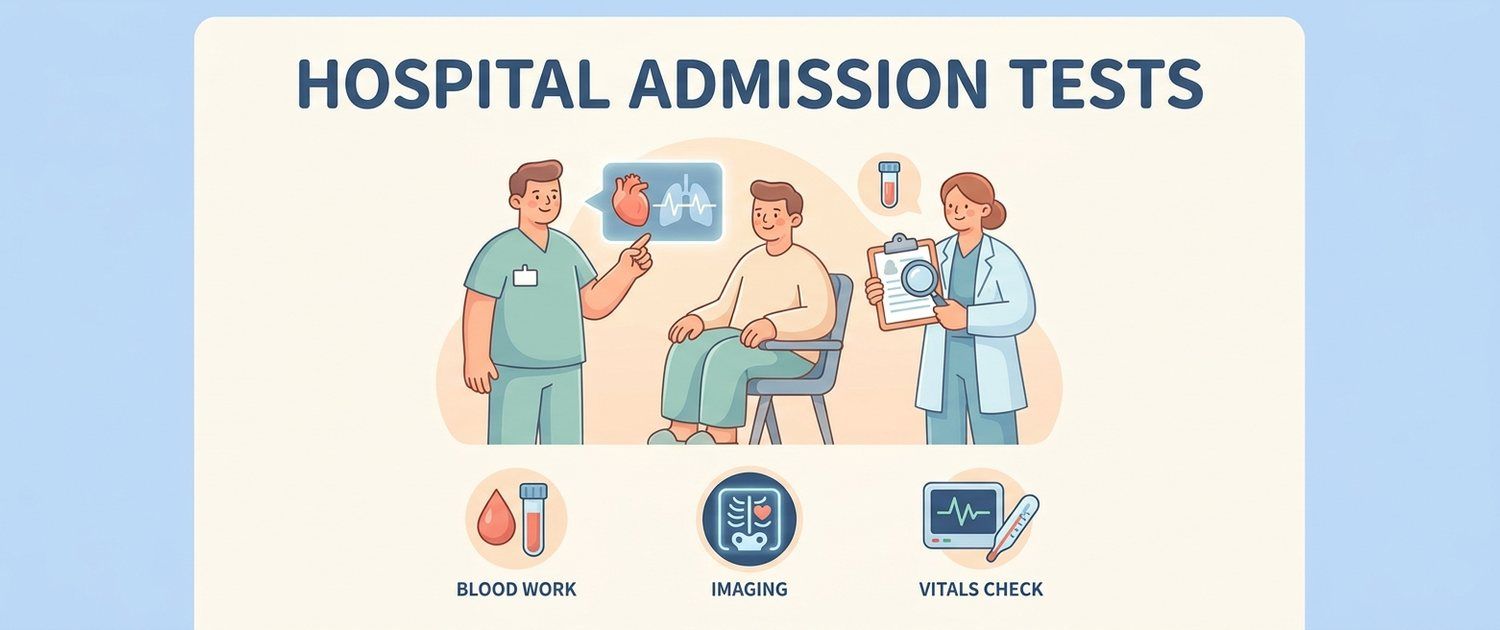
A planned hospital admission is one of the few situations where the test list is handed to you, and the whole task comes down to logistics: taking everything so that no result "expires" by the admission date. Below: the typical set, real validity periods for each item, and a checklist that saves you from last-minute re-testing.
Why there is no single list — and who defines it
Let's be honest: no single Ministry of Health order lists "tests for hospitalization". The list is set by the hospital itself — it depends on the department profile (internal medicine, surgery, gynaecology), the diagnosis and the planned scope of care. So the right sequence is: first get their list from the hospital or referring doctor, then start testing. The only nationally fixed piece is the referral form for planned admission — 057/u-04 from Ministry of Health order No. 834n.
The good news: in practice, different hospitals' lists overlap by about ninety percent. The typical core is below.
The typical set: a table with validity periods
| Test | Usual validity |
|---|---|
| Complete blood count (CBC) | 10–14 days |
| Urinalysis | 10–14 days |
| Blood biochemistry | 10–30 days |
| Coagulation panel | 10–14 days |
| Blood type and Rh factor | Indefinite |
| HIV, hepatitis B and C, syphilis | 1–3 months |
| ECG with a report | 10–30 days |
| Chest fluorography | 12 months |
The periods in the table reflect the practice of most hospitals, not a legal norm: a specific hospital may demand "fresher" results. If your list says "CBC — 10 days", follow it, not the table.
Why each item is needed
- CBC and urinalysis — baseline screening: anaemia, inflammation, kidney status. Their short validity is exactly why they are taken last.
- Biochemistry — liver and kidney function: drug dosing and anaesthesia eligibility depend on it.
- Coagulation panel — blood clotting; no invasive procedure is done without it. What its values mean — in the coagulation panel guide.
- HIV and hepatitis — the hospital's epidemiological requirement. A positive result is not grounds for refusing admission; it only changes the routing. How to read those forms — in the guides to hepatitis B and C tests and the HIV test.
- ECG — required for nearly all adults: the anaesthesiologist needs a fresh tracing with a report. What it says — in the ECG interpretation guide.
- Fluorography — ruling out tuberculosis before placement in a shared ward. What it shows and why it stays valid for a whole year is a separate topic.
Planned vs emergency: a big difference
Everything above applies only to planned admission. If you arrive as an emergency — by ambulance or walking in with acute symptoms — no tests are required in advance and none may be demanded: the emergency department runs everything at the hospital's expense. Refusing emergency care over "missing tests" is unlawful.
Under public insurance: form 057/u and code Z01.8
For a planned admission under public insurance, the clinic doctor issues a referral on form 057/u-04 (order No. 834n) — with it, every test on the hospital's list is done free at your clinic. Referrals for this work-up often carry the code Z01.8 — "other specified special examinations": it is not a diagnosis but a service note meaning you are being examined while healthy, as preparation.
Paying a private lab makes sense only for items your clinic cannot complete before the admission date.
Checklist: 2 weeks out and 3 days out
2–3 weeks before the date:
- check your fluorography — if the last one is over 11 months old, get a new one;
- take HIV, hepatitis and syphilis tests (valid 1–3 months — plenty of margin);
- confirm blood type and Rh if you have no documented result;
- do the ECG if your hospital accepts one up to 30 days old.
3–5 days before the date:
- CBC, urinalysis, biochemistry, coagulation panel — the short-lived block, taken in one fasting visit;
- gather everything into one folder with the referral, passport and insurance policy.
How this differs from pre-surgery tests
If the admission is surgical, the hospital will extend the list: extra work-up for anaesthesia and the procedure is added, and validity requirements get stricter. That is a separate topic with its own nuances — the full pre-operative list and its deadlines are covered in the guide to tests before surgery. A "medical" (non-surgical) admission usually stays within the typical set above.
The short version
The hospital sets the list, but the typical core is the same everywhere: CBC, urinalysis, biochemistry, coagulation, blood type, infections, ECG and fluorography. The strategy is simple: close out the "long" items 2–3 weeks ahead, the short-lived ones 3–5 days before admission, all free with a 057/u referral. Once the results are in, you can upload them for decoding — the service explains every value and flags what the hospital will look at first.
For informational purposes only
This article is for informational purposes only and does not constitute medical advice, diagnosis, or treatment. Please consult a healthcare professional for medical guidance.