How to Check Your Kidneys: Creatinine, GFR and Urine Tests
Reviewed by the LabReadAI medical team
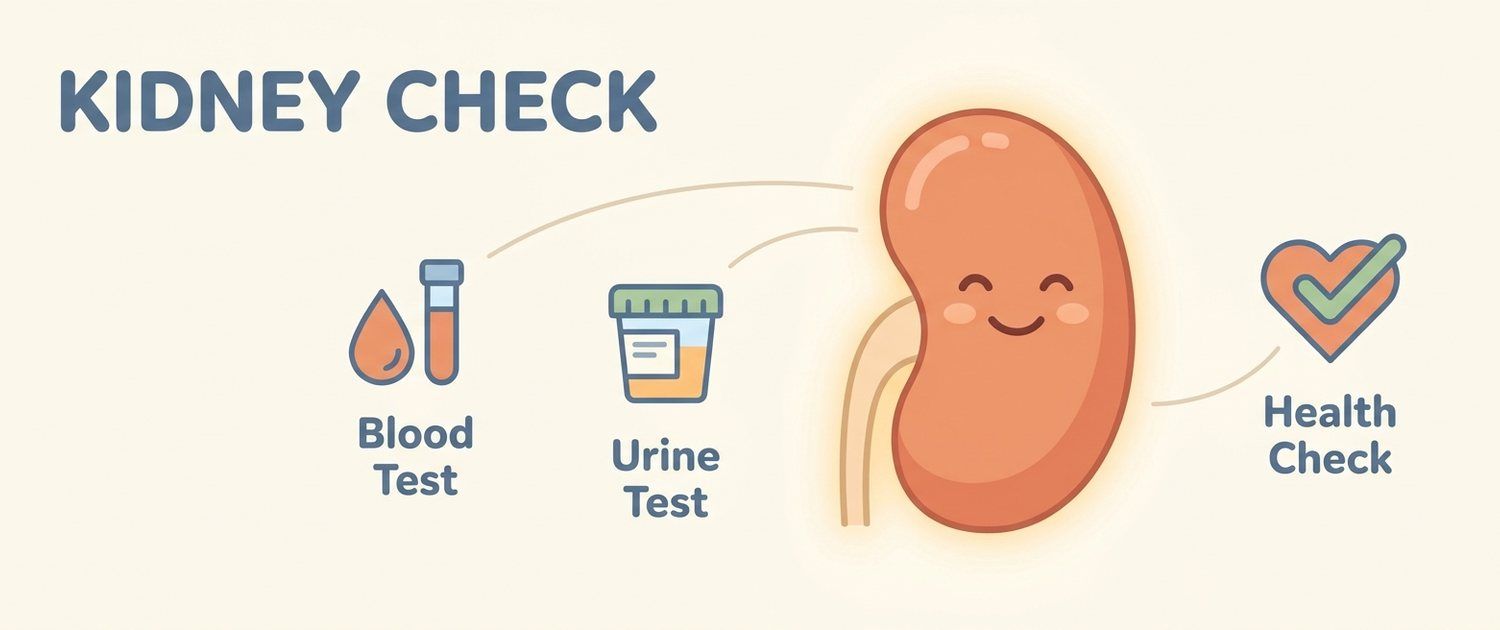
The kidneys are the only major organ you can seriously check with two inexpensive tests. They are also the organ that most often fails unnoticed: no pain, normal daily life, while function quietly declines. Below: which tests make up the basic check, what an extended work-up adds, who must be screened, and how not to ruin the result with a badly collected urine sample.
Why kidneys fail silently
Kidney tissue has almost no pain receptors, and the functional reserve is huge: visible symptoms — swelling, weakness, nausea — appear only after a large share of function is gone. Epidemiological data suggest about 10% of adults have chronic kidney disease, and most discover it incidentally, from tests taken for another reason. The practical conclusion: do not wait for symptoms — kidneys are checked on a schedule.
The base: three tests
| Test | What it shows |
|---|---|
| Blood creatinine with calculated GFR | The kidneys' filtering capacity — the main measure of function |
| Urinalysis | Protein, white and red cells — signs of kidney and urinary tract damage |
| Urine albumin-to-creatinine ratio | Microalbuminuria — the earliest marker of kidney damage, long before creatinine moves |
The key point: creatinine by itself is half a diagnosis. It depends on sex, age and muscle mass, so the GFR — glomerular filtration rate — is always calculated from it. You can compute yours in the GFR calculator: it is the GFR, not "creatinine within range", that answers how the kidneys actually work. Protein appearing in urine is a separate, independent signal — why it happens is covered in the guide to protein in urine.
What an extended work-up adds
If the basic tests are off, or risk factors are present, the panel is extended:
- Urea — the second nitrogen marker; rises as kidney function falls, but is heavily affected by diet and dehydration.
- Uric acid — its excess damages kidneys and forms stones; matters in gout and hypertension.
- Potassium and sodium — electrolytes the kidneys hold in a narrow corridor; potassium becomes critical once GFR is reduced or with certain blood pressure drugs.
- Creatinine clearance from 24-hour urine — a clarifying test when the calculated GFR is doubtful (unusual muscle mass, pregnancy); how it is derived is shown in the creatinine clearance calculator.
Labs often sell this set as a ready-made kidney function panel — cheaper than ordering each test separately.
Who must have their kidneys checked
Once a year, even with zero complaints, with:
- diabetes — diabetic nephropathy has led the causes of dialysis for decades;
- hypertension — high pressure and kidneys destroy each other in a loop; the full pressure work-up is covered in tests for hypertension;
- regular NSAID use (ibuprofen and other painkillers) — one of the most underestimated causes of drug-induced kidney injury;
- kidney disease in close relatives — polycystic disease and several nephritides are inherited;
- past urinary tract infections — recurrent cystitis and pyelonephritis need follow-up; where that work-up starts is described in tests for cystitis;
- age 60+ — GFR declines with age, and normal ageing must be told apart from disease.
CKD stages by GFR — what the number means
| Stage | GFR, ml/min/1.73 m² | Meaning |
|---|---|---|
| G1 | ≥ 90 | Normal function; CKD is diagnosed only with signs of damage (protein in urine) |
| G2 | 60–89 | Mild reduction; in older adults may be a variant of age norm |
| G3a–G3b | 30–59 | Moderate to substantial reduction — nephrology follow-up |
| G4 | 15–29 | Severe reduction, preparation for replacement therapy |
| G5 | < 15 | Kidney failure |
Important: chronic kidney disease is never diagnosed from a single result — changes must persist for more than 3 months. A one-off GFR deviation calls for a re-test, not panic.
How to prepare so nothing needs re-taking
- Blood for creatinine — in the morning, fasting (8–12 hours without food; water is allowed). The day before — no intense training and no meat-heavy meals: both temporarily raise creatinine.
- Urine — first morning sample, midstream: start into the toilet, collect the middle portion into a sterile pharmacy container. Hygiene first, without antiseptic soap.
- Women should not submit urine during menstruation — blood contamination makes the result unreadable.
- No urine tests right after sauna, fever or heavy exercise — transient "march" proteinuria resolves on its own.
- A doubtful deviation is a reason to re-test in 1–2 weeks with proper preparation, not a diagnosis.
When to see a doctor urgently
Some situations call for a doctor now, not for routine tests:
- a sharp drop in urine output, or none at all;
- visible blood in the urine;
- facial and leg swelling combined with shortness of breath;
- flank pain with fever and chills — the picture of pyelonephritis;
- nausea, weakness and itchy skin in someone with known kidney disease — possible worsening of kidney failure.
In these cases the doctor comes first — and the test list will be different.
The short version
A kidney check is creatinine with a calculated GFR, a urinalysis and the albumin-to-creatinine ratio; with diabetes, hypertension, regular painkillers or family history — yearly and non-negotiable. Tests do not replace an examination: the diagnosis and stage are the doctor's call. Once the results are in, you can upload them for decoding — the service explains every value against your lab's reference ranges and suggests what to discuss with a nephrologist.
For informational purposes only
This article is for informational purposes only and does not constitute medical advice, diagnosis, or treatment. Please consult a healthcare professional for medical guidance.