Tests for Cystitis: Urinalysis, Urine Culture and When to Check STIs
Reviewed by the LabReadAI medical team
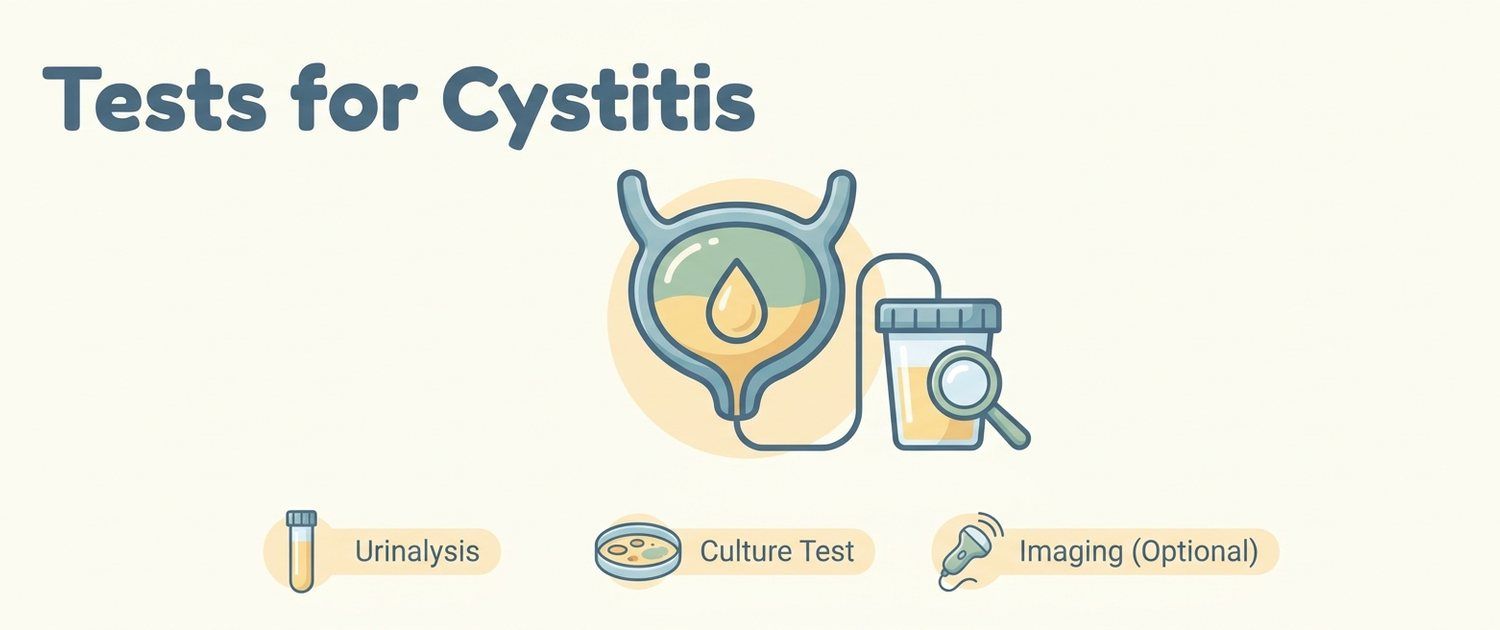
Classic cystitis — burning on urination, frequent urges, discomfort in the lower abdomen — is a diagnosis a doctor typically makes from the complaints and a single urine test. A long list of investigations is not needed. But there are situations where a culture, STI testing and blood glucose are indispensable — and these are exactly what gets skipped when "yet another cystitis" is treated by the old scheme. Here is what to test at a first episode, what to add for recurrences, and how to collect urine so the result can be trusted.
Step one — the urinalysis
With typical symptoms a urinalysis is enough — it is ready the same day and answers the main question: is there inflammation. Three findings point to infection:
- leukocytes — inflammation cells; what their different levels mean is covered in the guide to leukocytes in urine;
- nitrites — a metabolic footprint of the most common culprits (E. coli and its relatives); positive nitrites strongly favour a bacterial infection;
- bacteria in the sediment.
Red cells appear too: in acute cystitis the bladder lining bleeds slightly, and a small admixture of blood is part of the picture, not a separate disease. A full walkthrough of every line on the form is in the guide on how to read a urinalysis. The final diagnosis of acute cystitis (N30) is the doctor's, made from symptoms plus the test — never from one line of a form.
Urine culture: when it is mandatory
For a first uncomplicated episode in a healthy woman, guidelines do not require a culture — the culprit is predictable. But in some situations a culture with antibiotic sensitivity is strictly required:
- recurrences — a second episode within six months or a third within a year;
- treatment failure within 2–3 days — a resistant organism is likely;
- pregnancy — here a culture is mandatory even without symptoms, as part of routine screening;
- cystitis in a man or a child;
- suspected ascending kidney infection.
Crucially, the culture is taken before the first antibiotic dose. Even one tablet can "sterilise" the sample into a false negative — while the resistant organism stays unidentified.
When STIs are checked
If cystitis keeps returning while the culture is "clean", or treatment helps for only a week, the picture should be checked for sexually transmitted infections: chlamydia, mycoplasma, gonococcus and trichomonads cause urethritis with the same clinical picture — burning, stinging, frequent urges — but do not grow in a routine urine culture and need different drugs. This is what the STI panel by PCR is for. It is especially relevant with a new partner, symptoms in the partner, or onset after unprotected contact.
Glucose and other tests for recurrences
Recurrent cystitis is a reason to look for the soil it grows on:
- Blood glucose — undiagnosed diabetes turns urine into a growth medium for bacteria and is one of the most common hidden engines of recurrence.
- Creatinine and GFR — with frequent infections it is important to confirm the kidneys are not involved; the full set is in the guide to kidney check tests.
- Ultrasound of the bladder and kidneys — when ordered: residual urine, stones and anomalies are the targets.
And if the urges are frequent but the tests keep coming back clean — the cause may not be infectious at all: the alternatives are covered in the article on frequent urination.
Men and children — always a deeper look
In women cystitis is common because of a short urethra — an "anatomical" disease. In men and children the same symptoms are rare and almost always have an underlying cause: prostatitis, STIs or outflow obstruction in men; developmental anomalies or vesicoureteral reflux in children. So the standard "female" scheme does not fit a man or a child with cystitis symptoms: a culture, a urologist's examination and usually an ultrasound are mandatory. Self-treatment here wastes the time in which the process can reach the kidneys.
How to collect urine so the test can be trusted
Poor collection causes roughly half of all false results:
- collect the first morning urine — the most concentrated;
- hygiene first, with warm water and no antiseptics;
- midstream: the first seconds go into the toilet, the middle portion into the container, the rest into the toilet — the first stream washes away skin and urethral bacteria that imitate infection;
- only a sterile pharmacy container — never a food jar;
- deliver to the lab within 1.5–2 hours: in standing urine bacteria multiply, distorting both the sediment and the culture;
- no urine tests during menstruation — if needed, the doctor takes a catheter sample.
When to see a doctor urgently
Signs that this is no longer "just cystitis" but likely pyelonephritis (N11) or another complication:
- temperature 38 °C or higher, chills;
- flank pain, especially one-sided;
- visible blood clots in the urine;
- nausea, vomiting, marked weakness;
- any of these symptoms in pregnancy;
- inability to urinate despite strong urges.
With these signs, see a doctor the same day: a kidney infection is treated differently and longer, and delay is dangerous.
The short version
A first episode of cystitis — a urinalysis; recurrences, pregnancy, men and children — plus a culture with sensitivity; cystitis that keeps returning — plus STIs and blood glucose. Urine is collected midstream after hygiene into a sterile container — otherwise the result lies. The diagnosis and treatment are the doctor's call; tests do not replace the examination. Ready forms can be uploaded for decoding — the service explains every line and suggests what to clarify with the urologist.
For informational purposes only
This article is for informational purposes only and does not constitute medical advice, diagnosis, or treatment. Please consult a healthcare professional for medical guidance.